
Another year done! And another interesting one to dig into, although I probably say that about every year. Starting with overall performance, while market patterns in recent years have been similar in the UK and Ireland, 2025 diverged, with Ireland posting a better overall picture than the UK. Spending on print books grew 1.5% in Ireland in the latest year but declined 0.5% in the UK, although purchase numbers still fell short in both countries, by 0.4% and 2.5%, respectively, vs 2024. It wasn’t just the overall stats that differed, as Adult Non-Fiction was the most successful sector in the Irish market (up 4% in value and 0.3% in volume), while the UK was bolstered by positive Adult Fiction stats (+5%, +0.2%). Reversing that, Non-Fiction declined in the UK (-5% value and -6% volume) along with Fiction in Ireland (-0.2%, -2%).
In the UK, Children’s, Young Adult & Educational landed in the middle, with value back in growth by 0.4% but volume down 1%. Both measures were down in Ireland by less than 1% (-0.8% value and -0.1% volume), but changes in the educational market have affected the stats in recent years; if we remove School Textbooks & Study Guides, the Children’s & Young Adult market in Ireland was actually the best performer, achieving 4% growth in spending and a 3% increase in purchases.

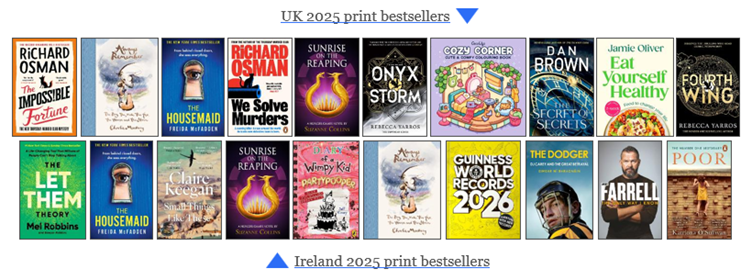
The varying performance of each broad sector is evident in the top titles across the two markets, with the UK led by Fiction (The Impossible Fortune by Richard Osman) and Ireland by Non-Fiction (The Let Them Theory by Mel & Sawyer Robbins). Neither book makes the top ten in the other country (The Impossible Fortune ranked 16th in Ireland and The Let Them Theory was 11th in the UK), and only three books match across the respective top tens, shown below: Always Remember by Charlie Mackesy, The Housemaid by Freida McFadden and Sunrise on the Reaping by Suzanne Collins.
Each top ten has one more Children’s & YA title, with the UK featuring Coco Wyo’s Cozy Corner and Ireland seeing Partypooper by Jeff Kinney at fifth (17th in the UK). Otherwise, the UK bestsellers lean more into Fiction, including two more hardbacks in Onyx Storm by Rebecca Yarros and The Secret of Secrets by Dan Brown, while the bottom half of Ireland’s top ten is all Non-Fiction. The only other Adult Fiction book within Ireland’s top ten is Small Things Like These by Claire Keegan, making the top five for the second year in a row and the top 20 for the fifth year. The novel spent time at the start of the year in the number one spot before giving way to Sunrise on the Reaping which was then surpassed by The Let Them Theory, shown in this animated bar chart, while The Impossible Fortune claimed the UK number one at the end of November, tracked in this visualisation.
If we look at bestselling authors based on cumulative volume sales, there are more similarities across the two markets, especially in Children’s & YA. Of the top ten overall authors, six feature in both lists, including Julia Donaldson as the number one name on both sides of the Irish Sea, joined by Dav Pilkey, Jeff Kinney, Jamie Smart, Freida McFadden (the top Fiction author for both) and Sarah J. Maas. The UK top ten is rounded out by Richard Osman, Fiona Watt, Coco Wyo and Rebecca Yarros, while Ireland features Chloe Walsh, David Walliams, Claire Keegan and Katie Kirby. Switching to the top ten names for each sector, Osman and Yarros also make Ireland’s top ten Fiction authors, with Colleen Hoover holding a spot for both the UK and Ireland, giving six overlapping names. Similarly, Kirby and Walliams appear in the UK Children’s & YA list and Watt appears in Ireland’s, plus Suzanne Collins in both, adding up to eight authors in common. Much like the titles, Non-Fiction is most distinct, with only Mel & Sawyer Robbins and Charlie Mackesy appearing in both top tens.
On a category level, Science Fiction & Fantasy, Horror & Ghost Stories, Westerns and Graphic Novels: Manga and Superheroes all posted record value sales in both the UK and Ireland, along with record volume sales for Science Fiction & Fantasy in both markets and for Horror, Westerns, Manga and Superheroes in Ireland. Historical & Mythological Fiction saw peak spending in the UK but declined in Ireland, while Romance & Sagas and Short Stories & Fiction Anthologies fell short in both countries. General & Literary Fiction saw very slight value growth in the UK but was down in volume, and down by both measures in Ireland. Crime, Thriller & Adventure set a new high for value sales in Ireland, with UK value second only to 2010 and volume up in both markets.
Pointing back to the top-level stats, Ireland experienced more widespread growth across Non-Fiction genres than the UK, but Personal Development; Philosophy & Psychology; Biographies & Autobiographies; Anthologies, Essays, Letters & Miscellaneous; Natural History: General; Current Affairs & Issues; International Relations and Handicrafts, Arts & Crafts were among the successful areas in both countries. Within Children’s & Young Adult, there was continued growth for Children’s Comic Strip Fiction & Graphic Novels, balancing a decline in Children’s Fiction, with Young Adult Fiction also up, as well as Young Adult General Interest & Leisure. For the youngest readers, Picture Books and Pre-School & Early Learning increased in both markets, as well as Novelty & Activity Books in Ireland.
Bringing all those stats together, there’s a lot to be positive about the UK and Irish book markets right now, across all sectors, even if some of it requires a bit of digging. As we’ve seen, there are many parallels between the neighbours, but each also sets itself apart in the titles and authors that consumers embrace and, in the case of 2025, the part of the market with the most momentum. Interestingly, in last year’s blog, I mentioned that 2013 was the last time that spending on print books had declined in both markets, prior to 2024. Building on that further, in 2014, much like 2025, it was only value sales in Ireland that grew, preceding a string of growth years from 2015 onwards. Of course, the book market, and the world, has changed significantly since then, so we can’t assume that history will repeat itself, but one thing that hasn’t changed in the intervening years is the importance of books, whether for entertainment, escapism, education, empowerment or even things that don’t begin with the letter E.
Watch this space for more updates as we see what 2026 has in store.
Based on data from the BookScan UK Total Consumer Market (TCM) and Irish Consumer Market (ICM), to 27 December 2025.
.