
More than 100m book purchases a year are impulse buys.
We all know the lure of the impulse buy, whether stemming from seeing something in a shop window, by the till or in an email or social media post. And thanks to our Books & Consumers survey, we have a measure of how much those impulses contribute to the UK book market, allowing us to see which areas are more driven by in-the-moment decisions and giving insight into the best way to position different books for different consumers.
In the survey, respondents can choose from four different options for the level of impulse vs planning:
- I had planned ahead to buy this particular book at that specific time
- I had planned to buy this particular book, but not necessarily at that specific time
- I was planning to buy a book at that specific time, but had not planned to buy this particular book
- I was not planning to buy a book at that specific time; it was an impulse purchase
Overall, the last one in the list tends to be the most popular; in the latest 12 months available (to July 2026), 30% of book purchases were impulsive, followed by 28% for both book and time planned, 24% for book planned/not time and 17% for time planned/not book. But while impulse buys still have the edge, they have lost share over the years, with planned purchases gaining ground: back in 2022, it was 33% impulse and 24% planned. A variety of factors will likely be behind that – for example, online purchases tend to be planned more than in-store, and we’ve seen growth in discovery via social media and video sites as well as recommendations which can drive more targeted shopping – and that variety is impacting all broad formats and sectors, as well as both in-store and online purchases, with the trend shown below.
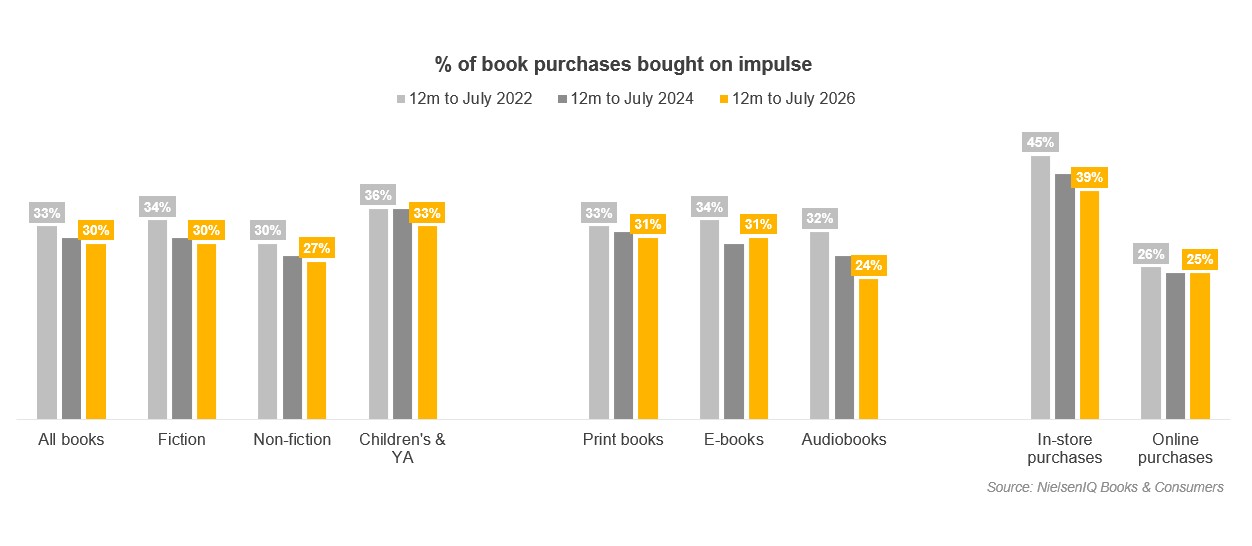
While the overall market sees that close margin between entirely impulsive and entirely planned shopping occasions, plenty of genres go to more extremes. The below graph is sorted by the combined share across the first two options, so where the book is planned, and religion is the most planned genre, with 70% of the books bought in the last year chosen prior to shopping, while fantasy is the most planned fiction genre. At the other end we have activity books and early learning: the latter is the highest for pure impulse, but if we include those buyers that set out to buy a book but didn’t choose that one ahead of time, activity books pull ahead.
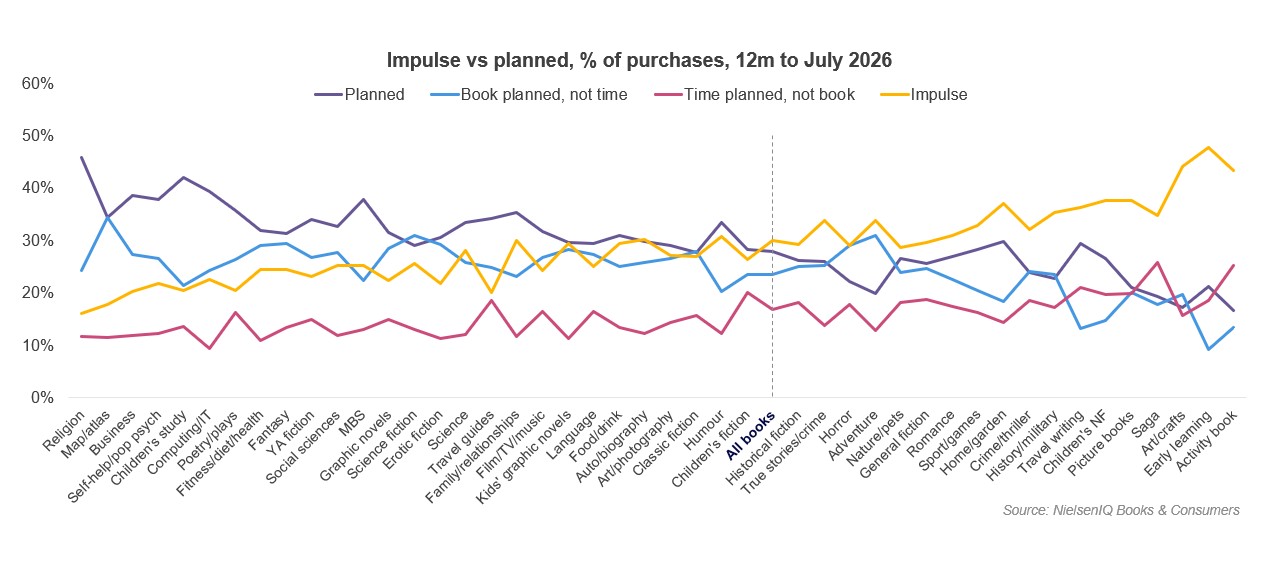
Arts & crafts books are also highly impulsive, and then we have saga fiction, which dips a bit for entirely impulsive but sees the highest share within the list coming from ‘time planned, not book’. So, saga buyers are relatively likely to be setting out to buy a book but leaving the choice up to browsing (or maybe evolving their plans while shopping), speaking to the importance of making titles stand out from those around them on the bookshop shelves (physical or virtual). Other genres that have a higher share stemming from ‘time planned, not book’ include travel writing, picture books, children’s non-fiction and children’s fiction, while history & military and home & garden are also on the higher end for impulse buys. Children’s fiction is the only area where all four options have at least 20% for the latest year, with planned purchases slightly ahead of impulsive ones, showing the impact of familiarity with the book or author as well as grabbing attention in the moment. That close relationship, and the shifting patterns across the market, highlights the need to understand how different consumers approach their shopping and how best to reach them.
The NielsenIQ Books & Consumers data includes further information on discovery, purchase influences, source of purchase, buyer demographics and much more, allowing in-depth examination of what is driving different parts of the consumer book market and how that is changing. For more information, please contact infobookresearch@nielseniq.com.
.