How match timings shaped drinks sales across Britain’s venues
The 2026 men’s football World Cup delivered a significant boost to Britain’s On Premise, generating some of the strongest football-driven trading occasions seen in recent years. However, its impacts on operators and suppliers varied substantially, and NIQ’s expert daypart and category analysis reveals the tournament’s biggest winners and losers.
Drinks sales score 7% growth
Across the competition, NIQ’s Trading Index shows drinks sales rose by 7% from the same period in 2025. Venues benefited from England’s progress deep into the World Cup, which meant they had eight matchdays in total. Scotland’s presence also provided three profitable days north of the border.
Some of these fixtures benefited sales more than others. For example, England’s semi-final with Argentina on Wednesday 15 July triggered a massive 94% uplift in average drinks sales compared to the equivalent day last year. Revenue soared by 69% on the day England played Ghana in a group stage match (Wednesday 23 June); and by 65% when they took on Congo in a round-of-32 game (Wednesday 1 July).
However, spikes in average sales were smaller on other dates. England’s match with Panama on Saturday 27 June brought an uplift of only 9%, while the country’s quarter-final with Norway on Saturday 11 July triggered a 31% boost.
Hour-by-hour highs
The biggest single factor behind these trading patterns was kick-off time. NIQ’s Trading Index breaks down sales from hour-to-hour as well as day-to-day, and it reveals how evening matches were more beneficial than late-night ones. However, it also highlights why understanding daypart behaviour is critical. While consumer research suggested late-night fixtures would struggle to attract pub visits, trading data often showed consumers behaving very differently in practice.
All three of the biggest daily boosts to sales came on days when England’s games started at 8pm or 9pm. On the biggest occasion of all – the semi-final against Argentina – there was a massive spike in sales of 289% between 7pm and 8pm compared to the equivalent hour in July 2025. This soared even higher to 335% over the next hour, thanks in part to fans flocking to bars during half-time.
The match had a powerful halo effect throughout the day. Hourly sales were up by 65% between 5pm and 6pm as viewers arrived early to secure seats, and they jumped 215% over the next hour. Despite England’s defeat, trading continued well after the final whistle, with sales up 45% year-on-year between 10pm and 11pm.
The impact of late kick-offs
Based on consumer intentions alone, England’s last-16 game against Mexico on Monday 6 July appeared to be one of the least attractive fixtures of the tournament for pubs and bars. A kick-off time of 2am meant that many fans watched the game at home rather than in pubs and bars. Nevertheless, NIQ’s trading data confirms some major boosts ahead of the match. Hourly sales rocketed by between 295% and 460% year-on-year in the three hours before kick-off, and there were massive spikes in the early hours as some venues stayed open – though these were compared to far fewer open venues in this daypart in 2025. The contrast highlights the danger of relying solely on stated intentions. While very few consumers said they would attend a pub for a post-midnight kick-off, many ultimately chose to do exactly that when faced with a high-stakes England knockout fixture.
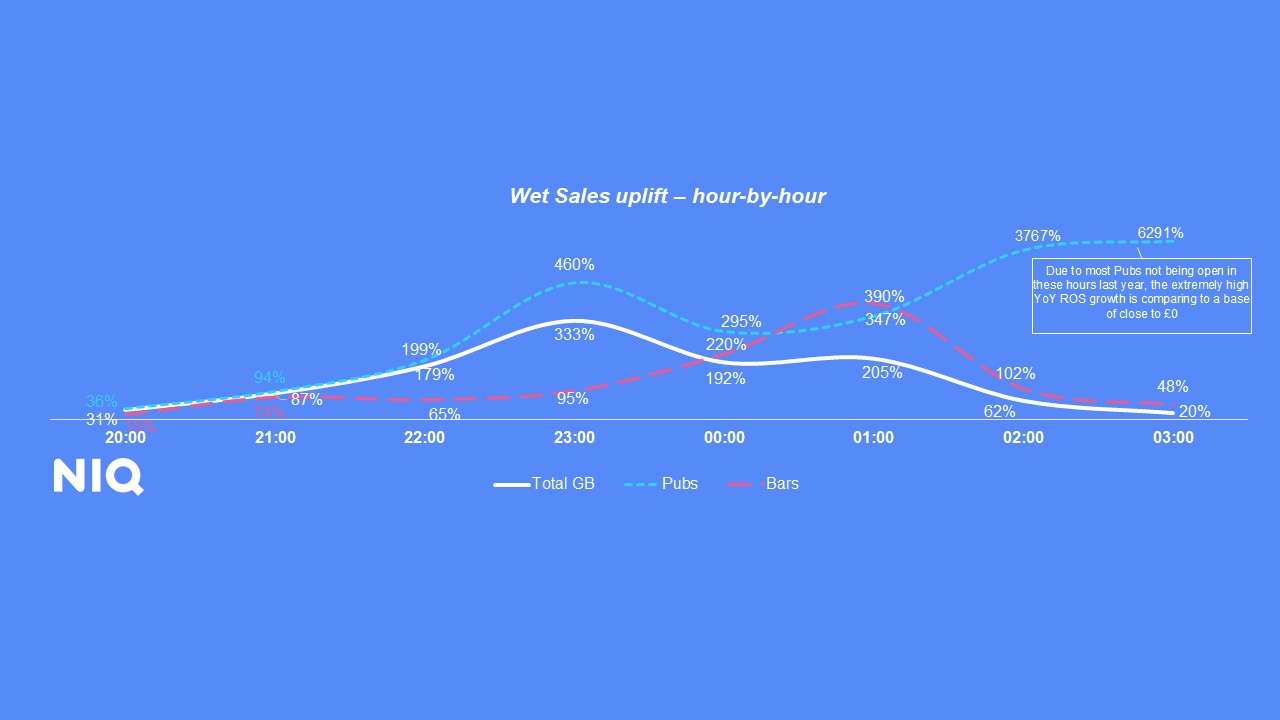
Hour-by-hour data shows similar patterns for Scotland’s World Cup games. Average On-Premise drinks sales were broadly flat on all three of Scotland’s matchdays, having been limited by kick-off times of 11pm and 2am. However, hourly sales were more than double those of last year in the two hours between 10pm and midnight on the night of Scotland’s big game against Brazil.
It’s also important to remember that while the World Cup powered drinks sales, it had a much more muted effect on food. For instance, dry sales on the day of England’s game against Argentina dropped by 7% year-on-year, as consumers focused on drinking rather than eating.
Big wins for LAD and premium
As well as valuable hour-by-hour analysis, NIQ’s Trading Index has expert insights into the World Cup’s impact on categories. As is usually the case during big sporting events, Long Alcoholic Drinks (LAD) felt the biggest benefit, with RoS up by 11% year-on-year over the duration of the tournament.
As well as drinking more, many LAD buyers traded up for the special event. Draught premium world lager was the standout segment, gaining 3 percentage points of LAD share at the expense of standard categories, while premium cider added 0.7 percentage points. This highlights the importance of driving value as well as volume, through high-quality execution, visible activation and occasion-led promotions.
Among other categories, soft drinks achieved 6% growth at the World Cup. This segment was boosted further by hot weather during much of June and July, which sent consumers to pubs and bars in search of refreshment. Spirits sales were broadly flat with bursts of growth on some of England’s matchdays as fans celebrated victories. Wine was the weakest category with RoS down 5% because of the drop in with-food occasions – though share growth for rosé highlighted a shift towards lighter wine styles during games.
NIQ’s trading data is enhanced by consumer research, which reveals subtle but significant changes in guests’ demographics and preferences during sporting events. A REACH survey ahead of the World Cup found that nearly two thirds (64%) of those planning to watch games in pubs and bars were male, while Gen Z was the generation most likely to do so. Older consumers, meanwhile, were more likely to follow the tournament from home.
While Beer remained the dominant World Cup drink overall, younger consumers displayed a broader drinking repertoire than older generations. Those who planned to watch games in the On-Premise were notably more likely to buy spirits and Ready to Drink products.
Another major World Cup dynamic was a shift towards familiar and accessible brands in LAD and soft drinks. This reinforces the importance of providing recognisable and easy-to-order options during group viewing occasions.
Fans’ changing habits
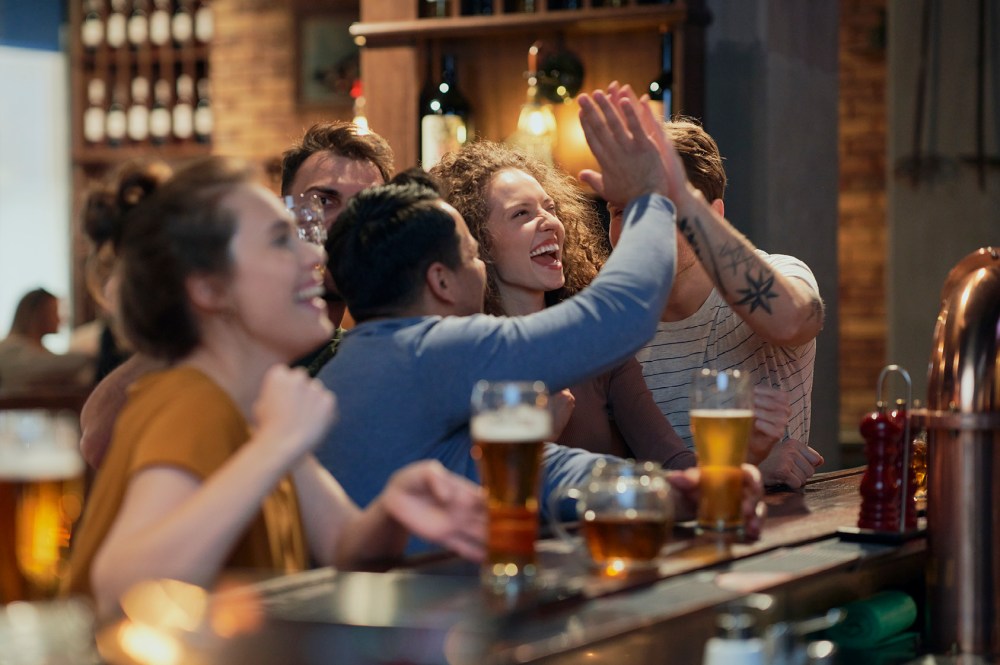
The view from NIQ
“After a challenging start to 2026, the World Cup delivered a very welcome boost to drinks suppliers and venues screening games. But the benefits were far from uniform, and sharp variations at a granular level show the need to scrutinise data very closely. Understanding hour-by-hour behaviour and category shifts is critical to unlocking the full value of big events like this, and to giving people what they want at every step of their visits, from pre-match build-ups to post-match celebrations. The England versus Mexico fixture is a perfect example of why this matters. Consumer intentions suggested limited opportunity, yet the match generated exceptional late-night trading. Only by combining consumer research with hour-by-hour sales data can operators understand where the real opportunities exist.”
Cerys Littlejohn, Insights Manager – UK&I BevAl On Trade, NielsenIQ
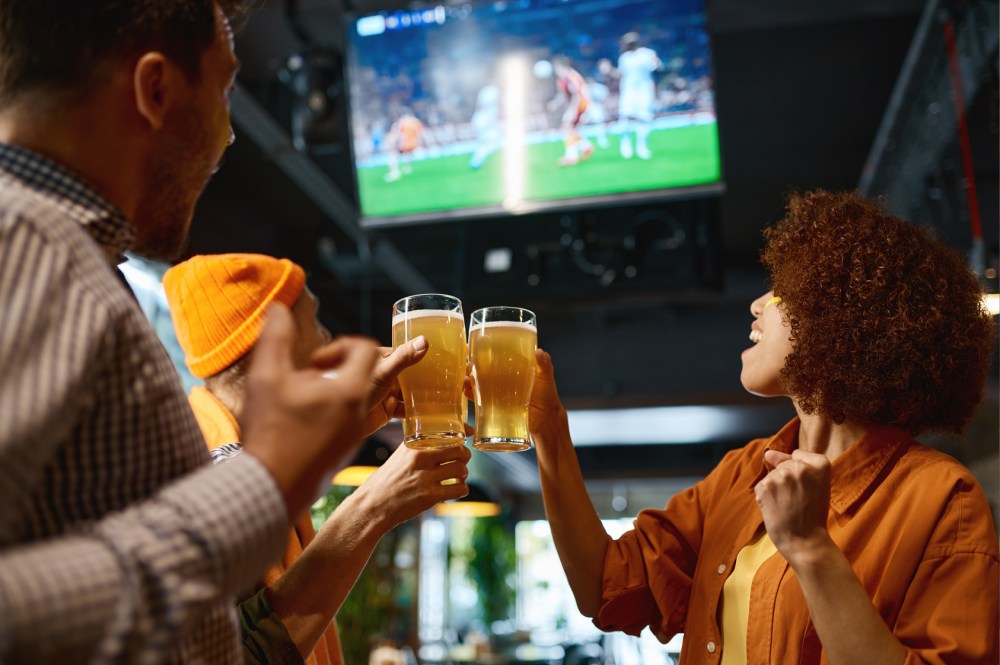
Discover On-Premise opportunities in Britain
NIQ’s Trading Index provides best-in-class data on sales across Britain’s On-Premise, with extensive breakdowns available by daypart, category, channel and much more. They build a detailed picture of consumers’ spending behaviours before, during and after big occasions like World Cup matchdays, helping suppliers and operators optimise planning and grow share.
To learn more, get in touch with the NIQ experts.