Health & Wellness in 2026: Winning the self-directed, results-driven consumer

The rise of the self-directed Health & Wellness consumer
Health & Wellness growth is increasingly being shaped by consumers rather than brands. Many of today’s health consumers are self-directed, intentional, and informed, seeking more agency over daily and long-term health decisions.
This mindset shift is reshaping how people evaluate health and wellness products. They’re prioritizing functional benefits, ingredient transparency, and personalized fit over brand familiarity alone. As a result, decisions are increasingly being made at the attribute and outcome level, accelerating disruption and opening the door for challenger brands to compete with—and even outperform—established players.
This shift is playing out across Health & Wellness—from nutrition and functional food to weight management, health technology, and wearables. Trends such as protein optimization, gut health, and feature-rich wearables are all expressions of a broader health consumer behavior shift, not standalone phenomena.
The next phase of Health & Wellness growth is likely to be shaped by how well brands translate these evolving consumer expectations into products that deliver clear, personalized outcomes.
“Health and wellness in the minds of consumers is becoming less about what they buy, but rather how they buy. Brands should design for consumers’ need states, not product categories, and support health journeys—from prevention to performance.”
—Sherry Frey, Health & Wellness Industry Lead, NIQ
What’s driving this shift?
NIQ’s Global State of Health & Wellness 2025 report identifies a major inflection point in this category: Health & Wellness is now embedded across more areas of the store and across the omnichannel journey, rather than being confined to a single aisle or product segment, contributing to category growth. According to the Global Wellness Institute, the wellness economy is projected to grow from $6.8 trillion (USD) in 2024 to $9.8 trillion in 2029—a compound annual growth rate of 7.6%.
The report identified several forces that are merging and driving change, including:
- the high volume of health and wellness content and ads across traditional and social media;
- the stubborn prevalence of lifestyle-related conditions such as type 2 diabetes, high blood pressure, and obesity in both developed and emerging economies;
- and high costs and other barriers to accessing Health & Wellness services.

Navigate the shift from health trends to lifestyle choices
Our Global State of Health & Wellness 2025 report reveals how consumers are approaching their health and what manufacturers and retailers must do to earn their trust.
Barriers persist—so care moves closer to home
Access to healthcare around the globe remains uneven. Consider this:
- 45% of US consumers struggle to afford healthcare—the fastest-growing health concern tracked by NIQ
- 55% of US GLP-1 users live in households earning more than $100K annually vs. 16% under $40K
- Globally, 54% cite cost as a barrier to healthier choices on the shelf.
- In geographically large countries such as China, Brazil, and India, rural access gaps further delay care.
Consequently, consumers adapt in the following ways:
- They turn to online sources, AI, and other digital tools for health product discovery, guidance, and purchase.
- They rely on at-home monitoring and wearable tech (e.g., continuous glucose monitors (CGMs), smart scales, fitness trackers) for real-time monitoring.
- They demand nearly immediate access to the products they seek through emerging commerce channels. In Asia Pacific, for example, over half of consumers regularly use quick or social commerce (58% and 59%, respectively) to shop.

Catalysts accelerating change
The merging of these factors (and others) has led to a natural response: Self-directed health consumers increasingly act as CEOs of their own health, gathering data and information for prescriptive and preventative needs and charting their own courses of action. While the major forces influencing the market haven’t changed, several factors are now acting as catalysts, enhancing and amplifying the consumer shift to outcomes and results.

Wellness is no longer a category.
It’s the architecture of modern living.
Catalyst #1: How GLP-1s accelerate new wellness priorities
It was only a few years ago that GLP‑1s were primarily associated with diabetes treatment, but their role has rapidly expanded. The 2021 FDA approval of Wegovy marked the category’s expansion into chronic weight management. Now the topic of weight loss—and the pros and cons of using semaglutides and GLP-1s such as Wegovy and Ozempic—seems to be the most buzzworthy of personalized wellness trends. In the US market this year, four major brands (Eli Lilly, Hims & Hers Health, Novo Nordisk, and Ro) ran expensive Super Bowl commercials for weight loss products—an interesting juxtaposition to the usual menu of ads for beer, sugary soft drinks, and salty snacks.
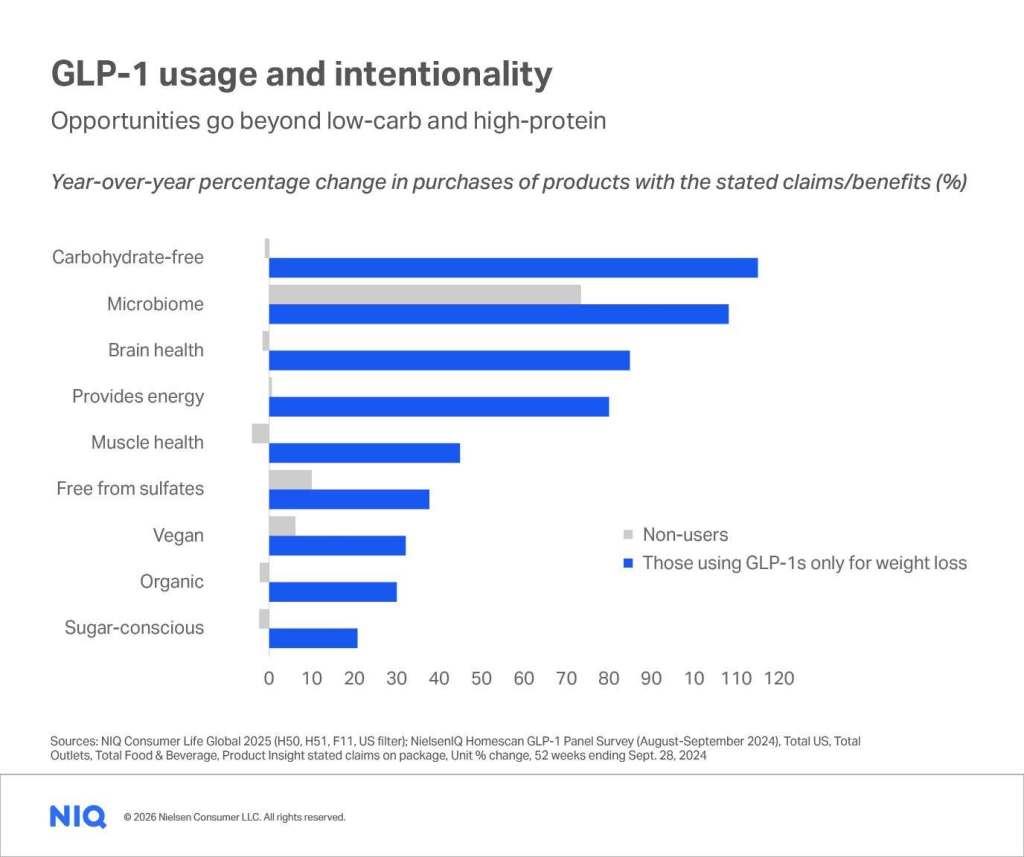
GLP-1 users are high-impact consumers, helping to accelerate the shift to outcomes and attributes by their increased focus on protein intake, fiber, probiotics, nutrient-rich foods, and simpler ingredients (to name a few). The reduced appetite these consumers experience leads them to smaller, less-filling meals (especially those low in carbohydrates), driving demand for snackable foods and functional beverages with added nutrients or protein.
Early retail concerns about GLP-1 users focused on a simple risk: a growing segment of shoppers who buy less over time, shrinking basket size and trip value. But the picture that’s emerged is more nuanced. The influence of GLP-1 users isn’t about shrinking demand—it’s about shifting spending patterns into different areas across both consumer packaged goods (CPG) and Consumer Tech & Durable Goods (T&D).
For the 52 weeks ending August 2, 2025, vs. previous 52 weeks, NIQ data shows:
- Shopping trips declined among GLP-1 users (weight loss only) by 6.4% year over year.
- Spending per trip increased over the same period: GLP-1 users spent 15.1% more per trip than nonusers.
- Total annual spend per shopper also increased, with GLP‑1 users spending 7.7% more overall than nonusers across the full study period.
Perhaps most striking is their outsized influence on specific product categories. Despite representing just 4.5% of households, GLP-1 users drove 43% of sales growth for products with muscle health claims (in NIQ data comparing two consecutive 52-week periods in 2024 and 2025). Anyone who’s made a recent trip to the grocery store can attest to the widespread popularity of protein-boosted versions of staple foods—from pasta and oatmeal to breakfast cereals and bagels.
The spending shifts occur elsewhere in the store too. Because of slower stomach emptying, GLP-1 users look to probiotics to restore a sense of balance in overall gut health. Even tangential categories are affected: GLP-1 weight loss users spend 1.3 times more on Health and Beauty products than nonusers, including 97% more on fragrance, 58% more on sun care, 53% more on hair products, and 39% more on deodorants.1 Although the household penetration of GLP-1 users is still relatively low, this can easily change with approval from regulators for other indicated conditions, including chronic kidney disease, liver disease, heart failure, and even sleep apnea.
Pill-form GLP‑1 options are already approved in the US market. In Europe, at least one oral formulation has received a positive recommendation from regulators, with a final decision pending, while approval in the UK remains outstanding. Given the vast difference in convenience between a pill and an injection, the next phase of GLP-1 usage may be defined by faster adoption and expanded access.
1 Source: Management Science Associates & NIQ, Homescan Panel On Demand, Powered By Label Insights
Catalyst #2: Wearables move from tracking to directing
Health and wellness innovation is defined by its ability to deliver measurable outcomes—and few products satisfy the desire for meaningful health measurement as well as wearables. Today, the category is undergoing a fundamental transformation—from hardware-centric devices to AI-enabled, health-focused platforms. Historically positioned as passive data trackers, wearables have evolved into always-on health companions capable of:
- continuous multi-sensor monitoring against personal targets;
- early detection of health signals;
- and delivering personalized, contextual recommendations.
Core wearables such as wrist-worn devices (e.g., Fitbit, Garmin), rings (e.g., Oura), or screenless strap-based devices (e.g., Whoop) are a dynamic growth engine across T&D, with the category continuing to scale rapidly. In 2025, the Wearables category generated $16.8 billion in global sales, growing 13% year over year, driven by strong momentum in China and Latin America.2
2 Source: NIQ Market Intelligence: Sales Tracking, International coverage (excl. North America and Russia), Sales revenue growth 2025 vs. 2024
60% agree with this statement: “Health-focused technology products are effective in helping me improve my health and wellness.”
Top motivations for buying a health-focused technology product include:
- Cooking more healthily
- Monitoring and/or improving my physical activity
- Improving my mental health and well-being
- Improving my sleep quality
- Monitoring and/or improving my diet and nutrition
Source: NIQ Global Consumer Tech & Durable Goods survey, March 2026, 17 countries (Asia Pacific: China, India, Japan, South Korea; Eastern Europe: Czechia, Poland, Türkiye; Latin America: Brazil, Mexico; Middle East & Africa: Saudi Arabia, South Africa; North America: Canada, US; Western Europe: France, Germany, Italy, UK)
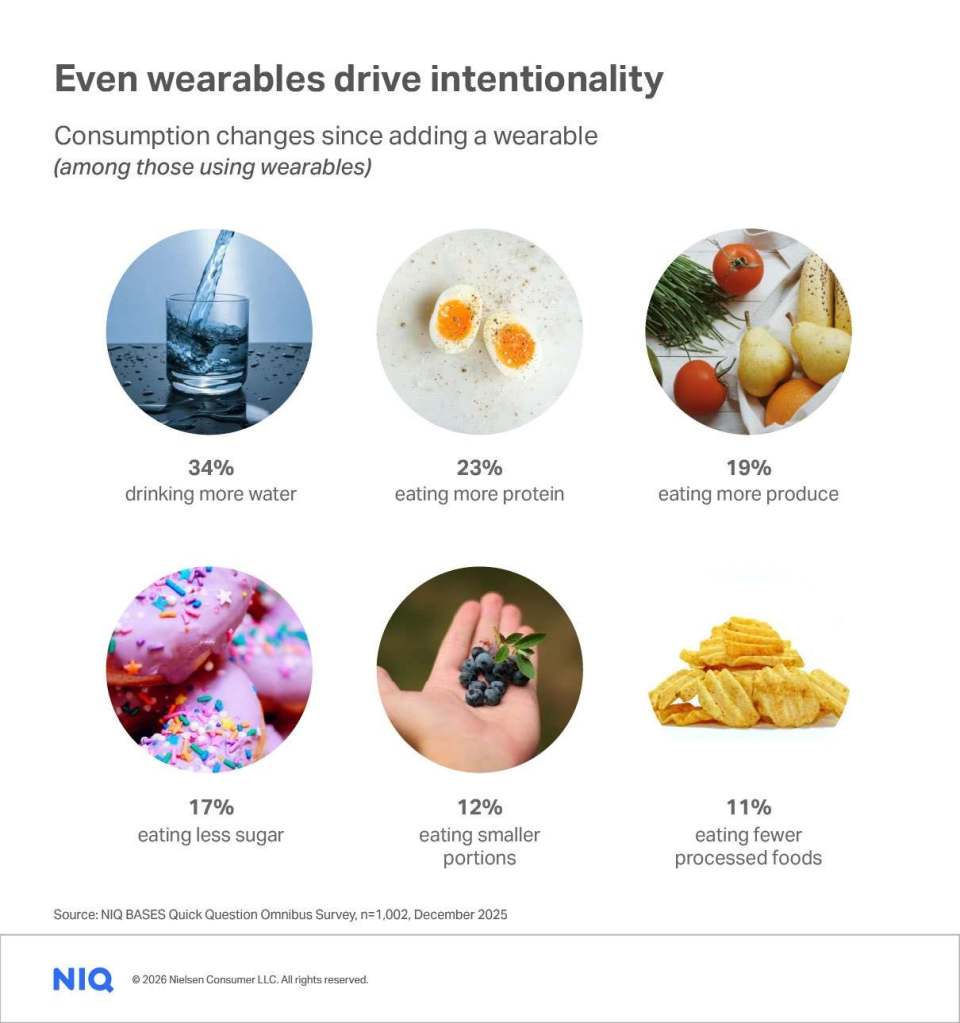
The rise of wearables, connected apps, and AI-enhanced monitoring demonstrates their evolution toward monitoring a wider range of health-related data—from sleep and oxygen absorption levels to biometrics like stress levels, blood sugar, and exercise recovery. But more importantly, these tools influence behavior. For example, wearable usage is associated with increased water, protein, and fresh produce consumption. This suggests that technology is no longer just reflecting habits; it’s shaping them. This shift elevates the importance of personalization, interoperability, and proof. In a results-driven market, the behavioral impact of wearable health technology is becoming the ultimate measure of value.
Catalyst #3: Artificial intelligence (AI) and agentic commerce resetting the rules
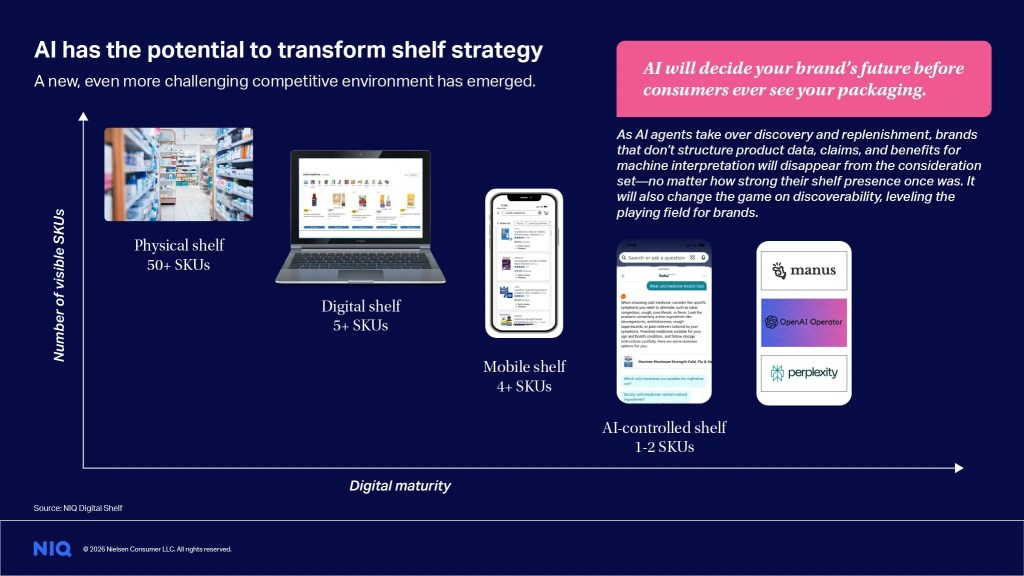
Retail is being reshaped by AI, moving closer to an agentic commerce model where algorithms increasingly curate the path to purchase. At the same time, consumers are becoming more comfortable using AI to research health and wellness information and product discovery.
As AI becomes embedded in these journeys, its role is expanding from enabling discovery to actively shaping decisions. In retail more broadly, AI is increasingly becoming the operating system of modern retail, enabling hyper-personalization, predictive recommendations, and automated decision-making across the consumer journey.
This has direct implications for health and wellness, where consumers are navigating an increasingly complex landscape of claims, ingredients, and outcomes. Consumers are more informed—and overwhelmed—than ever: 62% say they don’t trust health claims made by food companies.3
In this environment, AI-driven search and recommendation engines may become trusted intermediaries—filtering complexity and guiding choices. For brands and retailers, this elevates the importance of structured, accurate, and attribute-rich product data. As AI narrows the visible shelf and curates results, discoverability will increasingly depend on how well products are understood by AI—and by consumers.
3 NIQ Consumer Life 2024 survey
Implications for brands
The shift toward more self-directed, outcome-focused health decisions is raising the bar for CPG and T&D brands across categories. Consumers are no longer passively influenced by branding. Instead, they’re actively evaluating products based on ingredients or functionality—and demonstrated results. That shift is redefining what it takes to earn trust and ultimately win at the shelf.
Earning trust with transparency
Consumer skepticism about health claims is shaping behavior. It’s no surprise, then, that consumers’ use of third-party label-scanning apps is rising. Apps like Yuka evaluate packaged products by analyzing nutritional quality and the presence of additives, translating complex label data into simplified health scores, risk flags, and product recommendations.
NIQ BASES survey data revealed that in January this year, one in four consumers were now using these apps—nearly a 50% increase in less than a year. Trust in these apps is rising too: 27% reported they trust these apps more than labels, and 62% reported equal trust with labels. At the same time—and critically: 87% said they would put a product back on the shelf if it’s flagged by an app for poor or undesirable ingredients.
Together, these signals point to a fundamental shift. Label transparency has become a conversion driver, with brands evaluated on how well label claims stand up to external scrutiny and comparison. Success increasingly depends on clearly defined benefits, credible ingredient stories, and the ability to show how products fit into specific health needs.
“Trust has moved beyond labels because misleading claims, diversions, and greenwashing have been detrimental. Technology increasingly arbitrates what makes it into the basket. An algorithm shouldn’t be better than the manufacturer or retailer at explaining the product to the consumer.”
—Chris Costagli, Vice President, Food & Beverage Insights Lead, NIQ
Disruption and discovery
As consumers’ expectations become more specific and outcome-driven, challenger brands continue to gain traction by delivering more targeted solutions. These players are winning with precise functionality, transparent positioning, and accessible formats—particularly in areas where categories are converging, such as the intersection of supplements, snacks, and beverages. Larger brands still benefit from scale and distribution, but the advantage is shifting toward relevance, agility, and proof. NIQ research shows that innovation remains a critical growth lever, but it’s also becoming more complex to execute successfully.
The next era of health and wellness growth is consumer-led, attribute-led, and outcome-led rather than brand-led.
Consumers’ product discovery is increasingly mediated by digital platforms, social influence, and emerging agentic AI. These systems help consumers navigate an overcrowded and complex market while raising expectations for clarity and comparability. Products still compete on the shelf, and now increasingly within systems that filter, rank, and recommend. In that environment, clear ingredient labeling, consistent claims, and well-structured product data become essential for visibility, as well as trust.
What’s next for Health & Wellness leaders?
Health & Wellness is more than just a product category; it’s a lens through which consumers evaluate everything they buy. Competing effectively in this environment may require more than participating in the latest consumer health trends. It demands clarity, credibility, and consistency—delivering products that meet specific needs, supported by transparent ingredients and benefits information that can withstand scrutiny across every stage of the consumer journey.
In a market defined by outcomes, personalization, and proof, the next phase of growth will depend on how well brands can turn insight into action.
That starts with asking the right questions:
- How are evolving wellness definitions reshaping your category?
- Are you aligned with the attributes and outcomes driving consumer choice?
- Where are the next sources of disruption—and growth?
Answering these questions requires a connected view of the consumer and the market.
Solutions like NIQ Product Insights, NIQ Discover, NIQ BASES, and Retail Measurement Services can help brands decode these signals and act with confidence.
Disclaimer: All product and company names are trademarks™ or registered® trademarks of their respective holders. Use of them does not imply any affiliation with or endorsement by them.
Forward-looking Statement: This report may contain forward-looking statements regarding anticipated consumer behaviors, market trends, and industry developments. These statements reflect current expectations and projections based on available data, historical patterns, and various assumptions. Words such as “designed to,” “enable(s),” “allowing,” “creating,” “are enabling,” “offers,” and similar expressions are intended to identify such forward-looking statements. These statements are not guarantees of future outcomes and are subject to inherent uncertainties, including changes in consumer preferences, economic conditions, technological advancements, and competitive dynamics. Actual results may differ materially from those expressed or implied in these statements. While we strive to base our insights on reliable data and sound methodologies, we undertake no obligation to update any forward-looking statements to reflect future events or circumstances, except to the extent required by applicable law.