
Why Winning Premium in Tech & Durables Is Harder Than It Looks
For years, premium has been treated as something steady in an otherwise volatile market. It might slow in tougher times, but it rarely comes into question. But the latest signals across Western Europe suggest something more fundamental is changing. Premium is not in decline, but the way it is won has shifted so significantly that past success is no longer a reliable guide.
Growth is not coming from stronger demand. It comes from concentration: fewer decisions, carrying more weight. Premium hasn’t become less relevant; it has become harder to win.
Fewer decisions, higher stakes
The most important shift is behavioural.
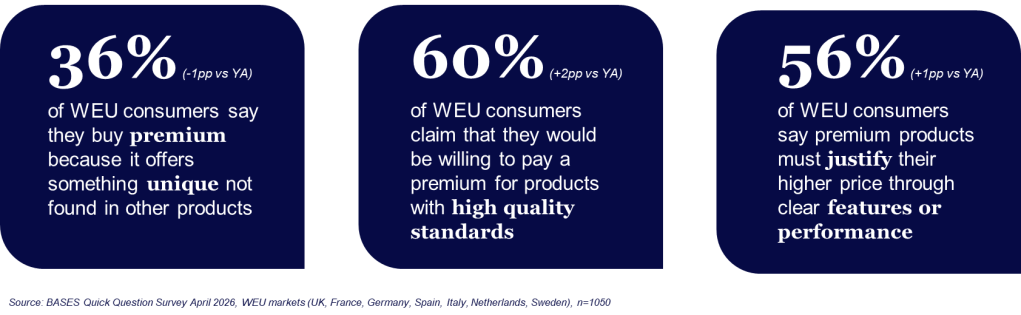
According to our recent survey across 7 West European markets, consumers are delaying upgrades, holding on to products longer, and approaching replacements with far greater scrutiny. They are not necessarily spending less overall, but they are thinking much harder about where and why they spend.
This creates a new kind of competitive environment. Brands are no longer competing for frequent purchase occasions. They are competing for fewer, higher-stakes moments and decisions that must feel fully justified.
In this context, premium is no longer driven by volume. It is driven by conviction.
From status to substance
At the same time, the meaning of premium is shifting. Consumers still show a clear willingness to pay more, particularly for quality and performance. But the reasons behind that willingness have evolved.
Premium is moving away from perception and toward proof. Brand alone is no longer enough. Instead, consumers are looking for something far more tangible: clear features, superior performance, and a benefit they can immediately understand.
What matters is not whether a product is positioned as premium, but whether it makes that premium feel real.
Value only wins when it’s visible
This is where many brands are falling short. Differentiation still exists, but too often it isn’t obvious. And in a more selective market, anything that requires explanation risks being overlooked.
Consumers assess value in the moment, combining functional performance, emotional resonance, and contextual comparison into a single, rapid judgment.
That is why premium growth is uneven across the market. It accelerates in categories where improvements are easy to see and experience, such as small domestic appliances, and slows where differentiation is harder to communicate, even if innovation is still happening.
The implication is clear: value does not convert unless it is immediately visible.
A more competitive premium landscape
This shift is also reshaping who wins.
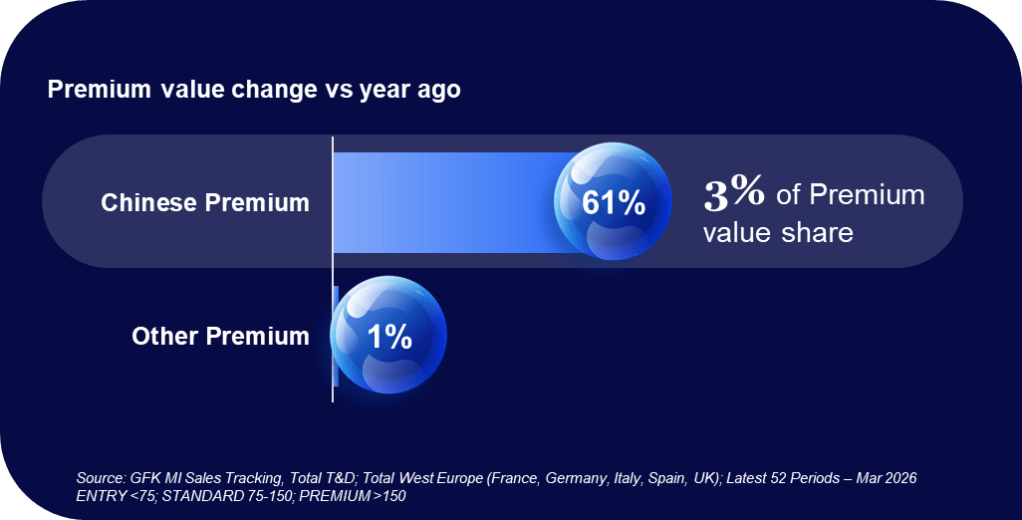
While premium value remains concentrated among the largest brands, growth is increasingly being captured by those that make value simpler to understand, and easier to justify. Increasingly, this includes Chinese challenger brands, which are gaining traction by combining strong performance with clearer, more accessible value propositions.
Challenger players are gaining ground by combining strong performance with clearer, more accessible propositions. In a low-loyalty, high-trial environment, clarity becomes a competitive advantage.
Premium is no longer owned by heritage. It is continuously contested in every decision.
The new premium imperative
What emerges is a very different playbook.
Premium is no longer something consumers default to, it is something brands must actively earn. Each decision requires a clear reason to upgrade, a visible point of difference, and a level of proof that removes doubt at the moment of choice.
The brands that succeed are not just those that innovate, but those that translate innovation into something immediately understandable and something consumers can see, trust, and justify without hesitation.
Because the question shaping the market today is no longer whether consumers want premium. It is whether brands can make it feel worth choosing.
