Black Friday doesn’t just affect your brand. Your brand affects your Black Friday performance. Understanding brand health can reveal the opportunity your brand should be pursuing when shoppers are most actively in-market.
For Tech & Durables brands, few moments put brand strength to the test quite like the Friday after the US Thanksgiving holiday.
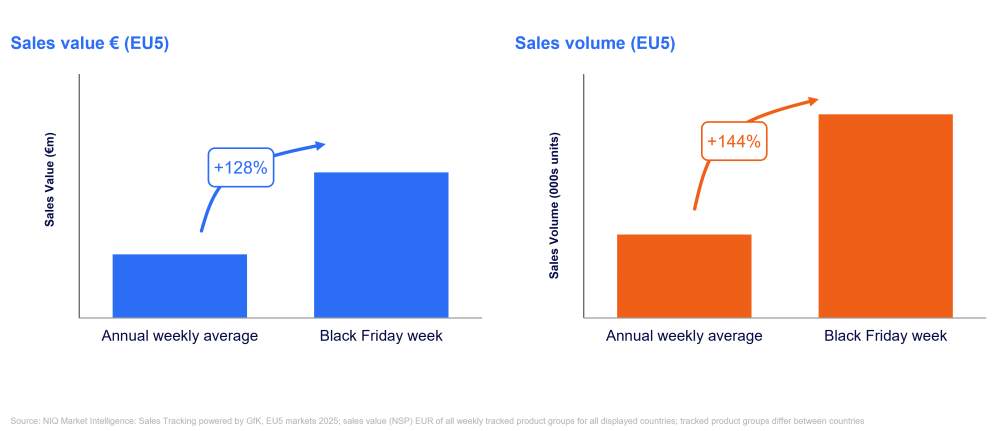
Black Friday is no longer just a sales event. It is the moment when years of brand building are harvested into revenue. In 2025, unit demand during Black Friday week was almost 2.5 times that of an average week in Europe, while revenue was around 2.3 times higher.
But Black Friday itself is changing. What began as a concentrated promotional event is increasingly stretching across November. Promotions start earlier, shoppers respond earlier – blurring the boundaries of when the Black Friday shopping period really begins.
And shoppers aren’t simply waiting to buy cheap products. They are using Black Friday to buy products they might not otherwise justify. In 2025, the average price paid across T&D during Black Friday was €147, compared with €131 across the year, even as around one quarter of products were sold with discounts of 20% or more.
That makes Black Friday about much more than promotional effectiveness. It is a test of whether a brand has built enough awareness, relevance and consideration to be chosen when consumers are most actively in-market. For established brands, the year’s biggest shopping moment is too important to miss. For emerging brands, it can be the moment when shoppers notice them for the first time.
One shopping event, very different opportunities for brands
The extraordinary concentration of demand around Black Friday creates opportunities for almost every Tech & Durables brand. But those opportunities are not the same.
For established brands, Black Friday is an opportunity to harvest years of investment in awareness, trust and desire. Strong brands enter the period with consumers already predisposed to consider and choose them. The challenge is knowing how hard they need to promote. Discount too aggressively and they risk giving away margin to shoppers who would have bought anyway. Understanding the strength of the brand, and particularly its pricing power, plays a critical role in deciding the promotional offer.
For premium brands, Black Friday can turn aspiration into accessibility. NIQ’s 2025 data shows that the average price paid during Black Friday was higher than the annual average across a range of categories. This suggests shoppers are not simply searching for bargains; the promotional environment puts products within reach that they may struggle to justify to themselves at other times of year.
The opportunity for mainstream brands is different: encouraging shoppers to trade up within a brand they already know and trust. Promotions on higher-spec models put better technology or additional features within reach, making an upgrade feel like particularly good value. Indeed, NIQ’s 2025 Black Friday analysis explicitly identifies premium positioning and upselling as opportunities for manufacturers.
And for emerging and challenger brands, Black Friday is a shop window like no other. The surge in consumer demand creates an opportunity to win first-time buyers, demonstrate product capabilities and introduce an unfamiliar brand to shoppers when they are actively paying attention to what’s available. The challenge is only partly about securing Black Friday sales; it’s also about cutting through the promotional noise and getting noticed in a way that has the potential to build future consideration.
Black Friday doesn’t just affect your brand. Your brand affects Black Friday performance.

Curious about our Brand solutions?
The sales achieved during Black Friday reflect more than the competitiveness of the offer. They also reflect what the brand brought into the event: how well known it was, how relevant it was to the shopper, whether consumers trusted it, how strongly they wanted it and how much they were prepared to pay for it.
At the same time, the experience of Black Friday has the potential to change those dynamics. Emerging brands can reach thousands of new shoppers. A premium brand can become accessible to consumers who previously considered it beyond their budget. And an established mainstream brand can encourage existing customers to discover more premium parts of its portfolio.
So understanding Black Friday performance means looking in both directions:
What did the strength of your brand contribute to your Black Friday performance, and what did Black Friday contribute to the strength of your brand?
And that brings us back to brand health.
Answering these questions requires looking beyond sales uplift. Brands need to understand their existing platform in terms of awareness, relevance, desire and pricing power, then assess whether Black Friday activated existing brand fans, attracted new buyers and strengthened future purchase potential. Connecting sales performance with these measures of brand equity provides a more complete view of both immediate commercial returns and longer term brand impact.
There is no single Black Friday strategy that’s right for every brand. The opportunity depends on the health of the brand you are taking into it. An established brand with strong consumer desire and pricing power may have more to gain from protecting value than chasing incremental volume. A premium brand may use the period to convert aspiration into purchase. A mainstream brand might use it to trade shoppers up, while an emerging player may value the opportunity to build awareness, trial and consideration alongside immediate sales.
Sales tracking tells you what consumers bought. Putting that together with brand health helps explain why they bought it, the role your long-term brand building had in delivering the sales, and what opportunity it may have next.
Because the right Black Friday strategy starts long before Black Friday. It starts with understanding the strength of the brand you’re taking into it