
Report
2026 U.S. Mother & Baby Market Trends: Understanding Moms, Rethinking Consumption
New NIQ x Momcozy insights reveal how moms’ evolving needs, everyday support, trust and technology are reshaping the mother and baby market

New Growth Opportunities Amid Shifting Consumer Behavior
Parents are increasingly looking for solutions that simplify everyday routines, support confident decision-making and deliver clear value. For brands, the growth question is no longer only what to sell. It is how to meaningfully support parents across everyday moments of care.
See what stress relief means for product design
Mom-Led, Support-Driven: Understanding What Moms Need Most
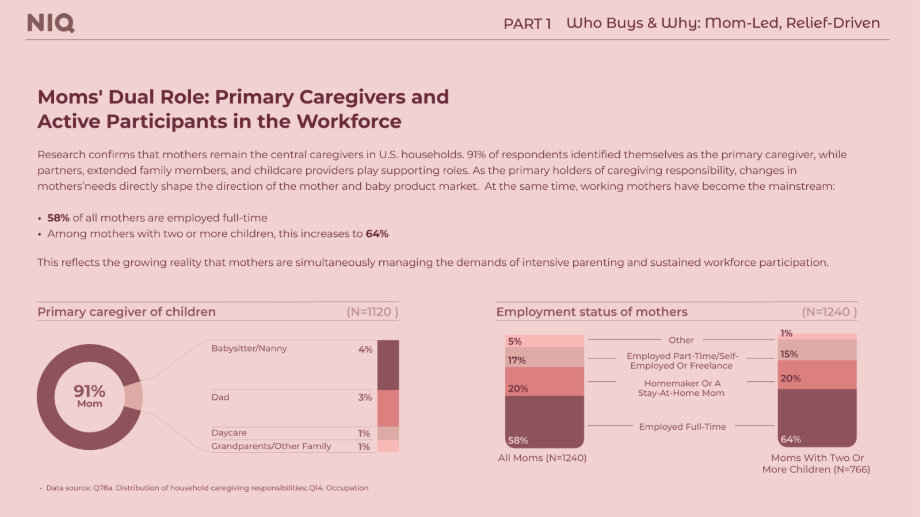
Moms remain the primary decision-makers in the category, while many are also managing sustained workforce participation. The report shows 91% of respondents identified themselves as the primary caregiver. At the same time, 58% of all mothers are employed full-time, increasing to 64% among mothers with two or more children.
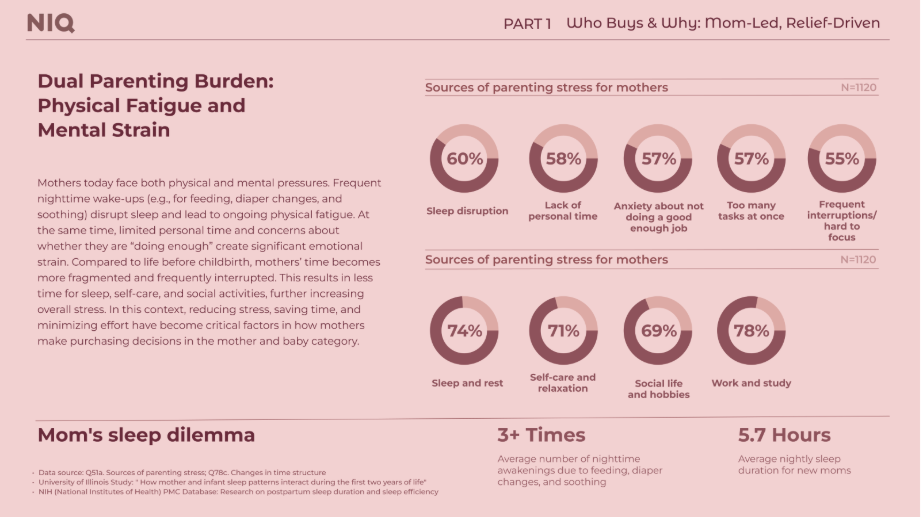
Moms are navigating both physical demands and significant mental load. Sleep disruption, limited personal time, and anxiety about whether they are doing enough create demand for products that reduce effort, save time, and make routines easier.
- 60% cite sleep disruption as a source of parenting stress.
- New moms report an average of 3+ nighttime awakenings and 5.7 hours of average nightly sleep.
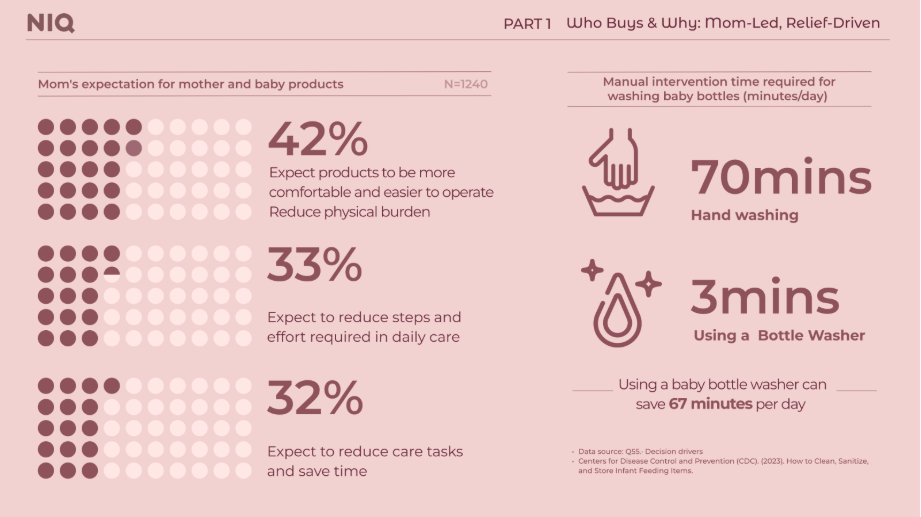
- 42% expect mother and baby products to be more comfortable and easier to operate.
- Using a baby bottle washer can reduce manual intervention from 70 minutes to 3 minutes per day, saving 67 minutes.
Explore scenario-based growth opportunities
From Individual Products to High-Frequency Scenario-Based Systems
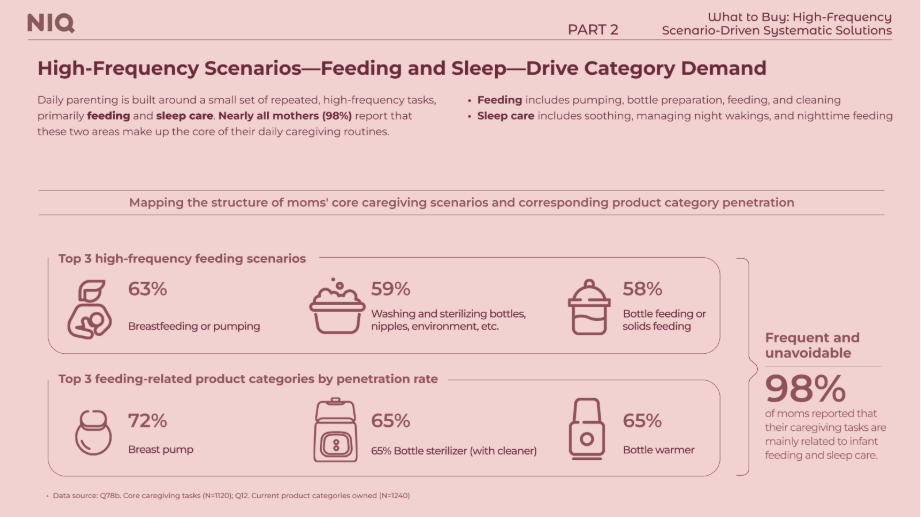
Feeding and sleep care are the highest-frequency caregiving scenarios. Nearly all mothers in the study, 98%, report that their core caregiving tasks are mainly related to infant feeding and sleep care.
Because these tasks repeat multiple times a day and often at night, they drive demand for reliable, easy-to-use products that work across connected caregiving journeys rather than stand-alone tasks.
- Top feeding scenarios include breastfeeding or pumping at 63%, washing and sterilizing bottles and related items at 59%, and bottle or solids feeding at 58%.
- Top feeding-related product categories include breast pumps at 72%, bottle sterilizers with cleaner at 65%, and bottle warmers at 65%.
- Top sleep care scenarios include soothing baby to sleep at 65%, dealing with frequent night wakings at 59%, and night feeding at 54%.
- Top sleep-related categories include bassinets or cribs at 61%, baby monitors at 50%, and bouncers or swings at 42%.
Learn how to build enduring trust
Decision Drivers: Trust Is Shifting Under Information Overload
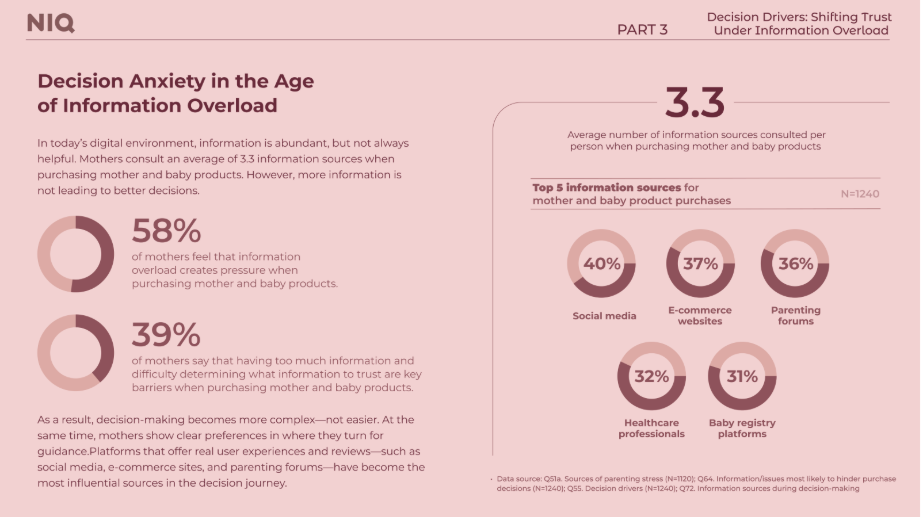
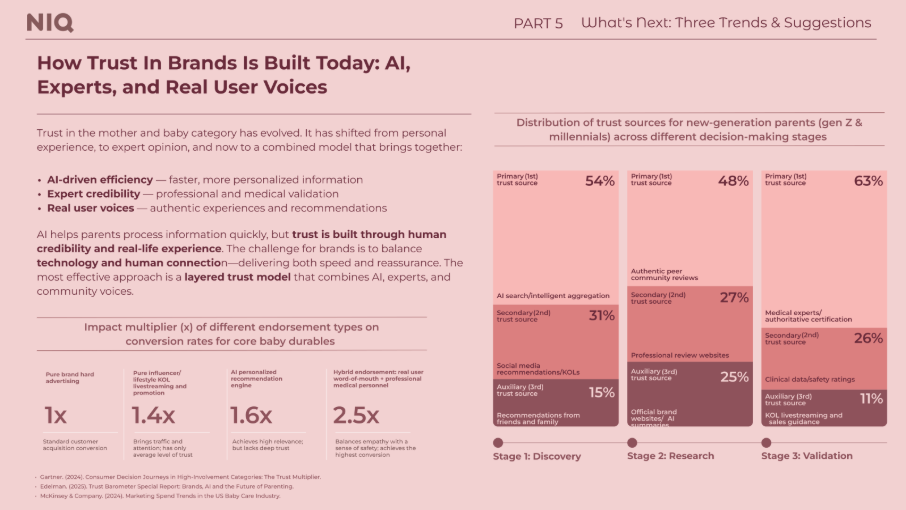
Information is abundant, but more information is not always making decisions easier. Mothers consult an average of 3.3 information sources when purchasing mother and baby products, yet 58% say information overload creates pressure and 39% say too much information and difficulty knowing what to trust are key purchase barriers.
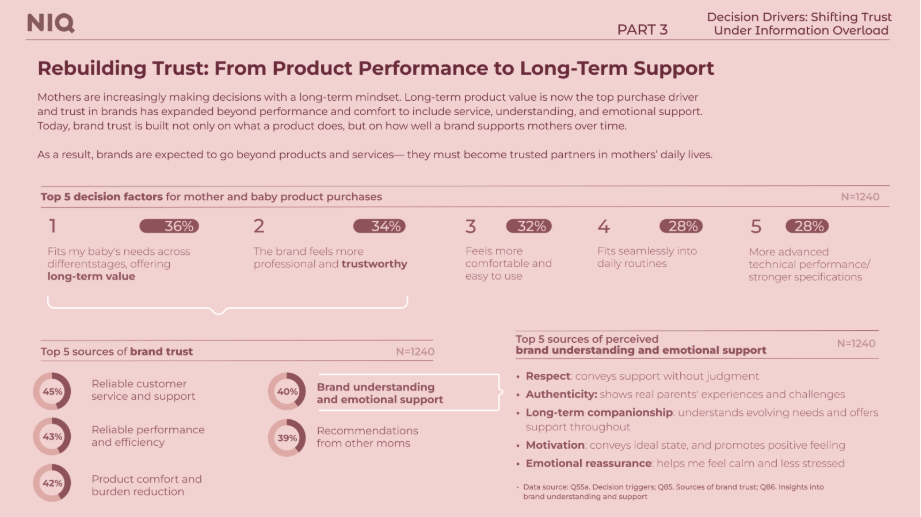
Trust is expanding beyond product performance. Brands are increasingly expected to offer reliable service, professional guidance, emotional reassurance, real parent experiences, and support that lasts beyond the moment of purchase.
- Top information sources include social media at 40%, e-commerce websites at 37%, parenting forums at 36%, healthcare professionals at 32%, and baby registry platforms at 31%.
- The top purchase factor is long-term value, with 36% saying the product should fit the baby’s needs across different stages.
- Reliable customer service and support is the leading source of brand trust at 45%.
- Brand understanding and emotional support is cited by 40% as a source of brand trust.
Understand the right role for AI in parenting
AI in Parenting: The Value of Supportive Technology.
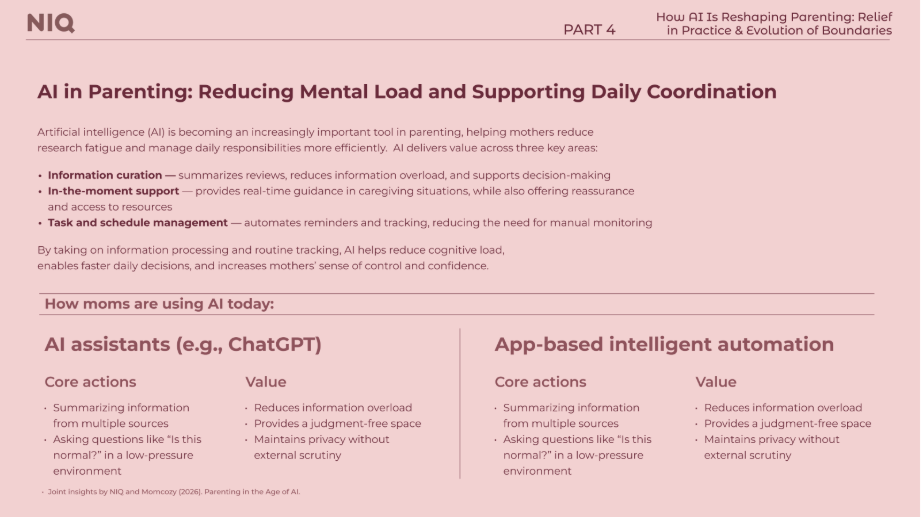
AI is emerging as a parenting assistant by helping mothers process information, manage schedules, and reduce cognitive load. The strongest role for AI is supportive: it should help parents make faster daily decisions while keeping final control with the parent.
The report makes a clear distinction between supportive AI and supervisory AI. Supportive AI intervenes only when needed, handles routine tasks, and strengthens confidence. Supervisory AI, which requires frequent monitoring or appears to evaluate parenting behavior, can weaken trust and discourage continued use.
- Key AI use cases include information curation, in-the-moment support, and task or schedule management.
- Supportive AI acts as a second brain for routine tasks and preserves user control.
- Future competitiveness depends on non-intrusive assistance that improves efficiency without replacing parent decision-making.
Understand the right Growth Opportunities
Three Growth Opportunities for Mother and Baby Brands
The next wave of growth will come from brands that simplify caregiving, build layered trust, and stay relevant across the parenting journey.
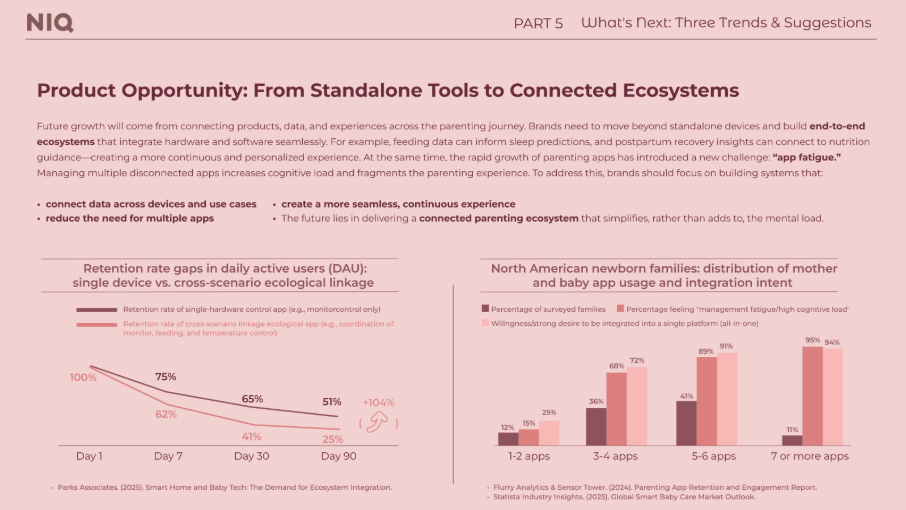
- Connected ecosystems: Move beyond standalone products by connecting hardware, software, data, and support across feeding, sleep, monitoring, and recovery.
- Layered trust: Balance AI-driven efficiency with expert credibility and real user voices. The report shows hybrid endorsement through real user word-of-mouth plus professional medical personnel can reach a 2.5x impact multiplier on conversion rates for core baby durables.
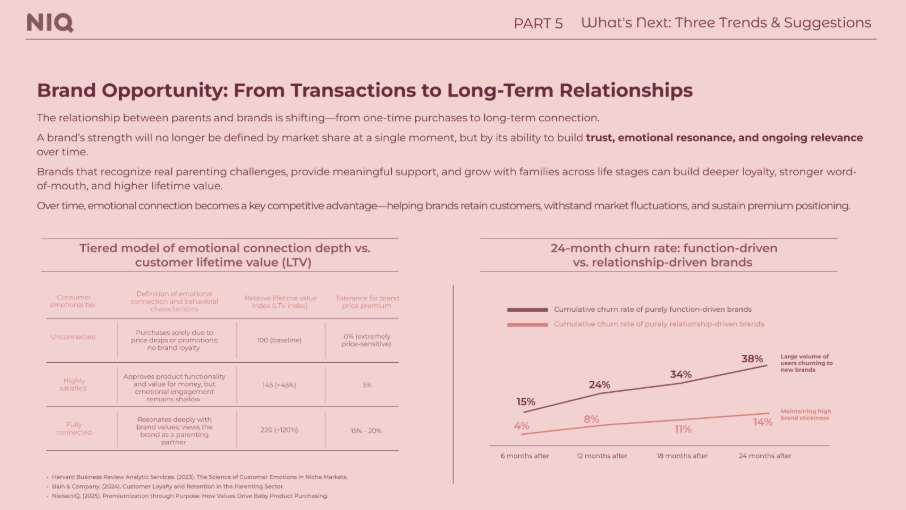
- Long-term relationships: Shift from transaction-led selling to ongoing support. Fully connected consumers show a relative lifetime value index of 220 and a 15% to 20% tolerance for brand price premium in the report’s model.
Partner with NIQ to Navigate the Evolving Mother and Baby Market
Contact us to access the full report and understand how evolving mom needs, trust signals, AI expectations, and connected ecosystems can inform your brand strategy.