

Africa and the Middle East’s FMCG sector continues to deliver impressive growth on paper. Regional FMCG value sales grew 13.7% in the 12 months to Q2 2026. But beneath that headline lies a more complex reality. Volume growth reached just 3.7%, while unit value growth accounted for 10.0% of market expansion, highlighting a marketplace where consumer behavior is becoming increasingly fragmented.
For manufacturers and retailers, the biggest risk today is assuming consumers fit neatly into traditional segments. The idea of the “premium shopper” and the “value shopper” is becoming less relevant. Across markets, the same consumer may willingly pay more in some categories while actively seeking savings in others.
The traditional idea of targeting the “average consumer” is also becoming less useful. As consumers increasingly move between premium and value choices depending on category, occasion, need state, and perceived value, brands can no longer assume consistent purchasing behavior across the basket.
The real shift isn’t that consumers are spending more or less. It’s that they’re becoming more selective about what deserves their money and what doesn’t.
Three Consumer Realities Shaping FMCG Growth
Headline growth figures often suggest a single story, but consumer behavior tells a different one.
Across markets, three realities are emerging simultaneously. Some consumers continue to navigate inflationary pressures and rising living costs. Others are benefiting from stronger purchasing power and increasing consumption. And in several markets, household budgets remain under significant strain, forcing difficult trade-offs between essential and discretionary spending.
What makes this particularly interesting is that these different circumstances are producing a surprisingly similar outcome: consumers are becoming far more deliberate about where they spend, where they save, and what they believe is worth paying more for.
Morocco provides one example of this dynamic. FMCG value growth reached 14.5%, while volume expanded by 16.4%, driven by strong demand across beverages and ambient food. This is a market where consumers continue to increase consumption despite minimal inflation.
The UAE reflects a different but equally telling trend. While FMCG growth remains healthy at 5.4%, consumers are increasingly shifting spending toward essential categories such as Ambient Food and Beverages, away from more discretionary purchases. Even in a relatively resilient market, consumers are becoming more intentional about where value matters most.
Meanwhile, markets such as Egypt are sitting somewhere in between. As inflation eases and consumer confidence gradually improves, FMCG growth is increasingly moving away from purely inflation-driven expansion and toward more sustainable demand-led growth.
At the other end of the spectrum, consumers in Saudi Arabia and Nigeria continue to face greater pressure. In Saudi Arabia, FMCG value and volume sales both declined by roughly 1%, while Nigerian consumers reduced discretionary spending and focused increasingly on essential purchases as volumes fell 1.5%.
The circumstances may differ, but the underlying consumer behavior is remarkably similar. Shoppers are becoming more intentional about the value they expect from every purchase.
While the behavior may be increasingly consistent, the route to growth is not. In some markets, growth comes from premiumization and higher-value propositions. In others, it comes from affordability, accessibility, distribution, or stronger participation in essential categories. Understanding which levers matter most remains highly market and category specific.
The Consumer Is Not Polarized. Their Decisions Are.
Much of the conversation around consumers today focuses on whether they are trading up or trading down. The evidence increasingly suggests they are doing both.
Shoppers continue to pay for products that earn their premium through quality, trust, convenience, performance, innovation, or relevance. At the same time, they are increasingly willing to switch brands or choose lower-priced alternatives when the added value is less clear.
Increasingly, consumers are protecting purchases that feel meaningful, functional, trusted, or personally relevant, while optimizing purchases where the premium no longer feels justified. As a result, the same shopper may actively seek value in one category while willingly paying more in another.
This dynamic creates significant pressure on products positioned in the middle.
The challenge is not that consumers have become unwilling to spend. Rather, they have become less willing to spend without a compelling reason.
Evidence of this shift can be seen across multiple markets.
In Lebanon, consumers are becoming increasingly price sensitive and more willing to switch brands in pursuit of better value.
In Kuwait, private label sales surged 18.4%, reflecting growing consumer acceptance of value-oriented alternatives.
In Oman and Qatar, private label continues to gain momentum, particularly across staple food categories where functionality can outweigh brand differentiation.
These shifts are not necessarily signs of consumers abandoning brands. They are signs of consumers reassessing where brands genuinely add value.
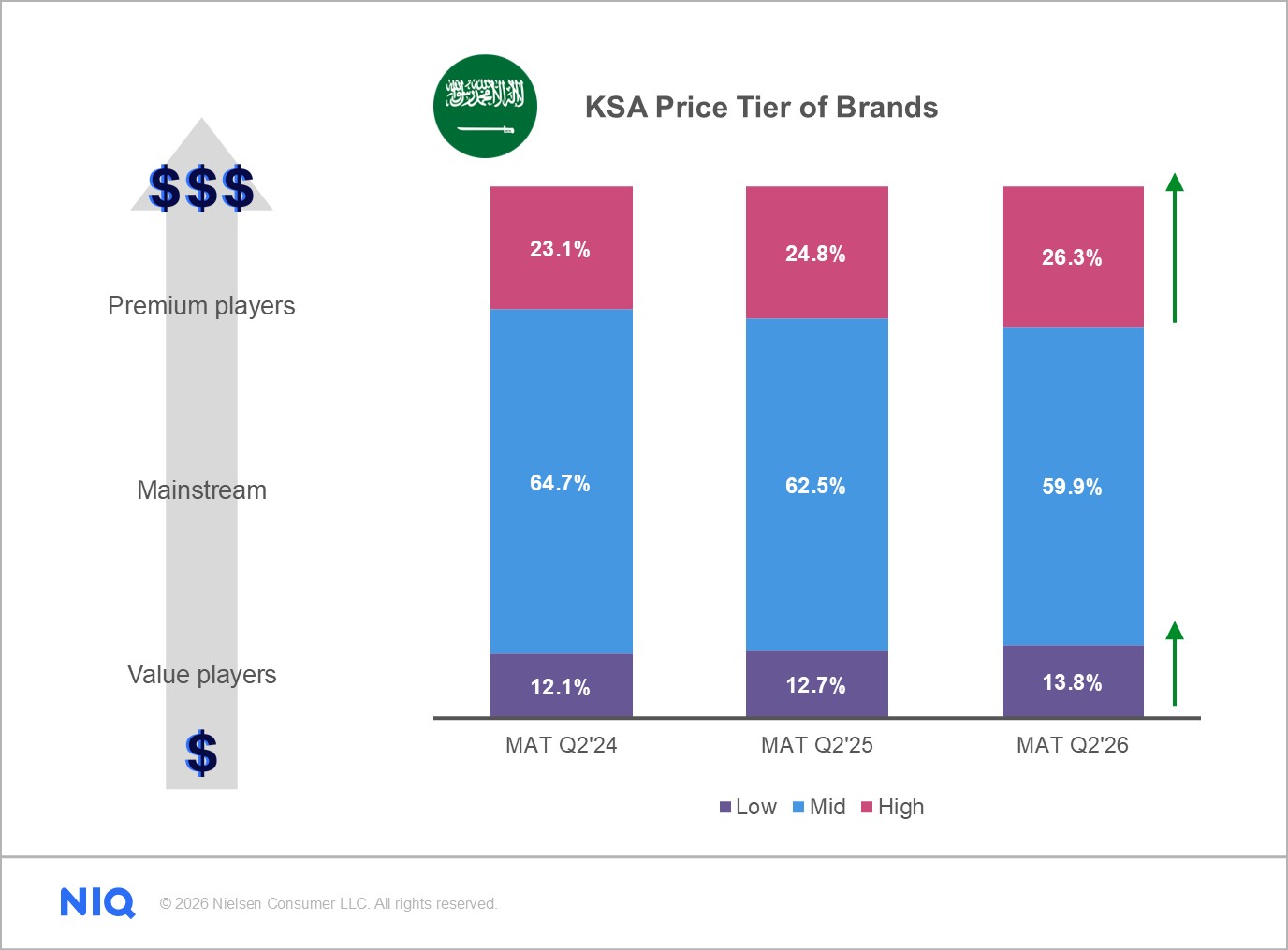
Premium and value segments continue to gain share while the middle tier loses ground, illustrating that consumers are not simply trading down. They are becoming more selective about where a premium is justified and where value is sufficient.
Why E-commerce Is Accelerating the Shift
Nowhere is this behavior more visible than online.
E-commerce remains the fastest-growing retail channel across many markets, expanding by 37.6% in Kuwait and 26.4% in the UAE, while contributing approximately 9% of FMCG sales in Saudi Arabia.
Digital commerce is doing more than creating a new route to market. It is changing how consumers evaluate value.
Online shoppers can compare prices instantly, access broader assortments, review alternatives, and switch brands with minimal effort. As a result, products increasingly compete on demonstrable value rather than habit or familiarity alone.
Research suggests that this environment amplifies the polarization already occurring in consumer decision-making. Online, the middle tier is often underrepresented, as shoppers gravitate toward either a clearly differentiated premium option or a compelling value alternative. Greater transparency, richer product information, wider assortments, and easier comparison make it simpler for consumers to act on those preferences.
In this sense, e-commerce is not simply reflecting changing consumer behavior. It is accelerating it.
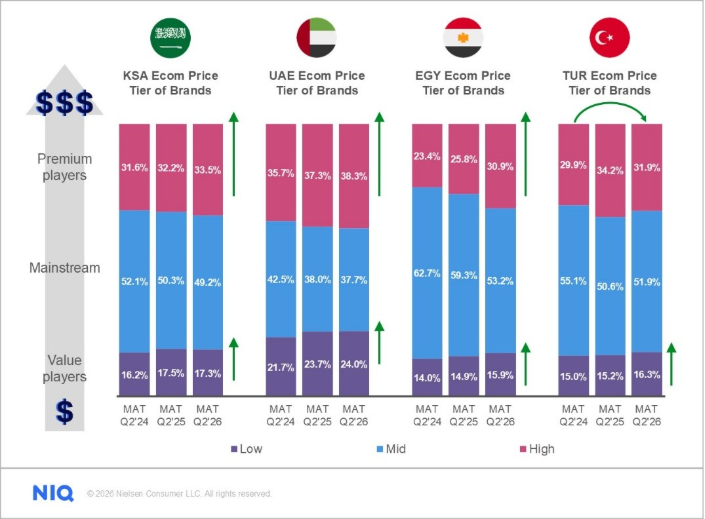
Consumer polarization becomes more pronounced online, where premium and value products capture a disproportionate share of the digital basket while mid-tier products lose share.

Why the Middle Is Under Growing Pressure
For many years, FMCG portfolios were built around broad, mainstream propositions designed to appeal to the largest possible audience.
That model is becoming harder to sustain.
The growth of private label, increased brand switching, rising price transparency, and evolving channel preferences all point in the same direction: products that cannot clearly articulate why they deserve their price are becoming increasingly vulnerable.
Consumers are not rejecting premium products.
They are rejecting ambiguity.
A premium can still command a higher price when the benefit is clear. A value proposition can still win when affordability is the priority. The products facing the greatest pressure are those caught between the two, offering neither compelling differentiation nor a meaningful value advantage.
Winning in the Era of the Contextual Consumer
The future of FMCG growth will not be determined by whether brands choose premiumization or affordability.
It will depend on how effectively they understand the context behind every purchase decision.
The same shopper may buy a premium infant product, a value-focused staple, a trusted heritage brand, and a private label alternative in the same basket. What matters is not whether that consumer is affluent or budget conscious. What matters is the role each product plays in their life and whether its value proposition is clear enough to justify its price.
For manufacturers and retailers, this requires a deeper understanding of category dynamics, shopping missions, channel behavior, and the benefits consumers genuinely care about.
The era of the average consumer is ending.
Growth will increasingly come from understanding not whether consumers are trading up or trading down, but when they are willing to do either and, more importantly, why.

Understand What Consumers Will Pay For
Discover how NIQ’s Consumer Intelligence and Pricing & Promotion solutions help manufacturers and retailers identify growth opportunities, optimize portfolios, and better understand changing consumer behavior.