Across Western Europe, nearly one in two new products now carries a retailer’s name and the ambition behind them has changed.
For years, the private label (retail brand) story was a price story. Trade down, trade back, repeat. The 2026 data tells a different one.
Across France, Germany, Italy, Spain and the UK, innovation value sales were essentially flat over the latest 52 weeks — down 0.2%. But underneath that stillness, the market moved. Branded innovation grew 1.8% while private label innovation fell 2.1%. Read quickly, that looks like brands winning back the ground. Read properly, it’s the first real test of whether retailer brands can behave like brands, because they’re now operating at brand scale.
The scale is the point. Private label accounted for 42% of innovation launches a year ago compared to 46% today. More than 83,000 new private label products reached the shelf this year, and retailers expanded their own assortments faster than the total FMCG shelf: +2.5% versus +1.6%, rising to +3.3% in Spain and +3.2% in Germany. Shelf space is being reallocated, not just contested.
The advantage is real and narrowing
Innovation contributes 11.7% of private label value versus 8.1% for branded products. That’s a meaningful gap, and it holds almost everywhere: Germany is the extreme at 16.9% versus 9.6%, with Spain at 11.0% versus 5.5%. Italy is the one market where the advantage has gone and where branded and private label sit at parity.
A year ago, though, the private label figure was 12.2%, while branded held flat at 8.1%. The lead is still substantial. It just isn’t growing anymore, and the reason sits in velocity, where private label innovation fell 6.9% against a market decline of 1.6%.
More launches, less traction from each one. Scale has been achieved; productivity is the open question. Which raises a more uncomfortable one for both sides of the shelf: if a retailer can now match a brand on volume of innovation but not yet on the return from it, is the constraint the pipeline itself, or the decision about what deserves to be in it?
Premiumization is already happening, just not where you’d expect
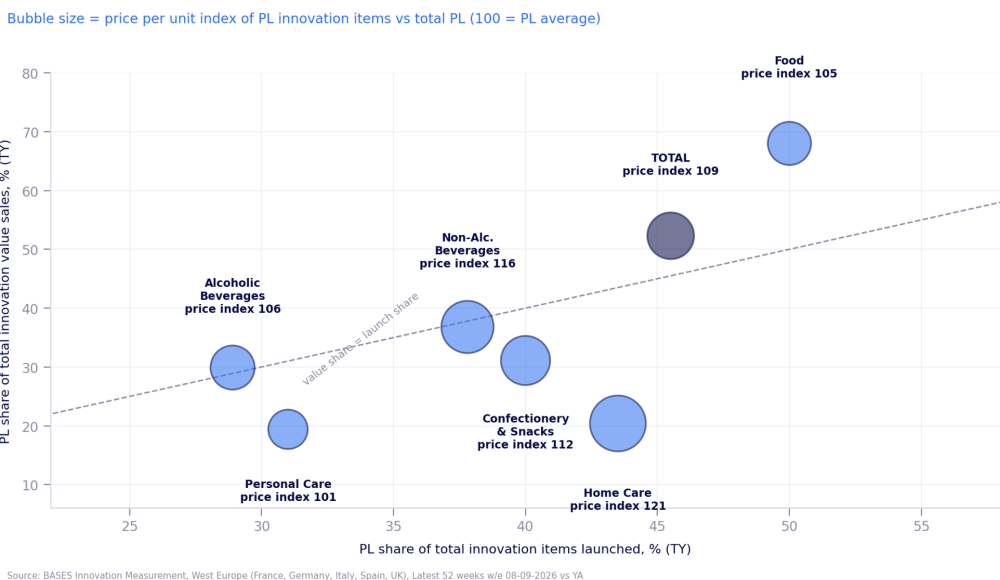
The most interesting signal is in pricing. On average, a new private label product is priced 9% above the typical private label item on shelf. Retailers are no longer launching only to defend the entry tier, they are using new products to reach up.
Home Care is the clearest example, and the most nuanced. New private label products in the category still sell at a 21% premium to the average private label item. A year ago that premium was 38%. The premium hasn’t disappeared, it has come down, as private label innovation prices in Home Care fell 12.3% year on year. In other words: retailers built a genuine premium tier here, and are now making it more accessible.
The opposite is happening elsewhere. Private label innovation prices rose 5.7% in Personal Care and 5.1% in Confectionery & Snacks — the two categories where private label innovation is growing fastest, up 11.5% and 23.9% in value. Higher prices and faster growth in the same place is not a discount strategy.
Meanwhile Food, that represent 72% of the private label pipeline, declined 4.4%, and its innovation intensity slipped from 23% to 20% of items. The volume is in one place; the growth is in another.
Who are you competing with in 2027?
If you are a manufacturer, the competitive question goes from “how do we defend against a cheaper copy?” to “what happens when the retailer brand innovates faster, prices higher and takes more of its growth from new products than we do?”
That changes what a 2027 plan needs to answer. Is the portfolio built for a competitor that now occupies the middle and the premium tier, not just the entry one? Where are you defending share with a product that hasn’t genuinely changed in years and would renovating it do more than another line extension? If innovation is carrying 11.7% of our competitor’s growth and 8.1% of ours, is the gap in our pipeline, or in what we choose to launch?
If you are a retailer, the question is harder: you are launching more and getting less from each launch. Which half of that pipeline is earning its space, and what would you stop doing to fund the half that works?
Both answers depend on the same thing: knowing which innovations work before they hit the shelf.