
Why the Future of Marketing Effectiveness Belongs to AI-Native Decision Systems
By Lauren Fernandes, Vice President of Global Content, NIQ
Marketing leaders are under more pressure than ever to prove impact. At the same time, the pace of decision-making has accelerated beyond what traditional measurement workflows were designed to support. This shift calls for a new framework, one that helps businesses move from hindsight-based reporting to continuous, intelligence-driven decision-making.
Marketing Has Reached an Operating-System Moment
For years, the industry has responded to complexity by adding more dashboards, more reports, and more point solutions. Yet many organizations still struggle to answer the most important question: What should we do next, right now?
The challenge isn’t a lack of data. It’s a lack of connected intelligence.
As media buying becomes increasingly algorithmic and consumer journeys continue to fragment across retail, social, streaming, search, e-commerce, and in-store environments, the gap between insight generation and business action has become one of the defining challenges of modern marketing.
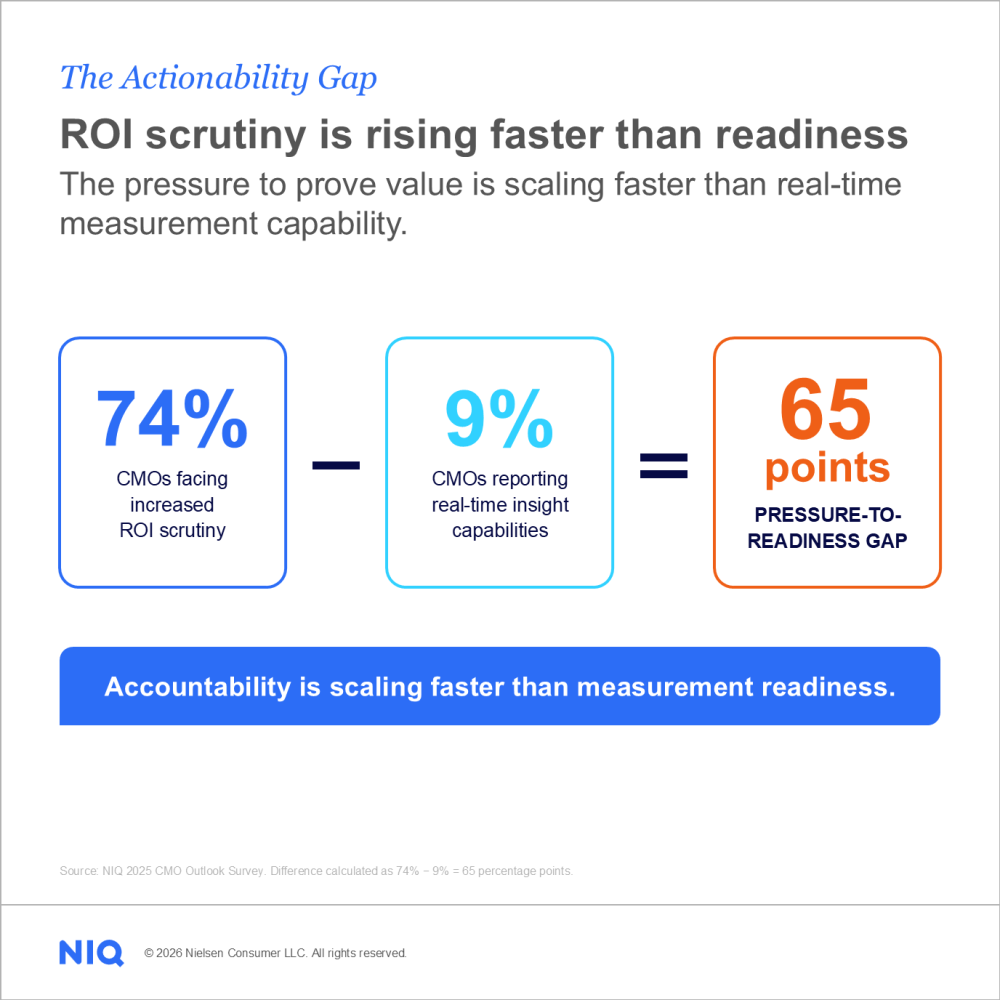
“74% of CMOs said they were under more scrutiny for reporting marketing ROI, while only 9% believed they had unlocked real-time insights,” says Tate. “So we have a 65-point gap between the pressure to answer questions and the ability to do so in real time.”
—Jason Tate, General Manager of Marketing Effectiveness at NIQ, describes this as the industry’s growing “actionability gap.”

Beyond the Agent: The Rise of Coordinated Intelligence
Much of the AI conversation has focused on the idea of a single, all-knowing assistant. The complex processes that marketing effectiveness solves cannot be facilitated by one single agent. Instead, it will be defined by networks of specialized intelligences working together across the measurement lifecycle.
Think of it less as a chatbot and more as a high-performing, synchronized team.
One agent cleans and harmonizes data. Another evaluates the models. Others surface insights, identify anomalies, benchmark performance, and recommend optimizations. Human marketers remain firmly in control, but they are supported by an ecosystem that can process information and surface decisions at machine speed.
This shift represents something far more significant than automation. It is a redesign of the marketing effectiveness workflow itself. The old model was linear: collect data, run analysis, build reports, make decisions. The emerging model is always-on, continuously ingesting new signals, updating intelligence, and surfacing recommendations so that marketers and their AI systems can act on the most current information available.
The organizations that embrace this transition will not simply gain efficiency. They will gain decision advantage.
Introducing NIQ’s ‘Continuous Intelligence’ Framework
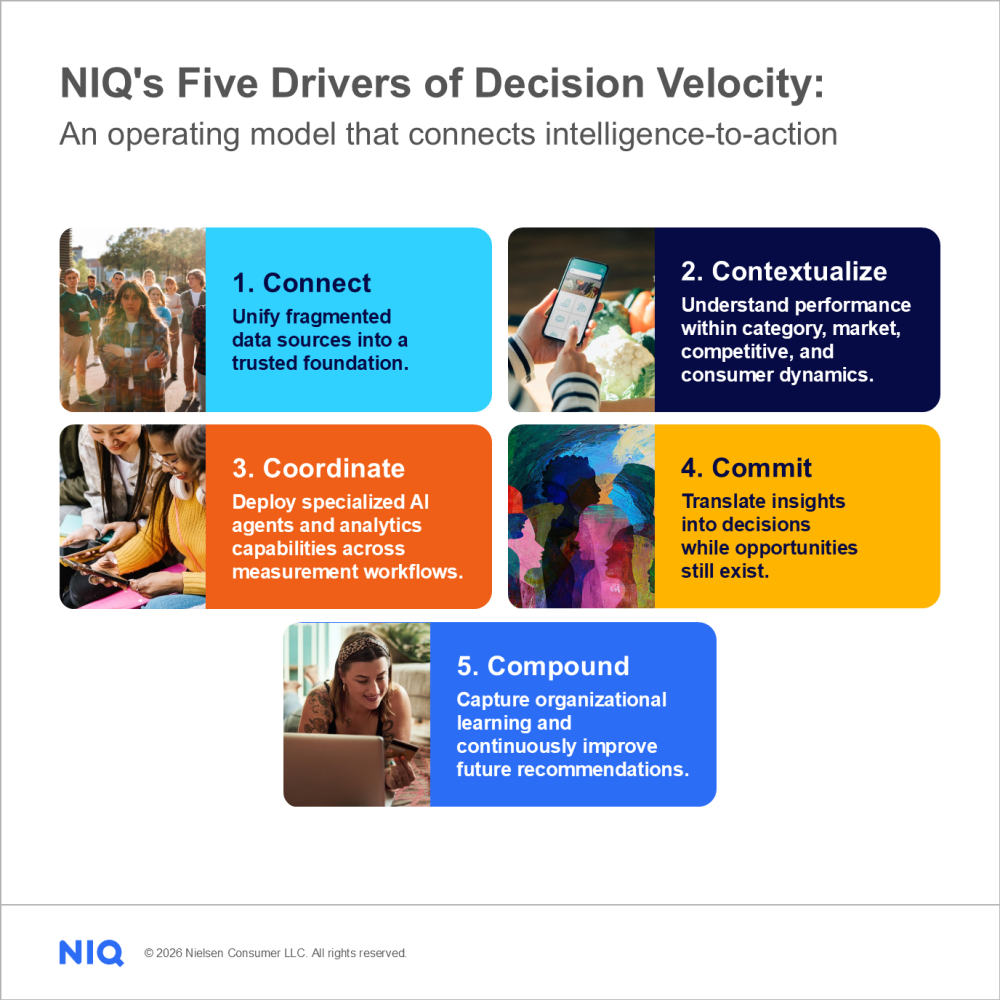
As marketing enters the AI-native era, leaders need a new way to think about effectiveness. For decades, marketers relied on the Four P’s of Marketing to shape growth strategy in a predictable, channel-centric world. Today’s environment demands a different framework, one built not around products and promotions, but around intelligence and action. I call these the Drivers of Decision Velocity: five capabilities that move marketing effectiveness beyond measurement and into continuous, intelligence-led decision-making.
- Connect: Unify fragmented data sources into a trusted foundation.
- Contextualize: Understand performance within the realities of category, market, competitive, and consumer dynamics.
- Coordinate: Deploy specialized AI agents and analytics capabilities across measurement workflows.
- Commit: Translate insights into decisions while opportunities still exist.
- Compound: Capture organizational learning and continuously improve future recommendations.
The power of this framework is that it transforms measurement from a reporting function into a decision engine. In other words, effectiveness no longer becomes something marketers review after campaigns conclude. It becomes something that actively guides performance while campaigns are running.
The goal isn’t better reporting. It’s creating an engine for continuous decision-making and growth.
Why Legacy Measurement Workflows Are Breaking Down
Traditional measurement systems were built for a world with fewer channels, longer planning cycles, and relatively linear customer journeys. That world no longer exists.
“Marketing leaders are being asked to do more with their budgets, prove business impact, and make decisions faster. It’s not that legacy measurement workflows are bad; they were built for a different time.”
—Arica McKinnon, Global Head of Go-To-Market, Marketing Effectiveness at NIQ
Today’s challenge is not collecting data. It’s reconciling thousands of fragmented signals that often tell conflicting stories.
Measurement providers, media platforms, retail media networks, attribution tools, and internal systems all produce their own versions of performance. The result is often an organization filled with dashboards but lacking a common understanding of what is truly driving growth. The consequence is delayed action, slower optimization, and reduced confidence in decision-making.
From Reports to Operating Rhythms
Forward-looking organizations are beginning to recognize that they do not need another measurement tool. They need a new operating rhythm. One-time studies increasingly resemble historical snapshots. Valuable, but limited.
Continuous decision systems, by contrast, are designed to keep pace with modern marketing. They allow marketers to move from reactive reporting toward proactive optimization. This is where AI-native platforms like NIQ Cadence™ point toward the future.
Rather than layering AI onto legacy workflows, Cadence was built as a compound AI operating system, orchestrating specialized agents across data ingestion, harmonization, measurement, insights generation, and optimization.
This distinction is important:
The value is not simply that tasks happen faster. The value is that intelligence flows continuously across the workflow, enabling organizations to move from asking, “What happened?” to “What’s happening, and what should we do next?”

The Competitive Advantage of Continuous Decision-Making
Over the next five years, the competitive divide in marketing will be determined by two factors: the depth of intelligence available to an organization and its ability to convert that intelligence into action at the speed of the market.
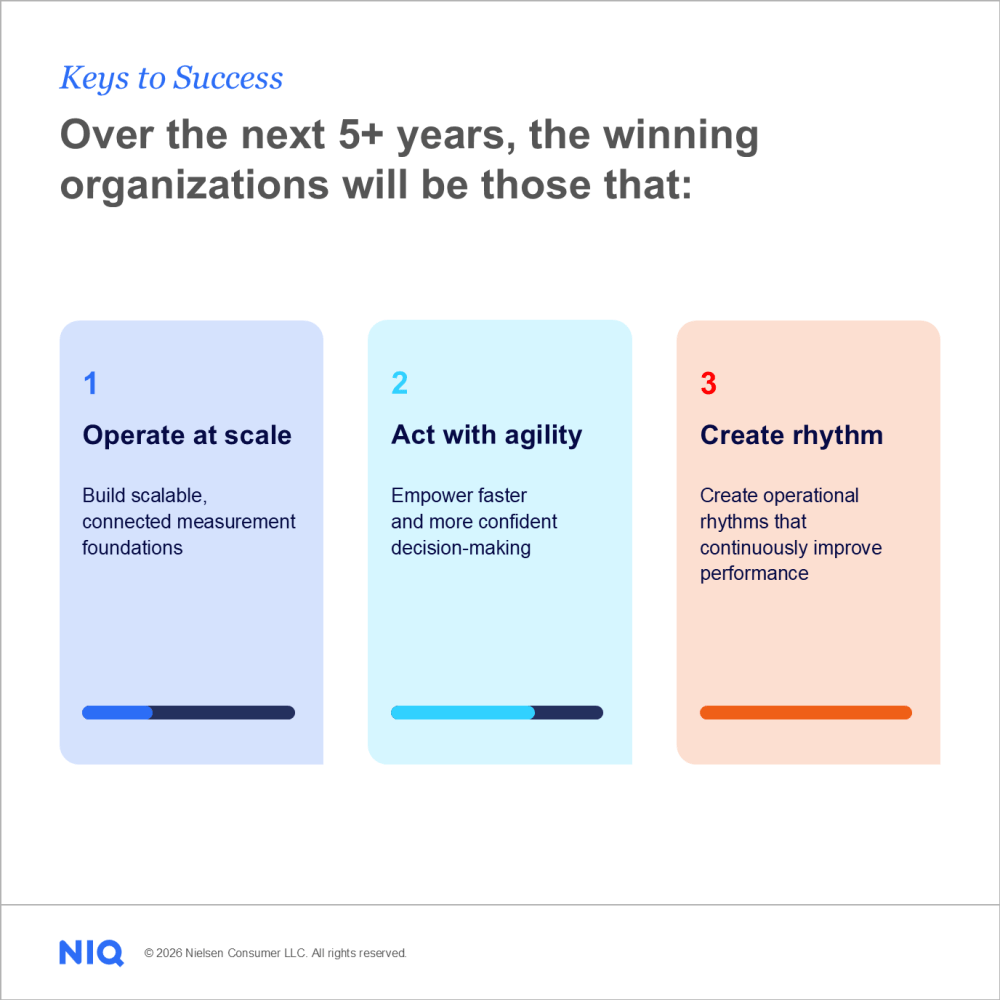
Marketing effectiveness is evolving from a retrospective discipline into a real-time capability. The future will not belong to brands with the most reports. It will belong to those with the most adaptive decision systems.
And as the industry moves beyond standalone AI agents toward coordinated intelligence ecosystems, platforms like NIQ Cadence offer a glimpse into what that future can look like: measurement that learns, evolves, and moves at the speed of modern marketing.
By 2030, we may look back on static reporting much like the way we look back on batch data processing today: a necessary step in the industry’s evolution, but no longer sufficient for how decisions get made.
The next frontier is not more analytics. It’s continuous intelligence.

NIQ Cadence: AI-Native Marketing Measurement
How AI-native, continuous marketing measurement can help leaders move from fragmented reporting to faster, more confident decisions.
Interested in learning more about NIQ Cadence?
Explore the platform and connect with our team for a personalized demo.