How AI and polarized wallets are redefining retail loyalty
Heading into 2027, consumers are recalibrating
For the past few years, most forecasting has rested on a single assumption: this is temporary. Inflation will cool, confidence will return, and shoppers will go back to behaving the way they did before. NIQ’s 2027 Consumer Outlook suggests that assumption no longer holds.
Consumers are no longer treating disruption as a passing phase. They’re recalibrating around it, seeking simplicity, craving clarity, and prioritizing purpose as permanent filters for how they spend, rather than temporary coping mechanisms.
As Laura McCullough, President of NIQ’s Global Customer Organization, puts it:
“Consumers are no longer responding to disruption as a “temporary” condition, and the next 12 to 18 months could mark a shift from the prolonged holding pattern many households have been stuck in.”
For retail specifically, recalibration shows up as fragmentation in the shopping trip itself. Across the UK, Italy, Germany, and France, stock-up trips are in decline while mission-specific trips, drug store runs, refills, “quick meals and snacks” are accelerating, led by middle-aged shoppers. The single big weekly shop is giving way to a portfolio of smaller, purpose-driven visits, each one potentially happening at a different retailer. That’s not a loyalty problem retailers can see in a declining basket count. It’s a behavioral shift that happens between the baskets.


Shoppers at both ends of the spectrum — and what it means for loyalty
Recalibration isn’t pushing shoppers toward the middle, it’s pushing them to the edges. NIQ’s data shows the economic divide widening further, with “Strugglers” (consumers who’ve suffered financial insecurity and continue to feel it) now at 19% of the global population, up two points, while “Thrivers” hold their ground at elevated levels. The result is two distinct, deliberate mindsets rather than one undifferentiated squeeze:
- Constraint: 67% of consumers say that if a product isn’t clearly better, they’d rather save money.
- Upgrade: 56% say that if they’re going to spend more, they want it to be clearly premium.
The mainstream middle is the casualty. Globally, $23B in CPG value share has shifted away from mainstream-priced products toward both the discount and premium tiers simultaneously – mainstream share fell 1.0 percentage point while discount gained 0.3 and premium gained 0.6. NIQ’s six-archetype framework shows this “polarized” pattern is now the prevailing global trend, visible in markets as different as the US, UK, Indonesia, Chile, Saudi Arabia, and South Africa.
Here’s where this becomes a retail loyalty problem rather than just a pricing one: a single shopper is often the one driving both ends of this barbell. The same household trading down on laundry detergent is trading up on coffee. The same person switching to a value grocer for the weekly basket is paying a premium for a specific protein bar at a specialty retailer. Nothing about that shopper’s CRM profile at either retailer looks disloyal, their visit frequency might hold steady at both but their wallet is being split three or four ways across a constraint purchase here and an upgrade purchase there, and no single retailer’s data shows the full picture.
This is the shape the intelligence gap takes in 2027: not one dramatic defection, but a thousand small reallocations across the value-premium spectrum, each invisible to whichever retailer isn’t capturing that particular mission.
AI as the new discovery layer — and what it means for loyalty
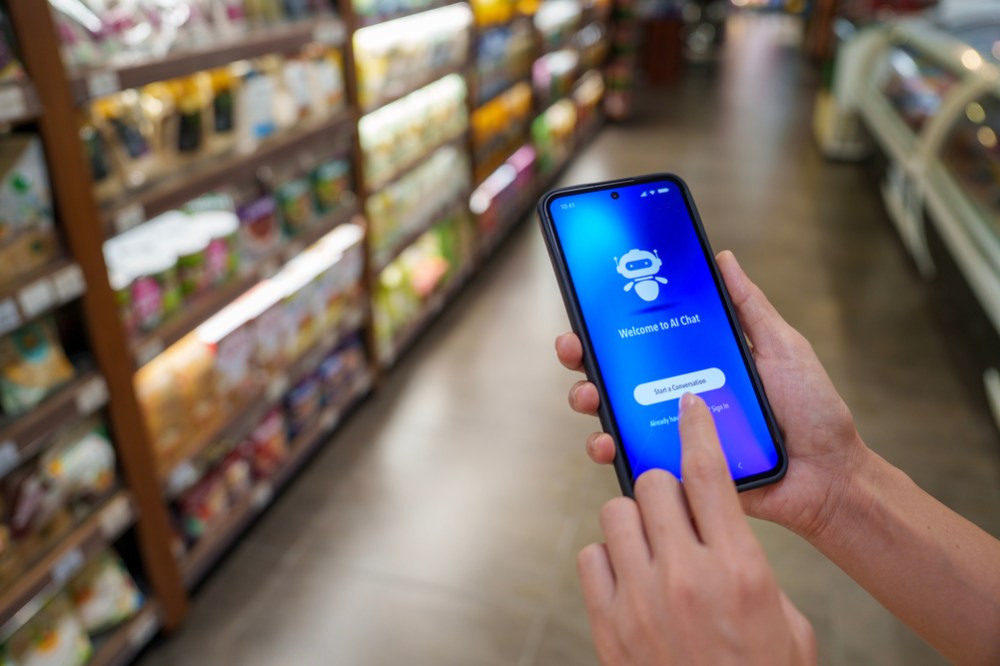
If polarization is splitting where consumers spend, AI is starting to determine how they get there and that has even bigger implications for loyalty.
NIQ’s research shows 55% of global consumers have already been influenced by AI recommendations for CPG purchases, and 27% say they’re actively using AI-powered tools to decide what to buy. Compare that to the more familiar channels: 76% still lean on family and friend recommendations, 65% on search engines, 65% on retailer recommendations directly. AI recommendation (55%) has, in a short space of time, become a mainstream input sitting right alongside these.
Each evolution of commerce has reduced the number of options a shopper actually considers, from dozens of products on a physical shelf, to a handful of filtered search results on a digital shelf, to a few options on a mobile screen, to a couple of AI-guided recommendations, to, ultimately, a single product selected and purchased by an agent on the shopper’s behalf. The data illustrates the mechanics behind this shift vividly: a shopper’s “10 minutes in the aisle” today could become a 30-second voice prompt tomorrow, with an AI agent querying product data, household history, and fulfillment signals behind the scenes to present just three ranked options instead of dozens.
For retail loyalty, this is the critical shift. Historically, a retailer earned loyalty by being physically convenient, well-stocked, and front-of-mind. Increasingly, a retailer will need to earn loyalty by being the one an AI agent chooses to query and trust because if a shopper isn’t walking the aisle themselves, “closeness to the shopper” starts to mean closeness to the system acting for them.
That reframes loyalty itself. A shopper can be “loyal” to a retailer by habit while an AI agent querying price, availability, and fulfillment data in real time quietly reroutes that same purchase mission to a competitor who’s simply more visible and better structured within the system. The retailer never sees a lapsed customer. They just see a transaction that, increasingly often, doesn’t happen.

Closing the gap in a recalibrated, polarized, AI-mediated market
Put together, these three forces compound each other. Consumers are recalibrating around permanent volatility rather than waiting it out. That recalibration is pulling spend toward the value and premium extremes, splitting wallets across multiple retailers in ways no single retailer’s data fully captures. And AI is becoming the layer increasingly deciding which of those retailers gets the purchase at all.
A retailer reading only its own loyalty metrics is working with a fraction of the picture on three fronts at once: it doesn’t see the full spending recalibration happening in the household, it doesn’t see where the rest of a polarized wallet is going, and it increasingly won’t see the moment an AI system chose a competitor instead. Closing that gap means building total-market visibility into planning as a standing discipline, tracking value/premium share shifts by category rather than assuming “the middle” is safe, and treating recommendation-readiness as seriously as shelf placement has always been treated.
The retailers who see all three of these shifts at once go into 2027 planning with a different picture than those watching a single green dashboard.
Join NIQ and National Grocers Association on Wednesday 18th November for our webinar – ‘Protecting Loyalty in 2027: Making the Invisible Shopper Visible’.
In the meantime, download our report – ’The Invisible Shopper: What Retail Data Isn’t Telling You’.