What two years of NIQ BASES Innovation Measurement data reveal about the changing nature of innovation growth in Western European dairy
After a difficult period, innovation in Western European dairy has returned to growth. But the more important story is not simply that innovation rebounded, it’s how the drivers of that growth have fundamentally shifted.
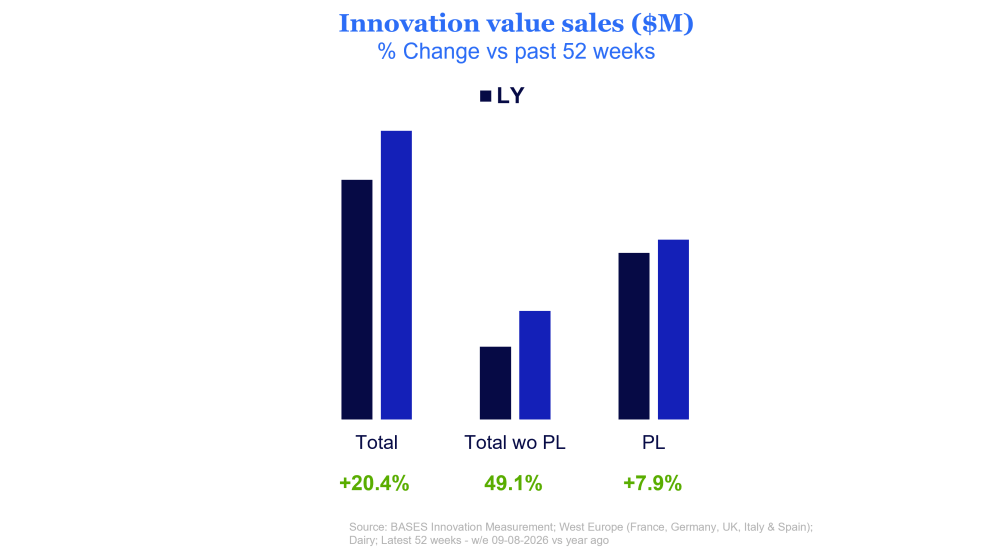
Just one year ago, innovation was losing momentum. Innovation sales declined 13.9% and contributed 6.8% of total category value across France, Germany, Italy, Spain and the UK. In 2026, the picture looks markedly different: innovation sales grew 20.4%, reaching $7.4B and increasing their contribution to 7.3% of category value.
That turnaround matters because overall category growth has slowed. Total dairy sales grew 4.8% in 2025 but just 0.7% in 2026 — meaning innovation is now a disproportionately important source of value creation within a largely flat category.
Delivering more with less
One of the clearest shifts across the past two years is that innovation growth is no longer being driven by a bigger assortment. In both years, the number of innovation items on shelf declined versus previous year. Yet the innovation sales outcome moved in opposite directions: a double-digit value decline in 2025 gave way to strong double-digit value growth in 2026 , achieved despite fewer innovation items available to shoppers.
Importantly, this growth was led largely by value rather than volume. Innovation unit sales rose only modestly (+2.3%), while innovation prices increased sharply, meaning most of the 20.4% value gain reflects price and mix rather than a surge in units sold. The industry is becoming more selective, with success concentrated among a smaller number of higher-value launches rather than a wider spread of products.
Brands are back in the driver’s seat
The competitive balance between branded manufacturers and private label also reversed sharply. In 2025, private label was one of the few sources of positive innovation growth, while branded innovation declined significantly. By 2026, branded innovation had become the primary engine of growth, expanding 49.1% year over year compared with 7.9% for private label.
This reversal signals that branded manufacturers have successfully re-established innovation as a source of differentiation within the category.
Premiumization re-emerges
Pricing tells a complementary story. In 2025, innovation prices softened even as overall category prices rose. In 2026, that pattern flipped: innovation prices increased sharply while category pricing stayed broadly stable.
The data points to a category in which higher-value innovation is once again finding traction, creating clear opportunity for manufacturers able to deliver meaningful differentiation rather than compete on price alone.
Broad growth, uneven opportunity
Innovation growth is now visible across all major Western European markets, but performance varies. Germany leads the region on innovation contribution, while Spain, France and the UK have generated the fastest innovation growth rates.
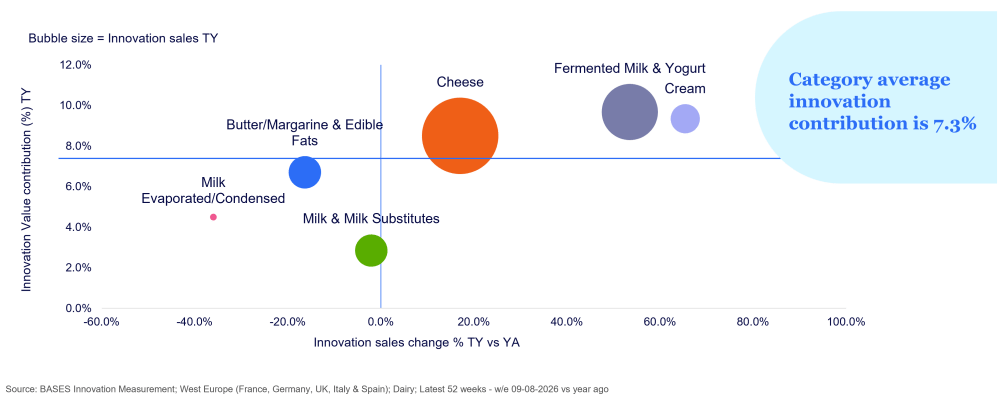
At a segment level, Fermented Milk & Yoghurt, Cream and Cheese are contributing disproportionately to innovation growth and exceed the category benchmark. Milk & Milk Substitutes, by contrast, remains a comparatively underdeveloped space — the biggest whitespace in the current data and a clear target for future innovation.
Innovation Value contribution to total sales (%) & Innovation sales change % TY vs YA
Fewer bets, bigger wins: the new innovation math
Taken together, the past two years mark more than a recovery. They mark a change in the rules of dairy innovation. Innovation is no longer a numbers game won by flooding the shelf.
The manufacturers pulling ahead are launching less and earning more: fewer, sharper propositions that command a premium and claim a growing share of category value. The uncomfortable implication for everyone else is simple. In a flat category, incrementalism is now the riskiest strategy of all, and the brands willing to be more selective, more premium and more deliberate are the ones who will own dairy’s next chapter.