Economic pressure rises, but South Korea’s On Premise holds firm
South Korea’s On-Premise sector is showing remarkable resilience in the face of ongoing economic pressures. Jaepil Sohn, NIQ Client Solution Director -South Korea, provides a comprehensive analysis of the market landscape, consumption patterns, and opportunities across channels, categories, and consumer behaviours, equipping suppliers, brands, and operators with the insights needed to develop strategies.
In such a culturally influential market, the On-Premise industry displays strong health as well. Our research, including the OPUS and REACH surveys, show positive indicators for penetration: some 88% of consumers typically visit the On-Premise, up 2 percentage points (pp) versus one year ago and 3pp above the average of Asia-Pacific markets (APAC). Frequency is also high, with 61% of users visiting weekly (1pp above the global average), and spending is robust, too. The average monthly visitor spend is just under ₩255,000 (approximately $170), up 8pp year on year, with more than one in three people willing to trade up for a better-quality drink.
The South Korean landscape, however, is not without its challenges. Total visitation to bars, cafés and restaurants is down 8.1% compared with one year ago, 2.7pp below the APAC average, and with only 18% of consumers expecting their visitation to increase over the next year. Much of this is, at least in part, likely driven by financial concerns stemming from economic instability and rising prices for everyday necessities (all trends that we are seeing across numerous markets globally). Indeed, 30% of consumers report that their disposable income is, overall, worse than last year, compared with a 23% global average; and only a mere 26% report a positive outlook versus 43% globally.
While these financial pressures are clearly affecting people’s willingness to spend in the On-Premise, we are seeing some signs of gradual recovery. Overall visitation is up 2pp versus last year, with a more pronounced rebound in eating-out occasions, which have increased by 4pp year on year.
Diversity in Drink Choices
With economic challenges influencing the behaviour of South Korean consumers, businesses need to refine their strategies to capture the opportunities presented by the industry’s positive trajectory and remain competitive and profitable.
Looking first at category performance, spirits, although the drop in value is slightly smaller at 7.9%. Beer is also down, falling 8.1% in volume and 7.2% in value. These categories are performing less poorly in the Off-Premise. Both spirits and soju, for example, have lost just under 1% in volume, and spirits have even posted a slight gain in value. Yet, brands should not underestimate the role that the On-Premise often plays in driving retail success. In South Korea, 60% of consumers say they are likely or very likely to repurchase a drink for at-home consumption if they try and enjoy it in a bar or restaurant – a behaviour that is strengthening, up 12pp year on year. So, dismissing the On-Premise simply because a product is currently performing better in shops is far from a future-proof strategy.
Despite the overall slump of the spirits category, some emerging categories are sustaining or growing their share of volume. Tequila consists of just 3.2% of the market in the South Korean On Premise, but has grown 0.3pp year on year. Meanwhile, gin is similarly just 3.4% of the market, but has gone up even more by 0.4pp. The picture is more nuanced when it comes to whisky, so businesses needed to dig deeper into the data to understand how to manage this category effectively. Overall, whisky accounts for just over three-quarters of spirits sold in the country’s bars, cafés, and restaurants. It is a rather significant share, but it is 0.7pp lower than last year. This is unlikely to indicate a loss of appeal across the entire category, though. In fact, the decline is concentrated in the more popular blended whisky segment (which makes up 87.1% of market volume and has fallen 0.9pp). Meanwhile, single malt has grown by nearly 1pp to reach a notable 12.9%, making it a key area for businesses to focus on in the coming months.
Premium and mindful growth
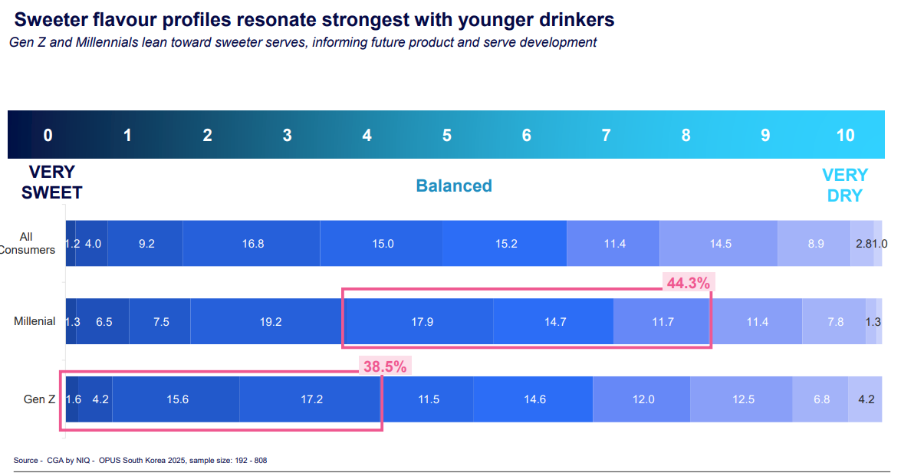
Premium has indeed become central to the South Korean On Premise, resonating most strongly with younger consumers: 25% of Gen Z order more premium or expensive options – 5pp higher than the average consumer – and Millennials follow a similar pattern at 20%. Research shows that Gen Z and Millennials are leaning toward sweeter serves and flavour profiles vs the average consumer.
Mindful drinking is also becoming an increasingly central focus within the Korean On Premise, as 28% of consumers now say they plan to choose healthier options, and 25% intend to drink less alcohol. This trend should not be interpreted as a threat to the industry; it just underscores the importance of having the right offerings available. Stocking drinks that are perceived as healthier or less harmful, including a diverse range of non-alcohol options, allows operators to cater to evolving preferences while maintaining engagement and loyalty. Research shows that Gen Z and Millennials are leaning toward sweeter serves and flavour profiles vs the average consumer.
The premiumisation trend can further support businesses in maximising health-driven trends, as both premiumisation and mindful drinking are primarily driven by younger users. So, to fully capitalise on the category, businesses should focus on offering premium options that align with mindfulness preferences.
A food-led approach
Premiumisation is not only key to understanding what South Korean drinkers order, it also shapes their choices of venues and the frequency of their visits. In fact, under economic pressure, more than three in four consumers would rather reduce their visit frequency than compromise on their choices when out, saving for fewer but higher-quality occasions. Capturing these drinkers at the right time and in the right place requires businesses to have a clear understanding of each channel and a well-defined strategy for engaging them.
As noted earlier, in the current challenging economic climate, food-led venues are proving more resilient than wet-led bars. Indeed, lounge bars and cocktail bars have both seen a decline of just under 30pp in visit frequency versus last year, whereas enduring favourites like traditional Korean eateries and Korean BBQ have experienced a much smaller scale of decrease of less than 10pp. When looking at specific demographics, Korean BBQ has actually gained 7pp among Gen Z, meaning this is a channel to watch closely when targeting younger drinkers. For other food-led channels, the best approach is to prioritise a broader, more mainstream consumer base, focusing on the core portfolio where the strongest growth potential lies. The faster recovery of food-led venues, however, does not mean opportunities are absent in wet-led On Premise. In these channels, businesses should concentrate on a smaller but higher-spending segment, particularly in bars, where the average spend is ₩33,245 ($22), and nightclubs, with ₩37,400 ($25). Once again, younger demographics over-index in these channels, splurging more than their average.
The opportunity in the South Korea On Premise is significant. With one outlet for every 97 people on average, it extends well beyond Seoul. Yet, the larger the scope of the venture, the more nuanced and targeted the strategy must be. To fully succeed in this dynamic and crucial APAC market, every element of the On Premise experience should be carefully considered, with decisions guided by granular data on each outlet, audience, time of day and year, and category.
Unlock On Premise success in South Korea
NIQ’s suite of research services, including OPM and REACH, provides brands and operators with an unrivalled, holistic view of South Korea’s On Premise sector. This enables businesses to address key questions around category, channel, and occasion, and to optimise their sales and marketing strategies.
Our expert team can also deliver bespoke analyses, pinpointing tailored opportunities for individual brands and operators. To explore how our research can enhance your strategies or to learn more about NIQ’s consumer insights for brands, operators, and suppliers, get in touch.