The hidden cost of incomplete beauty measurement
What you can’t see could be costing you market share.
Are you only measuring first-party sales? You could be missing two-thirds of Amazon Health & Beauty sales.
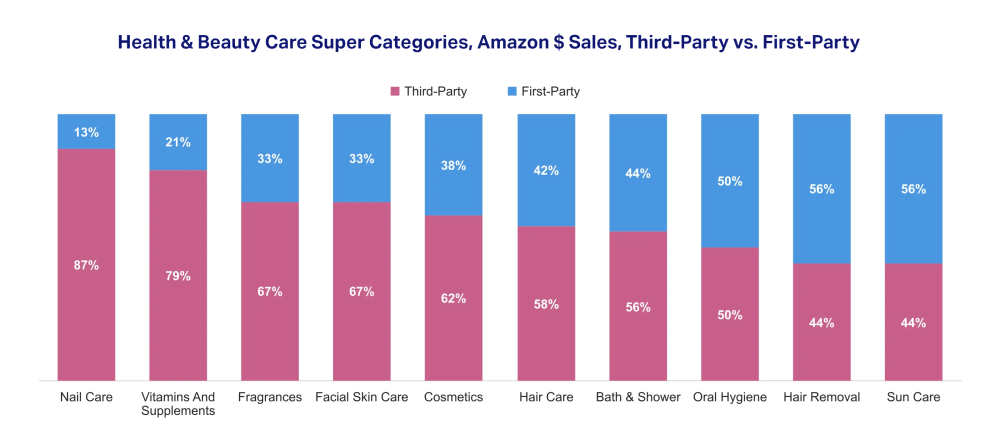
Third-party sales account for about two-thirds of Amazon Health & Beauty sales. Without them, your view of performance, competition, and emerging demand is incomplete.
Download the executive brief to see what third-party sales could mean for your pricing, competitive strategy, and innovation priorities.
Are sales declining, or are you missing where they’re happening? An established mascara product saw first-party sales fall while third-party sales grew. Compare performance and pricing across both before deciding whether a price cut is warranted.
Look beyond your familiar competitors. More than 35,000 beauty and personal care brands sell through Amazon’s third-party marketplace, and some prestige brands generate over 90% of their Amazon sales there. Identify which brands are gaining share in your categories.1
Watch third-party sales for emerging demand. Microbiome hair care illustrates how trends can emerge on Amazon’s third-party marketplace. Track ingredient and product trends to inform which innovation opportunities deserve closer evaluation.
Missing Amazon third-party sales can distort your view of performance, competitors, and emerging trends. Here’s what that means for your next business decision.
Approximately two-thirds of Amazon Health & Beauty sales come from third-party sellers. If your measurement focuses on Amazon’s first-party business, you could be missing a substantial part of the marketplace. 2
What does that mean for your brand?
A product that appears to be losing ground may actually be gaining sales through other sellers. Emerging competitors could be growing before they appear in your reports. And your next big category trend may already be taking shape outside your view.
When you can’t see the full picture, how confident can you be in your next pricing, promotion, or innovation decision?

Are you losing sales or just missing where they’re happening?
Imagine reviewing your Amazon sales and noticing one of your products is losing ground. You might question your pricing strategy, promotional activity, or whether consumers are shifting toward competitors.
But what if shoppers are still buying your product through a different seller?
During our recent webinar, The Beauty Blind Spot: What Health & Beauty Brands Don’t Know About Their Amazon Business, we examined an established mascara product and uncovered an interesting trend. While sales through Amazon’s first-party business declined, third-party sellers were capturing a growing share of the same product’s sales.
Could your next competitor be growing outside your view?
Amazon’s first-party and third-party marketplaces can tell very different stories about which brands are leading a category.
When we analyzed facial skincare, we found notable differences between the top-selling brands across the two marketplaces.
While established manufacturers dominated the first-party rankings, the third-party marketplace featured a different mix of competitors, including emerging and digitally native brands gaining traction with consumers.
For established beauty manufacturers, overlooking these competitors could mean underestimating changes in category share or missing early signs of competitive growth.
The size of this gap also varies by category. In nail care, vitamins and supplements, and facial skincare, third-party sellers account for a particularly significant share of Amazon sales.
Understanding who’s competing across the full marketplace gives brands greater context for evaluating their position and identifying where new opportunities may be emerging.

What if you could spot the next beauty trend earlier?
Some of the most interesting developments in beauty are taking shape long before they become widely recognized across traditional retail.
Amazon Third-Party offers emerging brands a relatively accessible way to introduce new products, test formulations, and build momentum with consumers.
Our analysis of microbiome-related hair care products provides one example.
In 2021, products featuring microbiome claims had a limited presence in the market, with early sales activity concentrated on Amazon’s third-party marketplace. As interest in microbiome, prebiotic, and probiotic positioning increased, Amazon Third-Party became an important contributor to the trend’s growth.
For beauty brands, spotting trends like these earlier can help inform product innovation, assortment planning, and competitive strategies.
Are you tracking where your competitors’ growth goes next?
The relationship between social commerce and Amazon is also changing how beauty brands grow.
Our webinar, The Beauty Blind Spot: What Health & Beauty Brands Don’t Know About Their Amazon Business, highlighted how TikTok Shop and Amazon Third-Party can play complementary roles throughout a brand’s development.
TikTok Shop has become an important platform for product discovery, while Amazon often supports repeat purchases and replenishment.
In the examples we examined, emerging beauty brands initially generated a substantial share of their sales through TikTok Shop before seeing more sales shift toward Amazon Third-Party as they matured.
For manufacturers, understanding these patterns can provide valuable insight into how emerging competitors build momentum and how consumer purchasing behaviors evolve across channels.

Turn a clearer market view into smarter decisions
Incomplete measurement doesn’t just leave gaps in your reports. It can change how you interpret performance, assess competitors, and decide where to invest next.
With greater visibility into Amazon’s first- and third-party marketplaces, you can better understand where sales are shifting, which competitors are gaining traction, and where new growth opportunities may be emerging.
We’re continuing to expand our beauty measurement capabilities through our upcoming Beauty Channel, helping brands build a more connected understanding of the market.
How much of your beauty market are you seeing?
Want to understand what incomplete measurement could mean for your business? Connect with our team to explore what more complete measurement could reveal about your category, competitive position, and growth opportunities.