The New Upgrade Equation: Why Consumers Need a Better Reason to Upgrade
The formula for success in consumer technology was clear: launch something new, make it visible, and consumers would upgrade.
Today, that approach is becoming less reliable.
Consumers remain enthusiastic about innovation, but interest no longer guarantees demand. Across Consumer Tech and Durable Goods categories, shoppers are taking longer to decide, holding onto devices for longer, and scrutinising the value of every upgrade.
For manufacturers and retailers, the implication is significant: innovation remains essential, but it no longer automatically translates into growth.
The challenge is not generating interest. It’s creating a compelling reason to upgrade.
That shift extends beyond technology itself. NielsenIQ’s latest AME Consumer Outlook found that 70% of consumers would rather save their money if a product is not clearly better. At the same time, Consumer Tech Trends research shows many shoppers are delaying purchases because they lack confidence in product quality, are unsure which model to choose, or simply don’t see enough benefit to replace what they already own.
Consumers still want innovation. They just need stronger justification to act.
The Upgrade Cycle Is Changing
Consumers have more information, more product choices, and more ways to compare alternatives than ever before.
At the same time, today’s devices often continue to meet consumer needs long after purchase. As a result, the question is no longer:
“What’s new?”
It’s becoming:
“What’s meaningfully better?”
This subtle shift has major implications for technology brands. Product launches alone are no longer enough to drive replacement demand. Brands must clearly demonstrate why an upgrade will improve the consumer experience in ways that matter.
When that value isn’t obvious, consumers are increasingly willing to wait.
Consumers Need More Than Features
Technology brands have traditionally excelled at communicating features.
Consumers, however, are focused on outcomes.
A faster processor, smarter algorithm, or upgraded specification may be technically impressive, but shoppers are increasingly evaluating technology through a practical lens:
- Will it save me time?
- Will it simplify daily life?
- Will it improve productivity?
- Will it reduce costs?
- Will it deliver a noticeably better experience?
Features create interest.
Outcomes create demand.
The brands succeeding today are not simply introducing innovation. They’re helping consumers understand why that innovation matters.
The New Growth Equation
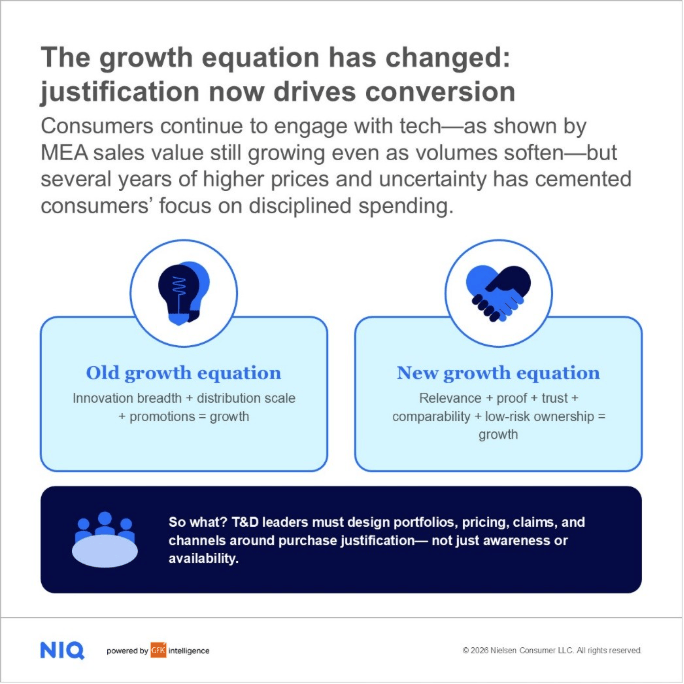
The traditional growth model relied on three familiar levers:
Innovation. Distribution. Promotions.
Those drivers still matter, but they are no longer enough on their own.
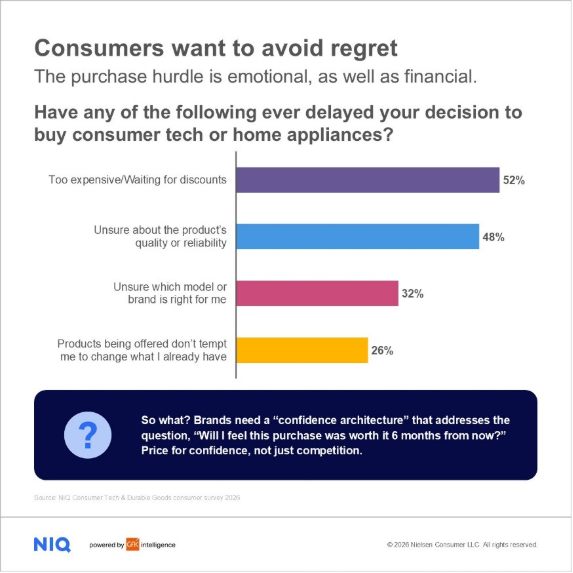
NIQ Consumer Tech Trends research found that 52% of shoppers delayed purchasing technology or appliances because they were waiting for a discount or felt products were too expensive. Meanwhile, 48% delayed because they lacked confidence in quality or reliability, 32% were unsure which model to choose, and 26% couldn’t see a compelling reason to upgrade.
Taken together, these findings point to a new growth equation.
Today’s winning brands must deliver:
Relevance + Proof + Trust + Comparability + Low-Risk Ownership
In other words, consumers need to understand not only what a product does, but why it deserves a place in their lives.
The Consumer Value Equation Has Shifted
The shift underway in technology reflects a broader evolution in consumer decision-making.
According to NielsenIQ’s AME Consumer Outlook, 39% of consumers agree that “less is more” and they don’t need as much to be happy, while 36% have stopped buying certain things altogether to focus on essentials.
This doesn’t mean consumers have stopped spending.
It means they have become more selective.
Importantly, value does not automatically mean lower prices. Consumers increasingly associate value with quality, performance, reliability, convenience, and longevity. They are evaluating purchases based on long-term benefits rather than short-term cost alone.
For technology brands, that creates both a challenge and an opportunity. While consumers are scrutinising purchases more carefully, they remain willing to invest when the value proposition is clear.
Why Some Innovations Succeed While Others Struggle
The technologies gaining the most traction today share one characteristic: they solve a clearly understood problem.
Whether it’s AI helping save time, connected devices simplifying everyday tasks, health-focused technologies supporting wellbeing, or energy-efficient appliances reducing household costs, the value proposition is tangible.
Consumers can see the outcome.
That’s becoming increasingly important as households evaluate purchases through a lens of utility and return on investment.
Innovation still matters.
But consumers are becoming more selective about which innovations deserve their attention and spending.
A Reason to Upgrade
The brands most likely to win in 2027 will not necessarily be those launching the most products or promoting the longest list of features.
They will be the ones that make innovation meaningful.
They will connect technology to real-world outcomes, demonstrate value clearly, and make the upgrade decision feel obvious rather than optional.
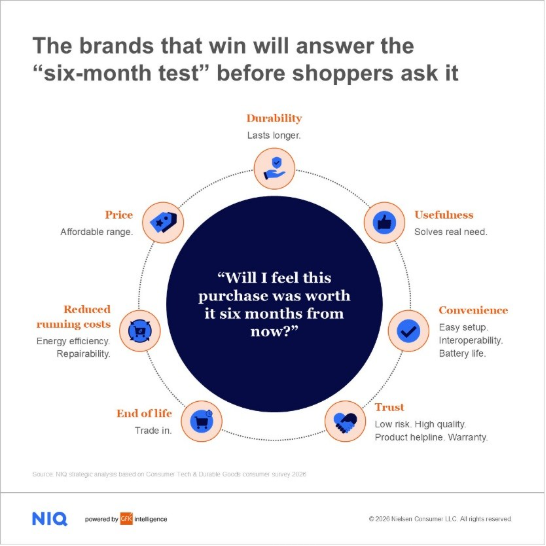
- In practical terms, that means answering five questions before consumers ask them:
- Is it relevant to a real need?
- Are the benefits easy to prove?
- Does the brand inspire trust?
- Is it easy to compare with alternatives?
- Does ownership feel low risk?
Innovation remains essential.
But in a market where consumers are scrutinising every purchase more closely, innovation alone is no longer enough.
The brands that succeed will be those that provide consumers with something even more powerful: A reason to upgrade
Connect with our Tech & Durables experts.
Discover how NIQ can help you create products consumers don’t just want but have a compelling reason to upgrade for.