
Attention is abundant. Brand desire is scarce.
If your brand disappeared from both shelf and search tomorrow, would shoppers notice, care, and actively look for it? Or would they shrug, pick up a competitor, and move on?
These questions matter more in 2026 than they have in decades. Our recent report, CMO Outlook: Guide to 2026, explores how chief marketing officers (CMOs) and brand leaders are tackling problems with no easy answers—such as being pulled toward short-term activation that feeds the top line this year (rather than next year), over long-term brand building.
Although discounts, promotions, and hyper-targeted advertising bursts can spike sales and deliver immediate, measurable results, they rarely build durable brand preference and can erode pricing power over time. There’s also a trap: Activation works best when it has existing brand equity to draw on. Without that foundation of brand equity, you’re spending harder to get less—and the bottom line doesn’t grow.
Getting the balance wrong between short-term activation and long-term growth can mean years of clawing back lost ground. Getting that balance right drives optimum, sustainable success. This is why CMOs must maintain a robust and constantly updated understanding of where their brand stands in terms of irresistibility, how to strengthen the levers of that irresistibility, and how best to convert that irresistibility into maximum sales.

“Short-term marketing can win the moment; brand equity wins the future. When you build memory, meaning, and desire, you earn consumers’ “automatic ‘yes’”—the instinctive choice that reduces friction at the shelf and in search. Your brand becomes a performance multiplier: it makes every channel more efficient, protects pricing power, and delivers resilience when volatility hits.”
—Stacy Bereck, Global Practice Leader, Consumer Insights and Brand
The scarcest resource isn’t attention; it’s brand desire at the moment of choice. Consumers face infinite choices, combined with pressure on their wallets, but they will still seek out—and pay more for—strong brands that feel like a perfect fit for their needs.
So the aim isn’t as simple as “more awareness”; it’s to build brand equity such that your brand becomes the one consumers see as the natural choice—the “automatic ‘yes.’”
Why brand building is essential to in-market performance
A wave of market disruptions continues to impact brand management. Put together, these disruptions are rewriting the rules of brand advantage.
1) AI and retail media are leveling the playing field for reach.
When targeting and optimization are available to everyone, the advantage shifts to what can’t be copied quickly: memory, meaning, and distinctive assets.
This is the uncomfortable truth behind many “performance breakthroughs” driven purely by unsustainable media spend or price promotions. Your competitors can quickly copy and catch up. Real performance breakthrough lies in increasing the value of what algorithms cannot instantly replicate: the brand equity behind a brand that every consumer recognizes, remembers, and feels is “for me.”
2) Economic disruptions are driving volatility.
Consistency isn’t a boring attribute in 2026; it’s a growth strategy. Consumers and brands are facing a barrage of economic disruptions that keep on driving uncertainty and market volatility.
Affordability or cost-of-living pressure is one of those disruptions. When consumers feel uncertain about their household finances, they rethink their purchasing. They’ll snap up a bargain, but they also crave confidence in the product choices they make. Presenting clear value for money is key, and brands that stand for reduced-risk purchases—such as reliable quality and strong after-sales support—gain share even when budgets are tight. Not all shoppers will automatically trade down, but they will trade toward value and certainty.
Changing consumer attitudes are another disruption, with demand being increasingly shaped by trends toward healthier lifestyles, more environmentally conscious consumption, and the needs of aging populations.
The effect of all this is to shift the competitive battlefield from “Who shouts loudest?” to “Who feels like a perfect fit?” The first benefit of a strong brand is that it builds stability and resilience in the face of those storms.
3) Desire: Moving from resilience to a real performance multiplier.
If your brand is the first one that comes into people’s minds—if they have clarity about what your brand stands for—every channel performs better: conversions rise, customer acquisition costs fall, promotions are more effective, and repeat purchases increase.
Desire isn’t a soft outcome; it’s the factor that changes the unit economics of everything you do. The same spend produces different results depending on how passionately the shopper is leaning toward your brand. Brand building is about building the platform that triggers optimal return on marketing investment—not by the marketing working harder, but by reducing friction at every touchpoint.
“What has an irresistible brand ever done for me?”
The answer: A lot more than make you famous.
Put bluntly: Performance marketing without underlying brand desire is renting demand. Brand building is investing in certainty. Here’s how:
A strong brand creates—not just captures—demand.
Brand building expands the future buyer pool and increases the probability that you’re chosen when people enter the market. A healthy brand is the foundation of market penetration.
Activation is great at harvesting existing intent. But growth requires increasing how many people consider you in the first place—and how quickly they choose you once they do. If you only “capture” shoppers after they have already entered the market, you’re locked into a zero-sum auction for the same shoppers. Brands that proactively create demand widen the field.
A strong brand protects price and margin.
Strong brands are about more than volume and penetration. They sustain pricing power, reduce reliance on discounting, and improve mix, which funds future growth.
In a value-pressured world, price isn’t just a number; it’s a trust contract. When a brand is chosen because it’s desired, premium is easier to hold, and you don’t need promotions to prove relevance. That margin headroom is what funds innovation, distribution expansion, and the next wave of marketing effectiveness.
A strong brand improves efficiency across the funnel.
Brand equity reduces friction at every stage. It lifts conversion and makes paid media more productive, lowering the long-run cost to acquire.
This is where many organizations undercount brand value. They see all marketing as an operating expenditure that should pay off immediately (like sales activation). But marketing that builds brand equity is actually a capital expenditure—an investment that pays a higher return in the long run. The real payoff of a truly strong brand is that it builds long-term value and changes the conversion rate of every downstream touchpoint. It’s not an “either/or”; it’s the multiplier on the rest.
A strong brand builds distinctiveness that competitors can’t readily copy.
Consistent communications and a clear brand identity that fits consumers’ aspirations builds “mental availability”—the extent to which the brand comes to mind easily and quickly in the situations where people might buy in that category. This becomes a durable advantage that competitors can’t easily copy.
Distinctiveness is what makes you easy to recognize and hard to confuse; it’s the practical defence against commoditization. When everything else converges, brand distinctiveness keeps you from being swapped out.
A strong brand reduces volatility and increases resilience.
Brands with strong mental availability and a distinctive offer to consumers are less exposed to shocks and recover faster from disruption.
Volatility is expensive. It not only forces reactive promotions but also destabilizes forecasting and erodes confidence in investments. Resilient brands don’t avoid headwinds; they are better prepared to ride out the storm.
A strong brand strengthens negotiating power with retailers and platforms.
Retail partners respond to pull. If consumers are actively seeking your brand, you stop “asking for space” and start earning it. That changes everything—from shelf position to media opportunities to category leadership.
A strong brand enables innovation and stretch.
Brand appeal accelerates consumers’ willingness to try your new products and supports credible extension into adjacent needs and price tiers. A strong brand changes new launches from a gamble into a more predictable growth lever.
Building brand irresistibility with measures that connect to sales, share, and pricing power

“Brand building is about building potential in people’s minds today, which will influence their future purchases. The best way to truly capture brand performance is to simulate these future decisions, today.”
—Trevor Godman, Global Practice Lead, Brand
It’s critical to understand how brand equity translates to actual in-market performance. Aligning brand and sales tracking allows marketing and sales teams to work together more effectively—to collaborate, not point fingers.
Traditional brand measurement has relied on asking people directly about awareness and preferences. But this misses a critical measurement—namely, how brand irresistibility connects to market performance.
That gap is exactly where brand leaders get stuck. You can know your brand awareness is measuring up well and still watch market share slip. You can see good sentiment and still feel like every quarter is a scramble for volume. The job isn’t to measure brand awareness and perception in isolation; it’s to understand whether brand equity is translating into sales outcomes—and what to do when it isn’t.
1) Focus on Brand Strength, not just stated preference
Instead of asking consumers to simply declare which brand they prefer, NIQ focuses on Brand Strength: not just how many people might consider your brand, but how many would choose it—and what they’re willing to pay for it.
This shift enables more rigorous brand strength analysis for CMOs, moving away from measuring inputs to understanding outcomes. Brand Strength, which combines brand appeal and pricing power, is a sharper signal of true brand equity because it reflects the real trade-offs consumers make.
On average, brand strength accounts for 30% of revenue across categories.
Source: NIQ foundational research utilizing NIQ GfK retail panel data
While Brand Strength is a strong predictor of market share, how well brands convert gives key insights on marketing investment.
By comparing Brand Strength to revenue share, we can identify two scenarios where market share is out of line with consumer equity:
- Under-leveraged brands: These brands have strong consumer perception but weaker sales, often due to gaps in activation—pricing, distribution, portfolio, or communications.
- Over-leveraged brands: For these brands, market share outpaces brand strength, signaling heavy reliance on short-term tactics like discounts and promotions, which can erode long-term equity.
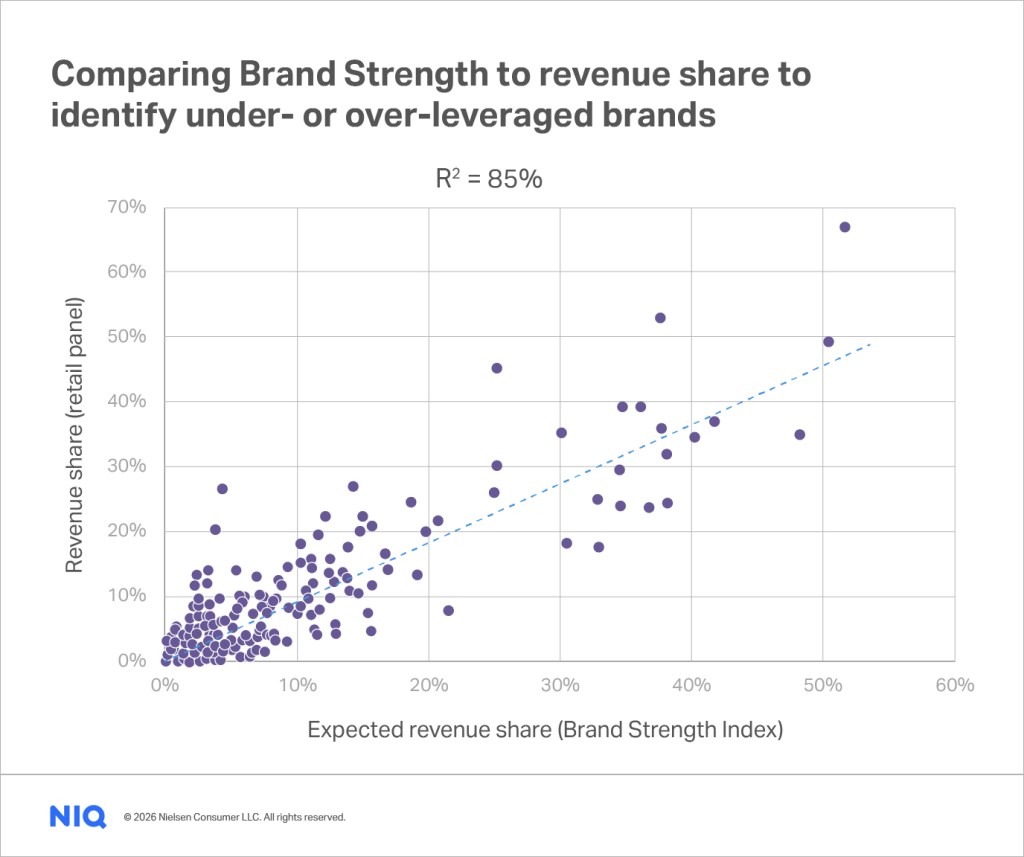
Under-leveraged brands are leaving money on the table and must sharpen activation by identifying how they can better capitalize on their desirability.
Over-leveraged brands risk margin erosion by leaning too heavily on short-term tactics, making them vulnerable when promotions stop or retailers want to list a new entrant. For over-leveraged brands, reinforcing brand strength is a priority.
2) Target the three pillars driving Brand Strength
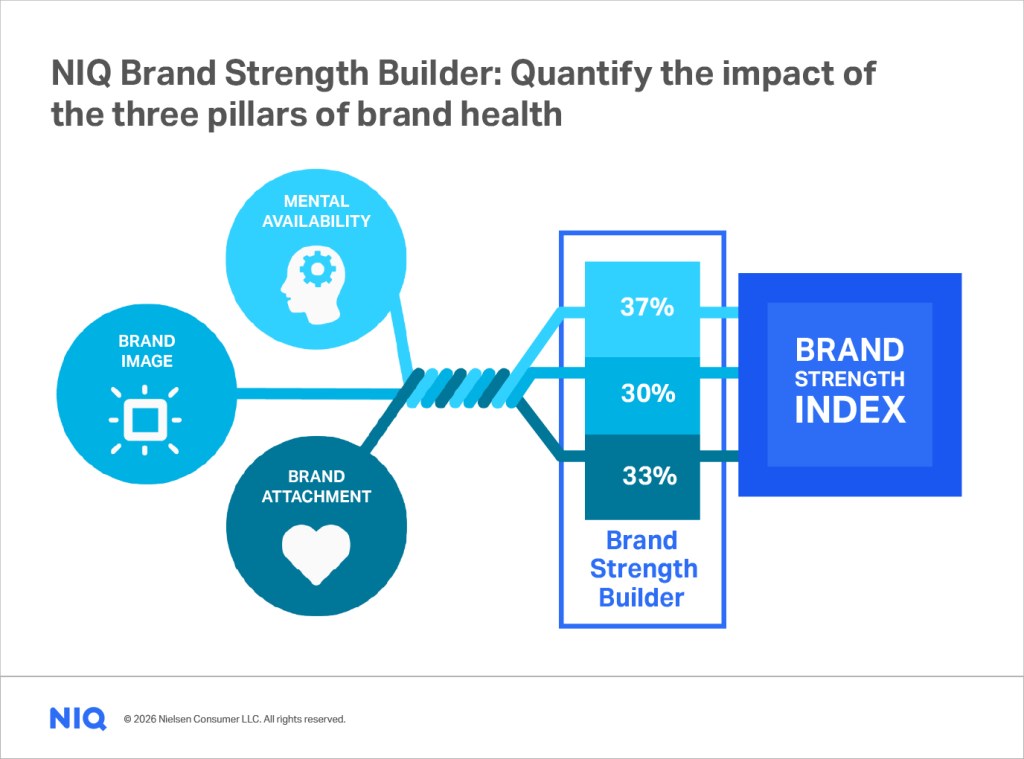
Three pillars, taken together, give CMOs a practical framework for building irresistible brand strength. For brands that are over-leveraged, understanding and strengthening your performance within each of these three pillars is essential:
- Mental availability refers to how easily your brand comes to mind when a consumer thinks about a product category. This is the “memory advantage.” If you aren’t top of mind in the buying moment, you are always playing catch-up.
- Brand image refers to how the brand, its values, and its products are perceived. This is the “meaning advantage” behind brand equity. The brand distinctiveness that determines whether being remembered helps or hurts.
- Brand attachment refers to the emotional bond consumers feel toward your brand. This is the “relationship advantage.” It’s what turns one-off buying into repeat buying—and repeat buying into brand advocacy.
3) Turn Brand Strength into sales, share, and pricing power
Brand irresistibility alone isn’t enough. This is where many brand strategies fail in execution, leading to under-leveraged brands.
A brand can be loved and still underperform if it isn’t activated properly to account for market realities. In these cases, the solution isn’t to build more equity, but instead, to activate existing equity more effectively. That might mean expanding product portfolios, increasing visibility, or refining promotional strategies.
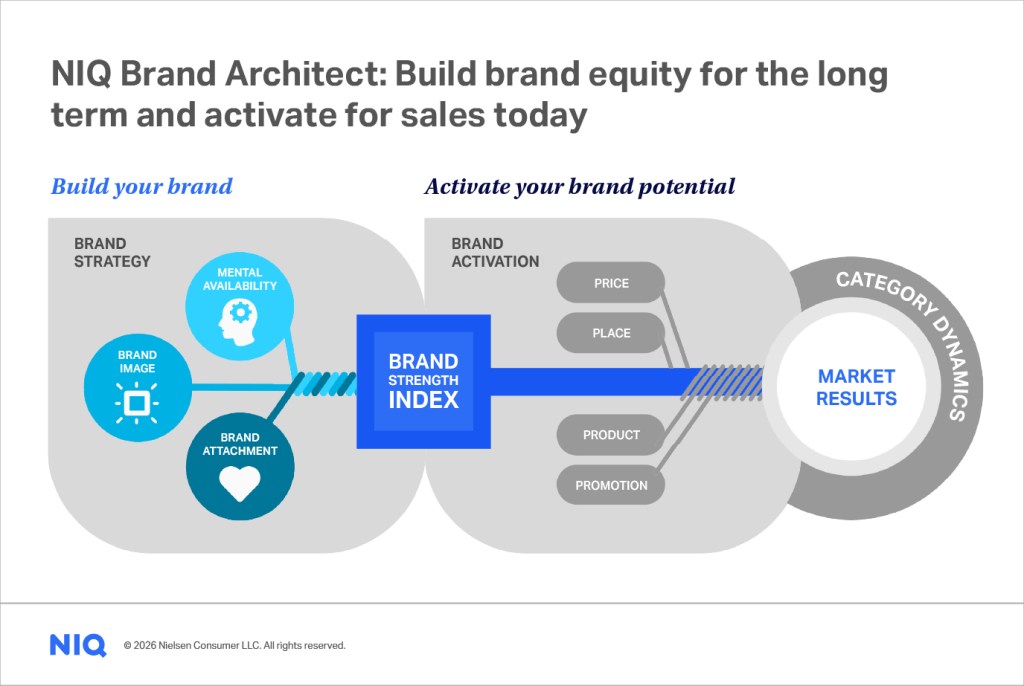
With pressure on CMOs and brand directors to prove return on investment (ROI), it’s vital that they’re able to measure whether market share is based on brand equity or whether it’s inflated by reliance on short-term tactics like price promotion or outsized product portfolios.
Your 2026 challenge:
Be the irresistible brand whose presence adds equity in the shelf space
In 2026, the most successful brands won’t be the loudest; they’ll be the easiest for consumers to choose—and the hardest for them to replace.
That outcome comes from two lines of work, executed together:
- Be the brand people immediately think of and want to buy. That’s irresistibility.
- Be available where they shop, with the right product, and the right price point. That’s activation.
For CMOs, this means understanding your brand’s balance: Do you need to become more irresistible? Or are you failing to capitalize on existing brand potential through the way you show up in distribution, assortment, pricing, and activation?
If your goal for 2026 is to be the brand consumers see as the obvious choice, the brand whose presence adds equity in the shelf space, then your roadmap is clear: Measure what makes you irresistible, fix the specific levers that drive strength, and ensure your activation model converts equity into sales performance.
Our e-book, How to Build an Irresistible Brand, provides a comprehensive guide to creating a brand that not only stands out but drives tangible business results.


For marketing leaders, delivering growth depends on your ability to build a strong, resilient brand that endures through change.
NIQ’s Brand & Media solutions help you accomplish this with data and expertise that put the consumer at the heart of your brand and marketing strategy. Contact us today.