
- Spring weather saw shoppers spending more at major UK supermarkets, with sales up +9.3% (w/e 14th March).
- Earlier than usual Easter offers accounted for 24% of sales purchased on promotion, which is ahead of this time last year.
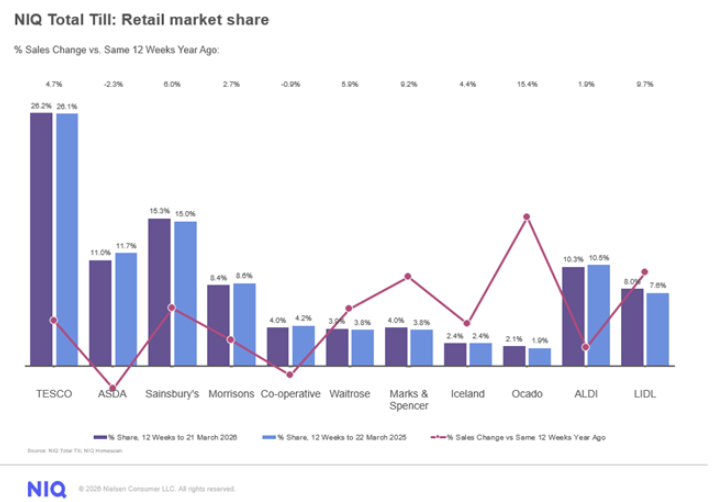
- Ocado was the fastest growing retailer (+15%), ahead of Lidl (+9,7%) and M&S (+9.2%), while Morrisons (+2.7%) improved sales growth.
London, 1st April 2026: Total Till sales at UK major supermarkets grew (+4.3%) in the last four weeks ending 21st March, following subdued (+3.3%) growth in February, according to new data released today by NielsenIQ (NIQ). This growth is due to Mothering Sunday falling two weeks earlier in the calendar than last year and shoppers getting a head start on Easter shopping.
The week before Mothering Sunday, ending 14th March, saw a brief interlude of warm Spring weather, which coincided with a surge in sales (+9.3%) at the major UK supermarkets and contributed to an extra £17 million of spend as UK shoppers splashed out on gifts. 1
The data shows that the frequency of visits to stores was down for the second month running (-1.1% YoY). This is reflected in online shopping behaviours as e-commerce remains the fastest growing channel with value sales growth accelerating (+10.6%)2 and market share increasing to 13.9%.
Celebrating events like Mothering Sunday and shopping ahead for Easter helped to boost category growth in the last four weeks. As well as Mothering Sunday gifting, Easter promotions appeared earlier online and in-store this year, with data showing an increase in chocolate confectionery sales (+22% value, +7.9% units), and a boost in sales for Easter Eggs (+44% value, +37% units) on this time last year when Easter was later. When compared to the same Easter build last year unit growth for Easter Eggs was an encouraging +6.6%.3
The phasing of Mothering Sunday also brought a boost to Boxed Chocolates value sales (+58%), Champagne (+44%) and Flowers and Plants (+30%).3 This also contributed to the average spend per visit across the store rising YoY (+4.2%), totalling £20.29. 4
M&S in particular had a strong performance in the last 4 weeks, due to Mothering Sunday spend, helped by Remarksable Value pricing, strong ‘Dine In’ offers as well as innovative new seasonal flavoured products, including its viral hot cross buns. This reflects NIQ Homescan survey data that showed 21% of households would be persuaded by exciting new flavours to buy new grocery products. 5
Meanwhile, Ocado (15%) continues to be the fastest growing retailer growing market share as well as Sainsbury’s (+6%), Waitrose (+5.9%) and Tesco (+4.7%). Lidl grew sales by +9.7%, reaching a 12-week market share high of 8%. Morrisons (+2.7%) also improved sales. Whilst Asda (-2.3%) lost market share, the decline in shopper numbers is slowing.
Mike Watkins, Head of Retailer and Business Insight at NielsenIQ, said: “Mother’s Day landed two weeks earlier this year versus last, helping to drive strong value growth of +9.3%1 week ending 14th March at the Grocery Multiples with the grocery e-commerce channel and other e-commerce retailers experiencing the fastest growth. Growth may also have been supported by warmer weather earlier in the month, alongside shoppers stocking up ahead of Easter in categories such as confectionery.”
Watkins continues: “Regarding inflation, it will take some weeks for supply chain cost increases to be reflected in the sales data, due to the Middle East conflict trickling down into retail prices. However, concerns about the wider economic situation have already started to influence Consumer Confidence as the GfK index fell further this month to -21.”
Watkins concludes: “Easter is looking good for the industry, but there are storm clouds on the horizon. As well as the downside from the offset comparatives later in April, shoppers now have concerns around rising prices and the wider economic uncertainty. So, whilst this has not yet impacted FMCG performance, rising fuel prices are likely to have a knock-on effect on shopper sentiment and spend post-Easter, as shoppers, remembering the period of high inflation in 2023, could start to batten down the hatches.”
Table: 12-weekly % share of grocery market spend by retailer and value sales % change
Notes
Unless otherwise stated all data is NIQ Homescan Total Till.
1 NIQ Scantrack Grocery Multiples 1 WE 14.03.26
2 NIQ Scantrack eCommerce (Defined Multiple Grocers)
3 NIQ Scantrack Total Coverage
4 NIQ Homescan FMCG
5 Homescan Survey March 2026
About NIQ Homescan Total Till
NIQ’s continuous panel of 30,000 GB households and our widest read of retailer performance is designed to measure household purchasing through major supermarkets intended for in-home consumption and brought back into the home. It includes all food and drink, household, and personal care and an estimate of non-food spend (e.g. clothing, electrical, cards and stationery, newspapers & magazines, toys, music, general merchandise, etc.).
About NIQ
NielsenIQ (NYSE: NIQ) is a leading consumer intelligence company, delivering the most complete and trusted understanding of consumer buying behavior and revealing new pathways to growth. By combining an unmatched global data footprint and granular consumer and retail measurement with decades of AI modeling expertise, NIQ builds decision systems that help companies turn complex data into confident action.
With operations in more than 90 countries, NIQ covers approximately 82% of the world’s population and more than $7.4 trillion in global consumer spend. Through cloud-based platforms, advanced analytics and AI-driven insights, NIQ delivers The Full View™—helping brands and retailers understand what consumers buy, why they buy it, and what to do next.
For more information, please visit www.niq.com.