
Author : Sophie Lee, Senior Client Insights Consultant CSM | Market Intelligence | Tech & Durables, NIQ

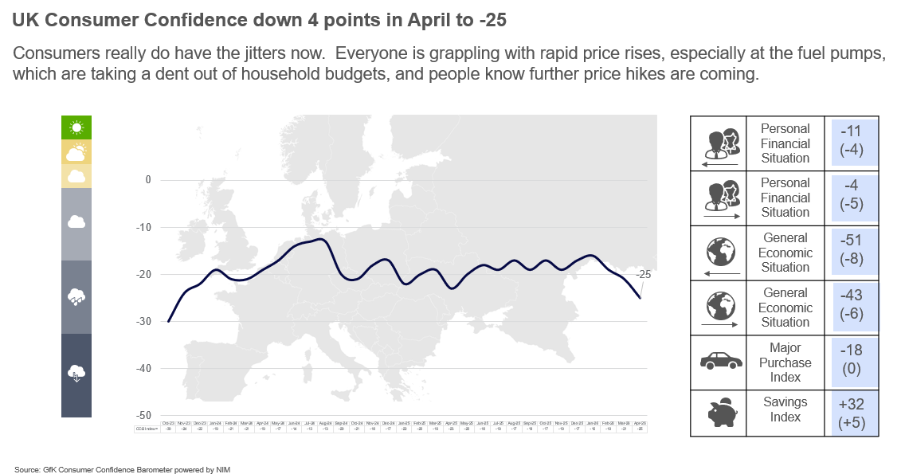
NIQ-GfK’s UK Consumer Confidence Barometer fell by four points in April to -25, marking the third consecutive monthly decline and the largest drop in a year. Confidence is now at its lowest level since October 2023 (see chart 1).
This movement relates to perceptions of the UK economy: views on the economic situation over the past 12 months declined by eight points, while expectations for the next year fell six points to -43, the lowest since February 2023. Earlier resilience around personal finances has also softened. Both retrospective (-11) and forward looking (-4) personal financial indicators fell month-on-month.
The Major Purchase Index, which measures whether consumers feel it is a good time to make a significant purchase right now, remains flat, subdued at -18. Continued price pressures, particularly rising fuel costs, are weighing heavily on household budgets, with further increases still widely expected by shoppers.
The only area to improve was savings, which usually reflects caution rather than optimism, as households seek to protect themselves against ongoing uncertainty. Overall, consumer confidence continues to worsen, with energy and fuel costs acting as persistent reminders of inflation.
Against this backdrop, how has the Major Domestic Appliances (MDA) market performed over the 12 months to March 2026 compared to the same period prior?
The market for Major Domestic Appliances has remained resilient
Despite challenging economic conditions, the MDA market remained relatively resilient in the 12 months to March 2026, with volume up 2% and value sales broadly flat at 0.4%. This is due to a 3% decline in average selling prices, representing the second consecutive year of price decrease following strong pandemic and post-pandemic growth between 2021 and 2023, driven by elevated home improvement activity.
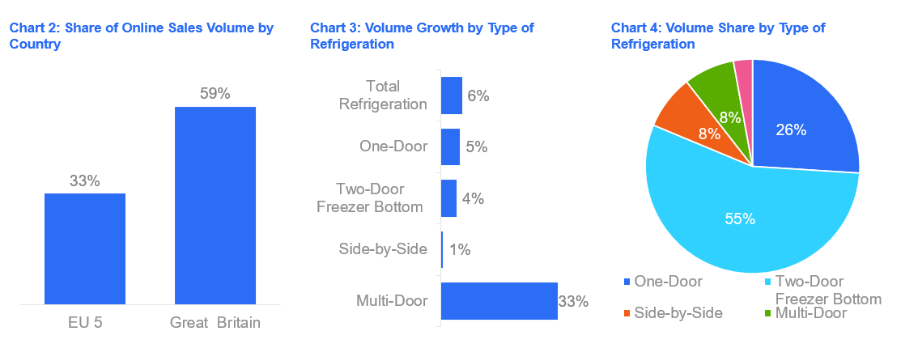
Both built-in and freestanding appliances recorded volume growth, with freestanding continuing to dominate. It now represents 71% of the total MDA market volume, up 3%. Online sales remain central to performance, accounting for 59% of the total MDA market volume, up 7% (see chart 2). While penetration has eased from pandemic highs, it remains above pre-COVID levels, confirming a structural shift in purchasing behaviour.
Across EU5 (Great Britain, France, Germany, Spain and Italy), similar trends are visible. However, online represents just 33% of the total EU5 MDA volume, highlighting the particular importance of online retail in Great Britain.
Rising household bills continue to push energy efficiency up the agenda. Across the four Great Britain MDA categories using the 2021 energy label (washing machines, fridges, dishwashers and freezers), 40% of volume sales were A rated, up 28%. This was largely driven by washing machines, where 85% of sales were A rated, up 26%.
Refrigeration: A standout category
Refrigeration was one of the strongest-performing categories in the 12 months to March 2026. As the second-largest MDA segment, it saw 6% volume growth and 3% value growth, despite a 3% decline in average selling prices, outperforming the total market.
Freestanding models account for 83% of refrigeration volume, up 5%, reinforcing wider MDA market trends.
Energy efficiency penetration remains lower than in other categories. A-rated models account for only 1% of total refrigeration volume, although this is up 32%.
Two-door freezer bottom refrigeration (bottom freezer combis) remains the largest segment, representing over half (55%) of total refrigeration sales volume, up 5% (see chart 3).
The strongest growth came from large, multi-door refrigeration (three+ doors/drawers), up 34% and accounting for 8% of total sales volume, driving most of the overall refrigeration market growth. While side-by-side remains the second-largest format, it faced the most pressure along with one-door refrigeration (see chart 4).
Growth was strongest in entry-level and mass-market segments, while premium contracted slightly. The exception was multi-door refrigeration (three+ doors/drawers), where increased competition supported premium momentum.
Need is driving the demand for refrigeration
‘Gfknewron Consumer’ shows that replacing faulty appliances is the main purchase trigger. Price and product dimensions remain the top decision drivers, followed closely by features such as energy efficiency and frost-free technology. In a constrained environment, consumers are prioritising practical value.
Looking ahead: Innovation and adoption
Innovation, particularly AI, continues to generate interest. Global technology events such as IFA and CES have highlighted refrigeration developments including food recognition, stock monitoring, recipe suggestions, AI optimized compressors for freshness management and more.
However, while the smart MDA market is growing (up 16% by volume, with smart refrigeration up 35%), it remains relatively niche. Smart products account for 22% of total MDA volume and 12% of refrigeration volume, suggesting innovation does not always translate to immediate mass adoption.
With refrigeration replacement cycles averaging 6 to 10 years according to ‘gfknewron Consumer’, demand may strengthen as the market moves beyond the pandemic replacement peak. Products that successfully combine innovation with clear, everyday value are likely to be best positioned for future growth.
Source: NIQ Point of Sales Tracking | Tech & Durables Cooling market | gfknewron Consumer | April 2025 – March 2026 V April 2024 – March 2025.
NB: This article was originally published in the Summer 2026 edition of IER e-magazine

Turn Insights Into Action
Gain deeper insights into refrigeration market trends, consumer demand drivers, and growth opportunities to stay ahead in a changing market.