
How Brands Can Measure Incrementality and Prove Retail Media Impact
Executive Summary
Retail media has outgrown its hype phase. US retail media spend is on pace to reach $107.6 billion in 2026 — nearly triple where it stood five years ago — and brands are no longer satisfied with reach and impressions alone; they want proof that spend is creating sales that would not have happened otherwise (NIQ, The Commerce Revolution). That proof is called incrementality, and it remains one of the most contested terms in the industry, despite growing investments in retail media.
Incrementality is not a mythical or unmeasurable concept. While most practitioners agree on its meaning, proving it requires the right data, infrastructure, and methodology. What breaks down is everything underneath that definition: the data, infrastructure, and organizational discipline required to prove it. This piece, informed by themes explored in NIQ’s Incrementality: Myth or Reality? podcast with Incremental, breaks down where brands go wrong, and the foundations that separate brands that can prove impact from those still guessing.
Key Takeaways
- Incrementality has a simple, widely agreed definition — the sales that would not have happened without a specific dollar of spend — but almost no brand has the foundation required for accurate incrementality measurement.
- Last-touch and multi-touch attribution explain how a purchase happened, not why — and using ROAS as a stand-in for incrementality is one of the most common, and costly, mistakes in retail media.
- Real measurement rests on three foundations: complete data, the infrastructure to harmonize it, and a methodology robust enough to substitute for the controlled experiments retail media rarely allows.
- NIQ’s own research confirms the stakes: incrementality and cross-channel measurement rank as brands’ top measurement pain point, even as retail media budgets climb toward $108 billion.
- The winning approach starts with the 10–20 decisions a brand actually needs to make, then works backward to the data required — not the other way around.

Incrementality Was Never the Hard Part to Define
Ask a room full of retail media practitioners to define incrementality and, perhaps surprisingly, they will largely agree: incrementality is the causal impact of a dollar spent — what happened, or what value was created, that would not have occurred otherwise. The definition, in other words, was never the fight.
The fight is over-proof. This is where effective incrementality analysis becomes far more challenging than attribution alone. Last-touch and multi-touch attribution can describe precisely how a purchase happened — which ad, which click, which page a shopper landed on — but they say almost nothing about why. A shopper might see a product on social media, get curious, then search for it directly on a retail site and buy it there; the attribution model credits the search, when the actual driver of the sale happened somewhere else entirely. Multiply that gap across a brand’s full media and commerce footprint, and it is easy to see why so many brands have a number they report, but do not fully trust.
Where ROAS Quietly Misleads
ROAS is not a bad metric, but it is often mistaken for proper retail media measurement. Treating it as an incrementality answer is a category error, and an expensive one. It measures efficiency, not causality: it tells a brand where its budget went, not what that budget actually created. Because retail media rarely allows the kind of controlled testing available on platforms like Meta or Google, ROAS and last-touch data have become the default optimization signal almost everywhere, even though neither was built to answer the incrementality question.
The unreliability runs deeper than most brands realize. No two retailers calculate ROAS the same way, the underlying formulas are frequently opaque, and independent academic research cited in NIQ’s own CMO Outlook: Guide to 2026 found that switching methodologies alone can shift the resulting number significantly — making it a shaky foundation for comparing performance, evaluating marketing effectiveness, or proving causality.
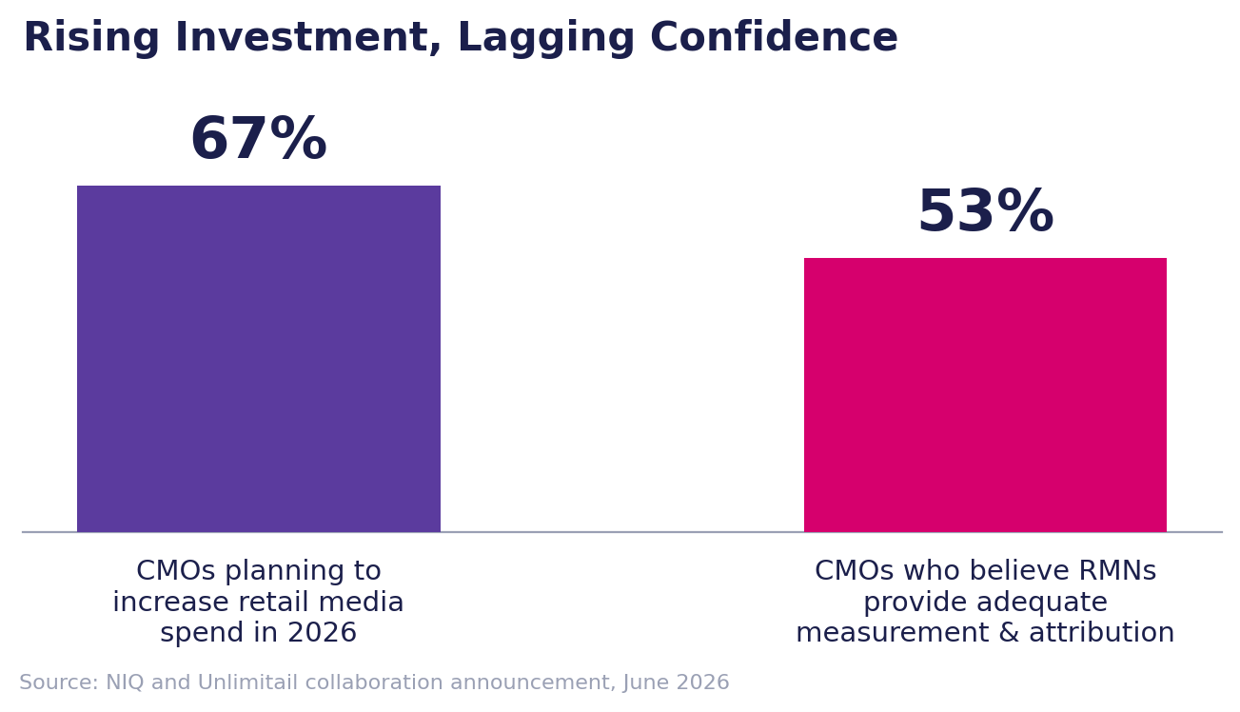
NIQ’s market research shows how widespread the resulting pain point has become. As retail media has scaled toward $107.6 billion in the US alone, brands are increasing spend faster than their confidence in measuring it: 67% of CMOs plan to increase retail media investment in 2026, yet only 53% believe their retail media networks provide adequate measurement and attribution to support reliable incrementality measurement (NIQ and Unlimitail, June 2026). Incrementality and cross-channel measurement top brands’ list of measurement pain points.
The Foundations Nobody Wants to Build
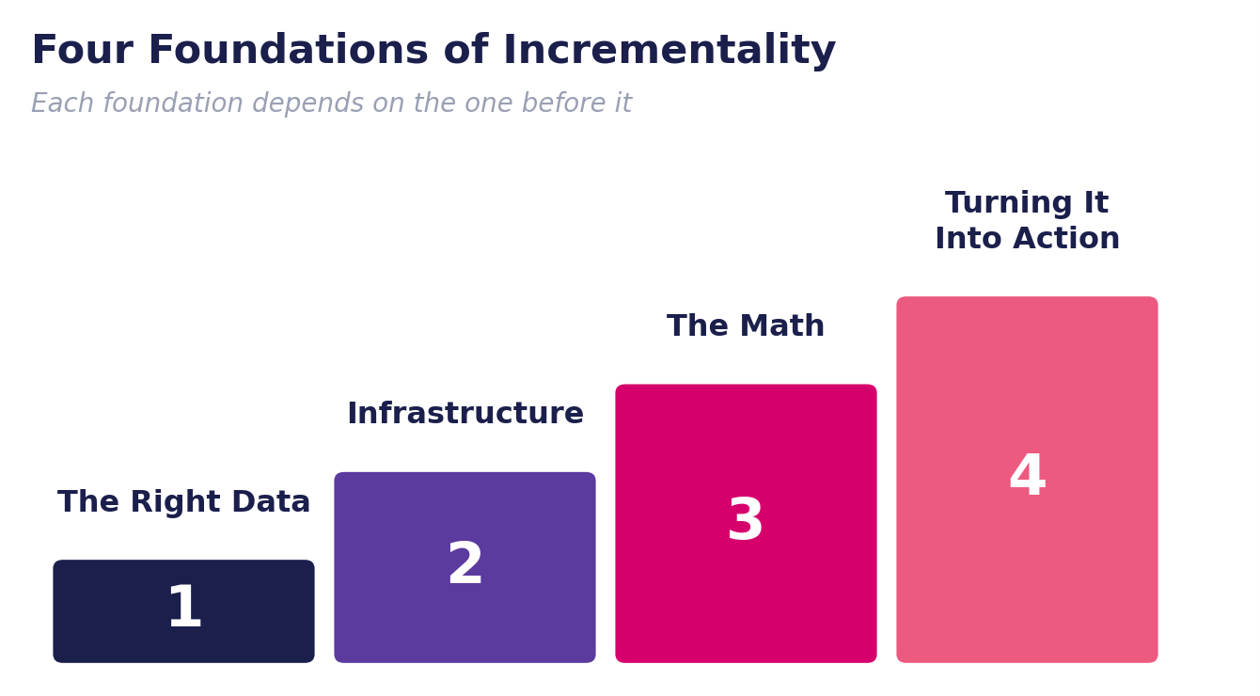
Foundation one: the right data
Incrementality cannot be measured from media data alone. It requires visibility into the full conditions of commerce surrounding every purchase: price, promotion, organic and paid rank, ratings and reviews, buy-box ownership — the entire digital shelf — alongside retail distribution data. Consider, for example, a brand that does not know one of its products moved from 2,000 doors of distribution to 3,800 in a single reset: it would have no way to separate that effect from whatever else changed during the same period.
Foundation two: infrastructure
Having the data is not the same as being able to use it. Harmonizing and cleansing disparate sources is foundational to any credible incrementality analysis — media, digital shelf, retail sales — into something a model can actually run on is, by most accounts, the majority of the real work. It is also the least glamorous and most chronically underfunded part of the process.
Foundation three: the math
Because retailers rarely support the randomized controlled trials or geo-lift tests that would make causality easy to prove, credible measurement has to substitute an ensemble of methods: econometric regression modeling similar to standard marketing mix modeling, designed experiments where a retail partner allows them, and “passive experimentation” — identifying naturally occurring situations where only one variable changed and treating them as a proxy for a controlled test.
Foundation four, and the most overlooked: turning the number into action
Most brands do not actually suffer from a lack of data — they suffer from an inability to convert a trustworthy number into a clear next move. Building that organizational muscle may be the hardest foundation of all to lay, precisely because it is a people and process problem rather than a technical one.
Why It Has to Be a Living Number
Marketing mix modeling (MMM) remains a legitimate and valuable tool for setting high-level budget allocation two or three times a year. But it was not built for the pace or granularity retail media now demands. Knowing that “Amazon media returned 1.7x” does not tell a brand which keywords or audiences to adjust tomorrow morning. The strongest version of incrementality measurement runs at the daily, campaign level — matching the actual cadence at which purchases happen, and compressing the distance between measurement, insight, and activation. That matters more, not less, as automated bidding and AI-driven activation take on a larger share of day-to-day decisions.
It also has to account for a simple reality about shoppers: they are not neatly online or offline. NIQ research finds that 91% of consumers now buy products both in-store and online, moving fluidly between channels and retailers, often switching the moment a preferred product is not available where they first looked. Measurement that treats any single channel in isolation will always underestimate what is actually happening and distort true ROI media calculations.


So What: What Brands and Retailers Should Do Next
For Brands
- Start from the 10–20 decisions you actually need to make, and work backward to the minimum data required — not forward from whatever data you happen to already have.
- Treat digital shelf signals (price, rank, ratings, availability) as a required input to incrementality measurement, not a separate reporting exercise.
- Combine methodologies rather than betting everything on one: using incrementality testing where possible to validate measurement outcomes; use MMM for strategic, infrequent allocation decisions, and always-on, campaign-level measurement for tactical ones.
- Build the internal capability to act on a number, not just the model that produces it.
- Stop using ROAS as a proxy for incrementality, even as a stopgap — it will actively point budget in the wrong direction.
For Retailers
- Make performance data available to brands, their agencies, and their chosen measurement partners rather than holding it back.
- Invest in in-market experimentation infrastructure — geo-lift and RCT capability — inside retail media programs.
- Recognize that no single retailer can solve incrementality for a brand operating across dozens of them; collaboration on standards and data-sharing strengthens the case for retail media as a channel for everyone.
Looking Ahead
Incrementality, in the end, is not a myth — it is a discipline, and a demanding one. That equation is about to get higher-stakes, not lower. As agentic commerce and automated activation take on more of the day-to-day decisions in retail media, AI systems will increasingly act on whatever measurement they are given making accurate retail media measurement more important than ever — good or bad — at a speed no human reviewer can match. Brands that treat data quality, harmonization, and organizational readiness as sequencing work to start now, rather than a problem to solve once a “perfect” model exists, will be the ones actually able to trust, and use, every dollar’s worth of proof.


Ready to Build Measurement You Can Trust?
If you’d like to explore how NIQ can help you structure your commerce data, measure AI-driven discovery, and build the foundation agentic commerce requires, we’d love to connect with you. Contact us to speak with an NIQ expert, or learn more about NIQ’s Digital Commerce solutions
1. NIQ, Incrementality: Myth or Reality? (podcast)
2. NIQ, The Commerce Revolution: Where East Meets West, 2026
3. NIQ, CMO Outlook: Guide to 2026
4. NIQ and Unlimitail, collaboration announcement, June 2026