
A welcome from
The consumer packaged goods (CPG) industry is undergoing a profound transformation—perhaps the most significant in decades. Artificial intelligence (AI), agentic commerce, and large language model (LLM) product discovery are rewriting the rules of growth at extraordinary speed. The New Growth Frontier: How AI and agentic commerce tilt the scales toward challenger brands, a collaboration between NIQ and Kearney, explores what this transition means—and what brands of all sizes need to know to get ahead.
For years, competitive advantage has been shaped by scale: think bigger budgets, broader distribution, and robust R&D pipelines, for example. But AI-democratized capabilities and new search and discovery pathways have made it possible for today’s emerging brands to innovate, test, and reach consumers with a level of precision and speed that wasn’t previously possible for them. Large manufacturers, meanwhile, are facing increasing pressure to reinvent the very systems that sustained their leadership.
This moment is more than another wave of digital transformation. It’s a structural reset of how consumers decide, discover, and buy—and importantly, how brands are evaluated by the algorithms influencing those decisions.
For large, established brands, go-to levers like mergers and acquisitions are no longer enough. Legacy players must reinvigorate innovation pipelines and compete for visibility in an environment where agents now reward the most relevant answer—not the biggest media budget. Those who can modernize their operating models, apply AI with strategic intent, and embrace the speed and adaptability that have propelled emerging brands forward will be best positioned to lead.
For emerging and challenger brands, this shift represents an unprecedented opening. Agentic commerce and AI‑powered tools reduce barriers that once constrained their ability to move quickly or compete for visibility. With agility, consumer understanding, and a willingness to take creative risks, these brands are seizing momentum—innovating faster, resonating more deeply, and winning share in categories historically dominated by established players.
For retailers, the implications are equally significant. As AI reshapes how shoppers navigate online and in‑store environments, retail media networks and search experiences are evolving in real time. Retailers who embrace these technologies—integrating agents, enabling new forms of discovery, and aligning their platforms with LLM‑driven journeys—will be the ones who capture future value and deepen consumer loyalty.
Across this landscape, one theme is unmistakable: The window of opportunity is open, but it won’t be for long. Manufacturers and retailers that act now, with intentionality and speed, can redefine their competitive standing for the decade ahead.
We hope this analysis equips you with clarity, urgency, and practical direction as you navigate this transformation. Together, NIQ and Kearney are committed to helping the industry move forward with confidence—grounded in data, powered by technology, and focused on what matters most: creating meaningful value for consumers.


Key takeaways:
- Company size and scale have often predicted “success” when it comes to CPG growth.
- But this dynamic might be on the verge of shifting, thanks to three forces in position to reshape the CPG industry: the rise of agentic commerce, the AI-powered democratization of capabilities that once required large budgets and resources, and the recent emergence of LLM advertising.
- For CPG brands, there’s no longer a question of whether change is coming but how quickly they can reset their playbooks to keep pace, as agentic commerce and AI in retail continue to grow. Success will go to brands that innovate for the consumer need state—and can prove it by showing up meaningfully in an LLM environment.
- This analysis, produced in collaboration with Kearney, is based on NIQ’s global retail measurement data, covering 90-plus countries and approximately $7.2 trillion (USD) in consumer spend, as well as NIQ’s Innovation Measurement data and joint NIQ–Kearney analysis of AI-mediated commerce trends.
The rules of CPG growth are changing
For decades, CPG size and scale meant leverage. From expansive R&D pipelines to securing distribution, large brands could outspend and absorb failure in ways that smaller players couldn’t, often translating to their growth success. Speed and agility mattered but was usually secondary to size, funding, and operational capacity.
Today, that dynamic is shifting. Margin, budgets, and speed-to-market timelines remain compressed, and organizations are being tasked with meeting evolving consumer needs, reducing risk, and delivering outsized impact.
As a result, many brands are defaulting to the most familiar or accessible growth levers. Line extensions and mergers and acquisitions (M&As) can offer short-term wins, but neither has proven to be a reliable driver of long-term, sustainable growth—particularly in an environment where challenger brands fight for share and consumer dollars are stretched.
The solution: innovate around consumer need states and develop a discoverability strategy, which helps to build brand awareness, trust, and lasting loyalty.
As AI reshapes the what, where, and how of consumer behavior, purchasing decisions, and products that will win on shelf, the implications are clear: For smaller brands, there’s a window of opportunity to go on the offensive, strategically leveraging AI to elevate innovation quality and optimize relevance in LLMs. For established CPG brands, there’s an imperative to refocus innovation pipelines and take cues from their smaller counterparts, drawing on AI, where appropriate, to accelerate the pace at which they adapt to this continually evolving environment.
There’s no longer a question of whether change is coming, but how quickly brands can reset their playbooks to keep pace.
Size and scale still matter, but when it comes to innovation and the new era of discoverability, they’re no longer the only—or even primary—determinants of competitive advantage. Three forces are accelerating this shift:
- The rise of agentic commerce
- The artificial intelligence (AI)-powered democratization of capabilities that once required large budgets and resources
- The emergence of large language model (LLM)-driven advertising
Together, these forces are reshaping how brands innovate, establish relevance, and capture value across the CPG ecosystem:
- For emerging and challenger brands, these forces are reducing the barriers to entry and scale.
- For large and established players, they’re eroding advantages that once felt durable.
- For retailers, they’re redefining the rules of discovery, assortment, and monetization.
Reset your playbooks

Winning brands
Make sure innovation is tied to consumer need states and consumer demand
Your next step
Prioritize data-backed, consumer-led product design rooted in category dynamics, functional benefits, and multi-benefit need states.

Winning brands
Use AI to enhance and optimize their innovations, applying it to functions that strengthen decision-making and accelerate timelines.
Your next step
Apply AI strategically across ideation, testing, and formulation to reduce time to market while improving decision quality.

Winning brands
Activate for agentic commerce and LLM discovery to ensure products are visible in searches and retail AI systems
Your next step
Shift from product-centric to consumer-goal-led activation, ensuring products and messaging are relevant and aligned with how consumers search and how products are discovered in LLM environments.

Winning brands
Win early, or risk failure
Your next step
Focus relentlessly on early distribution, velocity, and post-launch measurement to course correct during the critical first weeks in market.

“In a small business, we wear so many hats. AI helps us operate like a much larger organization. It bridges the resource gap in a really meaningful way.”
—Phuong Tran, Category Lead & Demand Planning Manager, Dose
The innovation imperative
A new era of advantage
When it comes to speed and agility, emerging brands have always had an edge. With fewer bureaucratic barriers for risk taking, challengers often lead digitally, leaning into bold and culturally relevant messaging, viral social trends, and brand or influencer partnerships. Now, the democratization of capabilities brought by GenAI are empowering them to gain even more ground.
To better understand the dynamics at play, we interviewed stakeholders from some of the fastest-growing emerging brands across the globe, digging into their innovation processes and how they’re leveraging AI in their day-to-day functions—including AI in product innovation.

AI proponents argue that the technology is leveling the playing field for brands of all sizes. Phil DeConto, Vice President of Sales, Strategy, and Trade Marketing at Cibo Vita, agreed, noting that it’s helping smaller brands “punch above their weight class” across a number of functions while also reducing barriers for capabilities—think concept tests, iterative creative development, and shelving simulations—that historically favored larger brands and six-figure budgets.
Our stakeholders also commonly cited benefits like sophisticated data capabilities, analytical infrastructure, and process transformation. In the past, smaller enterprises “spent a lot of time on strategy and little on process,” said Antonio Lanzone, a Trade Marketing Specialist at Andriani S.p.A. Benefit Corp. “AI helps us reverse that. With an efficient process, we can create a better strategy.”
But even as AI capabilities expand into seemingly infinite possibilities, our stakeholders noted that use case remains the most important criterion. “Our approach is very pragmatic,” said Florian Hartmann, Sales Director of ahead nutrition. “AI needs to directly improve speed, decision quality, and execution in store.”
According to Hartmann, one of their biggest impact drivers has been their partnership with a startup to co-develop an AI-native, retail CRM. Not only is the platform customized for their business and market needs, its ability to contextualize information like buyer personas and interaction history also enables more relevant conversations for their sales teams.
How emerging brands are leveraging AI
- Research: competitor benchmarks and SWOT analyses, consumer and market deep dives
- Data analysis and synthesis: faster insights generation for sales, market, and consumer data; survey summaries
- Product development: early-stage ideation, concept development, formula optimization
- Marketing: creative iteration, photo editing, mock-ups, copywriting
Emerging brands are gaining ground thanks to tech advances that empower them to move more swiftly
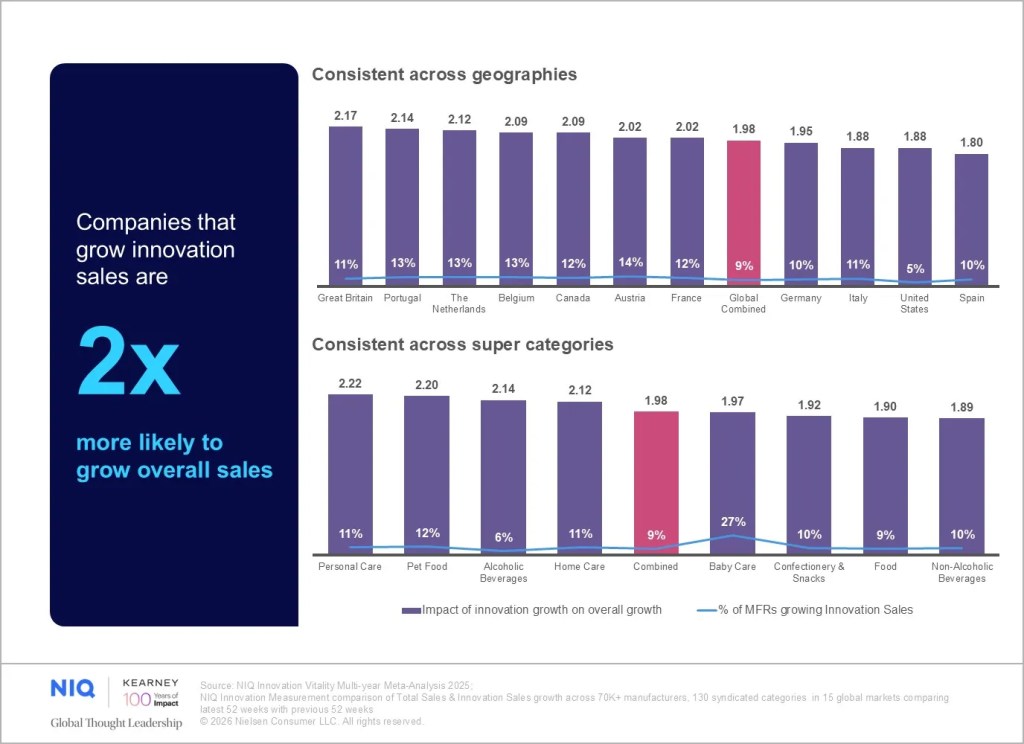
These gains, along with GenAI’s impact on consumer expectations and path to discovery and purchase, have made innovation one of the most critical pathways to CPG growth for brands of all sizes. Our research bears this out: Across geographies and super categories, companies that grow innovation sales are twice as likely to grow overall sales.
Innovation is a critical growth lever for all brands
Yet counterintuitively, the CPG industry is experiencing a broad-based innovation lag. The same research shows that, last year, only 9% of companies grew their innovation sales, and just half of those innovations sustained growth, or “vitality,” into year two—evidence of how difficult it has become to launch offerings that meaningfully expand a category rather than simply reshuffle share.
Year over year, strong innovations become your core
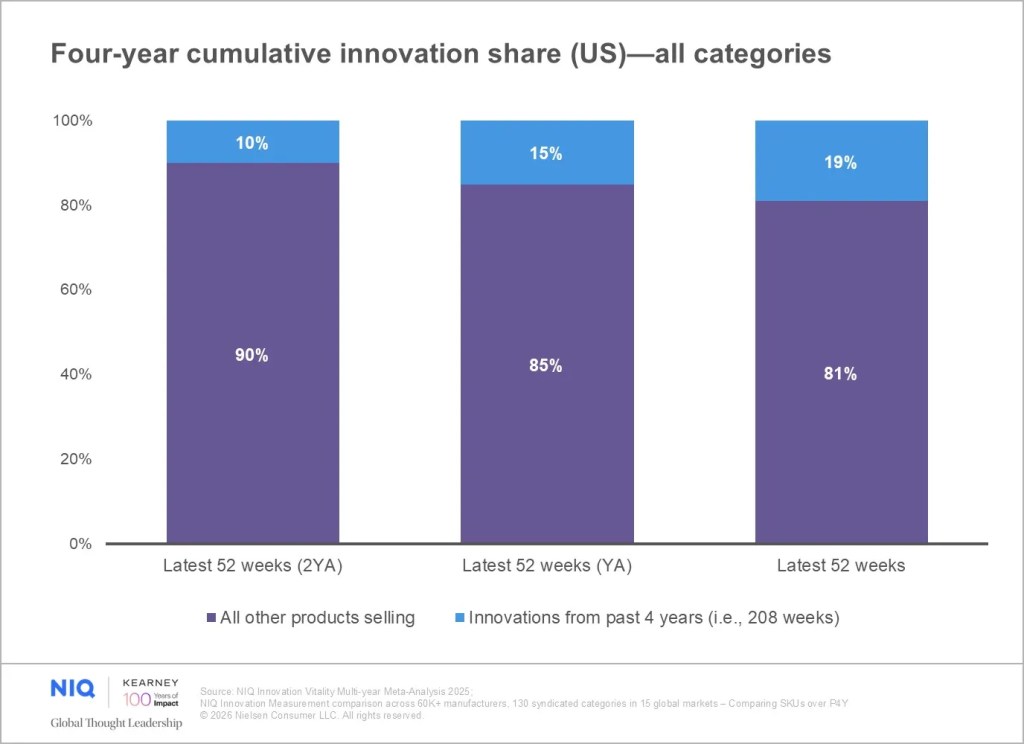
An overreliance on line extensions can threaten a brand’s long-term portfolio vitality, since strong new innovations ultimately become core products over time.
Outgrowing old levers: Why line extensions and M&As are no longer enough
Large brands are feeling the brunt of these tensions: With tighter budgets and pressure to accelerate innovation cycles, many have leaned heavily into line extensions as a safer path to something “new.” But NIQ research has found that, in the absence of deep category understanding, these extensions often cannibalize the portfolio instead of attracting new buyers.
At the same time, despite boardroom optimism, M&As have become even less predictable growth levers. Rapidly shifting consumer behaviors, economic volatility, and new technologies that are allowing emerging brands to scale more quickly all make it harder for large companies to acquire their way into sustainable growth.
One recent study found that nearly half of these partnerships fail, often due to mismatches in strategic fit or cultural alignment. Even worse: It can take years for businesses to unwind these deals, all the while undercutting shareholder value, undermining business credibility, and tying up resources. Meanwhile, as LLM-driven search and discovery upends size-and-scale advantages, even the most strategic and well-timed acquisitions are insufficient as standalone growth levers, as businesses must continually build brand and product relevance to win visibility—further underscoring the imperative for robust innovation pipelines.

Changing the innovation growth equation

At its core, the path to innovation growth is deceptively simple: Start with validated, unmet consumer needs. Everything else—from format to benefit claims and even messaging—follows from a clear understanding of the problem consumers are actually trying to solve.
This is where AI can help meaningfully shift the equation. When grounded in high-quality data, AI can accelerate every step of the product development innovation process without lowering the bar for decision-making—synthesizing insights, expanding ideation, and enabling rapid concept or formula refinement. The result isn’t just more efficient innovation; it’s smarter innovation, tying ideas directly to those unmet needs that can drive incremental growth.
Once a concept is built on validated need and developed into a product that not only meets consumer expectations but does it better than anyone else, long-term success comes down to how it enters the market. Early distribution and velocity are the strongest predictors of whether an innovation will sustain into year two.
But the game has also changed for driving trial, further widening the doorway for emerging brands. Outside of in-store displays and banner ads, which can be cost-prohibitive for smaller players, social media campaigns and content creators are now firmly entrenched in the marketing mix, offering a more economical (and in some cases, more effective) lever to build consumer buzz and repeat—and get noticed by retailers.
“A single social post can reach tens of thousands in a day, at a fraction of traditional costs,” said Wayne Nah, General Manager at Paulaner China. “On TikTok, an influencer goes live, shows a product, and you buy on impulse right there. It’s become the most effective way to drive trial.”
Nah also noted that these strategies can empower smaller brands to initially bypass retailers by launching exclusively direct to consumer (DTC) and scaling through creators, viral content, and special promotions—an approach employed by many successful challenger brands who have ultimately gone on to win exclusive partnerships or shelf space with large retailers.
And these tactics—along with strong online reviews, widespread consumer appeal, and traction in market—will only serve to further accelerate their success when it comes to discoverability via LLMs. Strong reviews and consumer need states are at the core of how products are surfaced in results, generating a win–win for emerging brands looking to gain compounding success early on.
Still, whether launching in-store or DTC, the ability to demonstrate velocity, scale, and stability is crucial when it comes to attracting retailer partnerships, said one leader of an accelerator program we spoke with. Their model—a full support system designed to speed impact—partners with select emerging brands that are disrupting within meaningful consumer trends.
Once the brand is in the program, they must drive trial, awareness, and repeat quickly. “We start reviewing performance seven months in. If they’re not hitting hurdles, they’re at risk,” our retailer said, adding that they begin reviewing data and making course corrections quickly post-launch, to set brands up for success.
Timely measurement and management are critical for launched innovations
Post-launch measurement: The make-or-break window
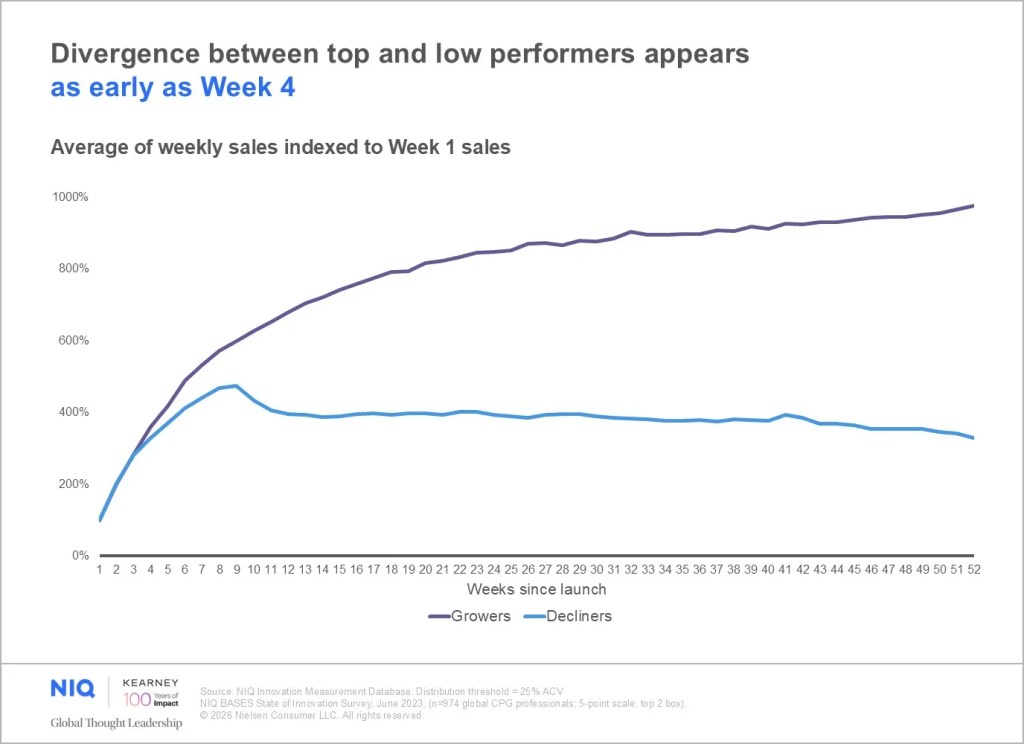
A focus on early measurement and course correction post-launch is critical for making in-flight adjustments that can impact a new product’s performance trajectory. Our data reveals divergence among top and low performers as early as four weeks post-launch. Teams that track weekly signals and optimize media, messaging, and distribution as needs arise can materially change outcomes, particularly in an environment where retailers are reassessing underperformers more quickly than ever before.
Importantly, our data also shows that brands of every size can win with informed innovations. And, as AI advancements continue to make the tools and processes once exclusive to large enterprises more accessible, the playing field only stands to become even more competitive. The next era of growth belongs to those who not only leverage this technology to innovate with more efficiency and precision—but also plug directly into the AI-driven pathways that now influence how consumers shop.
AI is poised to reshape innovation for large and small brands alike. Are you playing offense—or defense?
Download our insights below to learn where these changes are having the biggest impact—and how you can prepare.


“It’s a new land race. How do I become the answer to the agent’s question faster than my competitor?”
—Phil DeConto, VP, Sales, Strategy, and Trade Marketing, Cibo Vita
Changing the game: How agentic search is reshaping brand discovery
Relevance over reach
Imagine a marathon runner in training for a sub-five-hour finish. Instead of browsing through multiple websites, watching YouTube videos, or toggling between subreddits and reviews, she types a single question into an AI assistant: “How do I prepare to run a marathon in under five hours?”
Within seconds, the assistant returns a personalized plan—inclusive of training schedules, nutrition guidelines, supplements, running shoes, and gear—along with links to purchase each recommended product. No endless scrolling, no deep dives down rabbit holes, just a zero-click journey that replaces dozens of micro-interactions.
This example isn’t some futuristic consumer ideal; it’s agentic commerce in action. And it’s actively redefining how consumers discover and buy products, further upending the advantages large brands have largely grown accustomed to.
In traditional search, SEO dominance and paid placement shape discovery. But in agentic commerce, relevance reigns supreme, as the agent evaluates structured product attributes, social content, reviews, and price against the shopper’s specific goal. In addition to opening the door for emerging brands, this new model of search and discovery is also better for consumers, elevating products that authentically meet their needs instead of “hacking” the algorithm through keyword optimizations or massive budgets, according to Ellie Thornton, a Senior Category Manager at Phizz. In other words: AI often rewards the best answer, not necessarily the biggest brand.
Agentic shoppers could drive $190–$385 billion (USD) in US e‑commerce spending by 2030—the equivalent of 10% to 20% market share. This shift is already reshaping retail. LLM integrations with retailers or within retailer websites and retail media networks (RMNs) can recommend products, generate bundled baskets, and even propose recipes tailored to a user’s shopping history or needs. Instead of browsing a category page, a consumer might type: “I like citrus flavors, and I can’t have dairy. Which recovery drink should I buy?” The AI agent doesn’t return 100 search results to parse through; it instead returns two or three, along with an explanation why.
How agentic commerce is changing the rules of ranking
- LLMs optimize for the best answer, not the biggest brand.
- Traditional SEO levers like domain authority, backlink networks, and paid placements are no longer the only variables in an agentic commerce ecosystem.
- A new “trust layer” draws heavily from relevance signals across YouTube, TikTok, Reddit, Substack, and other creator ecosystems, influencing nearly half of agentic search results.
Given the explosive growth of agentic commerce, there’s an imperative for brands of all sizes to rethink activation strategies to either claim these spaces or to avoid losing ground.
The new media divide: retailer-specific vs. retailer-agnostic advertising

Also disrupting the dynamics of consumer search and discovery: Major AI platforms are rolling out (or quietly testing) LLM advertising—a projected $25 billion opportunity that introduces contextually relevant placements directly inside AI-generated answers and reflects the growing role of AI in e-commerce.
Early formats include:
- Sponsored product mentions within conversational responses
- Follow-up questions recommending branded products
- Integrated shopping assistants that surface retailers, pricing, and add-to-cart options
But unlike in traditional paid search, preserving consumer trust in agentic responses is key. As a result, many platforms are clearly labeling or separating ads from organic responses. This means that (for now), LLMs still prioritize the most contextually aligned product, ensuring the integrity of results for consumers and creating another case in which challenger brands can outperform category leaders.
For retailers, these shifts pose new questions: If AI assistants recommend multiple retailers (or none at all), traffic patterns, RMN revenue, and conversion dynamics could change dramatically. Retailers will need to accelerate adoption of their own generative AI capabilities (personalization, conversational search, contextual suggestions) and may need to rethink partnerships or data sharing with leading LLM platforms—as some already are doing.
How will LLMs disrupt the brand marketing mix?
- LLM advertising will become a standard layer of the marketing mix, but not a simple one. Each platform will have different formats, rules, and optimization paths.
- Because algorithmic relevance outweighs spend (for now), brands with strong structured data, transparent value propositions, and cultural relevance can win—even against legacy giants.
- These shifts in the marketing mix could compound existing challenges around data fragmentation and measurement, but they may eventually unlock new clarity around consumer motivations and cross-channel conversion.
Optimizing for the new rules of visibility
As agentic commerce and AI-driven discovery reshape the path from intent to purchase, a window of opportunity is opening. If a brand isn’t “legible” to LLMs or relevant to consumer need states, it will ultimately be invisible at the moment of choice.
With this urgency in mind …
We asked ChatGPT how to prepare.
Query: “Given the rise of agentic commerce and LLM advertising, how should CPG companies now prepare for new product launch and marketing? Please provide strategic action steps.”
ChatGPT says:
LLMs pull from explanatory content, not taglines.
- Design products and messaging for AI readability, not just human persuasion.
- Clearly articulate the problem you solve, for whom, and in what context.
- Use plain, descriptive language across FAQs, reviews, and your “About Us” story.
- Explicitly answer query formats like “Best X for Y,” “Alternative to Z,” “Is it worth it if …,” and so on.
LLMs learn from patterns of explanation, not just star ratings.
- Treat reviews, Reddit threads, and longtail content as performance media.
- Encourage authentic reviews that explain decisions, switching behavior, and surprises.
- Participate thoughtfully in niche forums, Substacks, and creator comment sections.
You don’t need to win the market. You need to win the top three suggestions.
- Shift traditional awareness goals toward being consistently shortlisted for a specific job to be done.
- Optimize your structured data and product clarity so AI agents rank you among the top one to three recommendations.
Build brand narrative around why you exist.
- Make origin stories searchable and quotable.
- Tie mission to tangible product decisions—e.g., ingredients, sourcing, formulation, and efficacy.
- Ensure your story is structured in ways LLMs can parse and retell.

“We are preparing for a world where AI agents actively influence customer decisions. In that world, visibility, availability, and clean data become critical currencies. If your product is not visible in the data layer, it effectively doesn’t exist for AI-driven commerce.”
—Florian Hartmann, Sales Director, ahead nutrition
The window of opportunity is open (but not for long)
The balance of power in the CPG industry is shifting from size and scale to agility, relevance, and proof. As AI in retail shifts consumer behaviors and expectations—particularly in how they discover, evaluate, and buy products—the brands that will ultimately win are those that treat this moment not as a disruption, but as a growth opportunity.
Successful brands are running an integrated play across innovation and activation strategies, recognizing the relationship between new product pipelines and an AI-driven marketplace that’s actively reshaping e-commerce. The advantage no longer lies in having the biggest budgets or the longest legacy, but in the ability to move swiftly and leverage technology with data-backed precision. This means strategically pairing AI with consumer-led innovation, activating in the environments where decisions are now made, and ensuring brand and product output are intelligible both to consumers and the systems guiding them.
The window is open for brands of every size to compete and even lead, but the moment demands both urgency and a commitment to designing for a future in which AI isn’t merely an add-on to the consumer journey—but the latest architecture to define it.
Plan with precision, test with agility, activate with confidence
As brands rethink how they innovate and activate in an AI-driven world, the following guidance brings together action steps and tools to move forward with greater precision and agility.
| Action | Why it matters |
|---|---|
| Ensure teams have democratized access to real-time market, retailer, shopper, and performance data to guide decisions across innovation, activation, and retail execution. | As AI technology and agentic commerce begin to tip the scales of power, brands need actionable retail, market, and omni insights to move quickly and decisively. |
| Monitor the innovation landscape of your category to understand present dynamics, competitor benchmarks, and rising trends. | As AI technology and agentic commerce continue to accelerate innovation cycles and reshape consumer behaviors and expectations, brands must stay ahead of category shifts and up-and-coming disrupters. |
| Leverage post-launch measurement data to assess performance and adjust distribution, media, and messaging in real time. | Our data indicates that divergence between top- and low-performing innovations happens as early as four weeks, post-launch. Staying attuned to early signals is crucial to keep innovation growth on track. |
| Strategically leverage AI to surface and synthesize insights, gut-check ideas, identify best concepts, and optimize formulas. | As business leaders are asked to move more quickly with fewer resources, the strategic use of AI can accelerate innovation cycles without compromising quality. |
Meet our contributors

Phil DeConto
VP, Sales, Strategy, and Trade Marketing, Cibo Vita
Cibo Vita is a US-based snack company founded in 2009 by Emre Imamoglu and Ahmet Celik and headquartered in Totowa, New Jersey. Built on a “taste-first, function-forward” approach to snacking, Cibo Vita develops and manufactures products that combine craveable flavor with purposeful benefits. Nature’s Garden is the company’s flagship brand and endorsed brand umbrella, home to science-backed innovations like Probiotic Yoggies and Probiotic FruiChias, as well as fan favorites including the Omega-3 Deluxe Mix and Clusters. Cibo Vita operates more than 600,000 square feet of production across multiple facilities, including USDA Organic-certified operations, and sells nationwide through leading retailers, including Target, Costco, Walmart, Kroger, and Amazon.

Florian Hartmann
Sales Director, ahead nutrition
ahead was founded in Hamburg in 2017 by Philip Brohlburg and Johannes Sörensen. Their goal: to create a versatile range of low-sugar, high-protein, and low-calorie snacks for every everyday situation that taste like childhood favorites and are affordable for everyone.
Sugar, empty calories, and refined oils are replaced with fiber, protein, and healthy fats. With around 80 employees, the company inspires a growing number of online and retail customers every day to replace poor nutrients without compromising taste. Whether you have a busy schedule, follow a specific diet plan, or are looking for something for your family, ahead is ideal for anyone who is searching for an alternative to conventional sweets and snacks with high sugar content and poor nutritional values, but doesn’t want to compromise on taste. Anyone can incorporate ahead into their daily routine without having to give up their favorite sweets.

Antonio Lanzone
Trade Marketing Specialist, Andriani S.p.A. Benefit Corp.
Andriani S.p.A. is a multinational company operating in the fields of innovation and healthy food, leading the food transition by integrating agriculture, nutritional sciences, and social responsibility, with a strong commitment to all stakeholders. Headquartered in Gravina in Puglia (Italy), with production facilities in London, Ontario (Canada) and Pistoia (Italy), Andriani operates in over 50 countries worldwide.
Since 2009, the company has specialized in the production of pasta, later expanding into bakery products and pet food. Andriani uses carefully selected, naturally gluten-free raw materials, including buckwheat, oats, brown rice, teff, corn, lentils, chickpeas, peas, cauliflower, and spirulina. Flexibility; a dynamic organizational model; research; innovation; and a constant commitment to a regenerative business vision, through concrete actions and best practices for all stakeholders, are the core principles driving the company’s performance. Andriani integrates the Ten Principles of the UN Global Compact and actively contributes to the achievement of the UN Sustainable Development Goals of the 2030 Agenda, promoting a more sustainable global economy.

Wayne Nah
General Manager,
Paulaner China
Founded in Munich in 1634, Paulaner is a brewery deeply rooted in Bavarian heritage and tradition. Its story began when monks at the Neudeck ob der Au monastery brewed a special beer to sustain them during the fasting period of Lent. This historic origin laid the foundation for nearly 400 years of brewing excellence.
The brand is strictly guided by the 1516 German Purity Law, utilizing only the finest ingredients: malt, hops, water, and a proprietary yeast strain nurtured at its own facility. This dedication to tradition is most famously celebrated at the annual Oktoberfest, where Paulaner is a top-selling beer, serving its iconic Festbier to millions in its own grand festival tents.
As Germany’s most exported beer brand, Paulaner’s reach spans the globe. In China, the brand’s largest export market, it is now one of the top leading international wheat beer brands in the country. Guided by a vision to introduce the most authentic Bavarian Weissbier experience to consumers in China, Paulaner continues to share its rich heritage and convivial spirit with a new generation of beer enthusiasts.

Ellie Thornton
Senior Category Manager, Phizz
At Phizz, our mission is simple: to transform lives through the power of better daily hydration. The Phizz range includes the signature Daily 3-in-1, Daily Energy, and Daily Immune+—all powered by a formula that hydrates three times faster than water, delivers added functional benefits, and never compromises on taste.
The brand was co-founded in 2015 by a group of friends after learning on a long-haul flight from Melbourne to London that passengers can lose up to six liters of water. Traditional sports drinks weren’t built for daily life, and the science behind many hydration claims didn’t hold up. The founders wanted something that worked harder—science-led hydration that’s effective, great-tasting, and easy to make a daily habit. That’s what Phizz delivers.
Alongside co-founder and PhD neuroscientist Dr. Paul Anastasiades, whose academic background focuses on brain health, fatigue, and performance, the team developed an all-in-one formula designed for the demands of modern life. The result is hydration that is convenient, delicious, and genuinely effective. Today, Phizz leads the electrolyte well-being category, achieving over 97% year-on-year growth, is stocked in every major UK supermarket, and is the country’s #1 hydration brand.
Sugar, empty calories, and refined oils are replaced with fiber, protein, and healthy fats. With around 80 employees, the company inspires a growing number of online and retail customers every day to replace poor nutrients without compromising taste. Whether you have a busy schedule, follow a specific diet plan, or are looking for something for your family, ahead is ideal for anyone who is searching for an alternative to conventional sweets and snacks with high sugar content and poor nutritional values, but doesn’t want to compromise on taste. Anyone can incorporate ahead into their daily routine without having to give up their favorite sweets.

Phuong Tran
Category Lead & Demand Planning Manager, Dose
DOSE is a Montreal-born ginger shot brand built to own one moment: the morning. Our refrigerated, cold-pressed shots deliver a bright, potent ginger hit designed to kickstart your day. This isn’t ginger tea in a tiny bottle. DOSE is made for people who want the real thing—bold flavor, immediate intensity, and no watered-down blends, powders, or filler ingredients. The intensity is intentional. You taste the ginger, and you know it’s doing its job.
The brand began in 2013 when founders Gen and Raph were juggling busy schedules and looking for a simpler way to build a healthier routine. In their small Old Port Montreal kitchen, they focused on freshness, high-quality ingredients, and a process that doesn’t “cook” the product. What started as a personal solution quickly grew into a mission: make a powerful morning ritual easy to repeat—one small bottle at a time.
DOSE is certified organic and produced in a Canada-based facility using a cold-pressed process designed to preserve flavor and punch exactly as intended. By keeping shots refrigerated and fridge-fresh, DOSE ensures the experience stays vibrant from production to first sip.
Today, DOSE ginger shots are available across Canada through major retailers, including Costco and Walmart, as well as leading grocery partners. Whether you’re building a new routine or reinforcing an existing one, DOSE makes it simple to start strong and restock wherever you shop.
Is your innovation engine ready for an AI-first world?
Download our insights below to learn how winning CPG brands are strategically applying this technology across their playbooks.