
How AI in Personalized Shopping Is Transforming the Way Consumers Discover Products
Executive Summary
Two shifts are converging from opposite directions, and they lead to the same conclusion. The first is behavioral: how consumers discover and choose products is moving from search to conversation, reshaping AI in personalized shopping and the way brands compete for attention, as AI increasingly filters, frames, and even acts on options for them. The second is structural: almost no brand’s underlying data is actually ready to be found, understood, or recommended inside that conversation. Commerce is becoming AI-mediated faster than most organizations’ data foundations can support.
NIQ’s own 2026 research puts a fine point on the stakes: brands that invest now in structured product data and AI-readable attributes will be positioned to capture share, while those that wait risk becoming invisible to the agents that increasingly decide what consumers buy (NIQ, The Commerce Revolution). This piece, informed by themes explored in two NIQ podcasts on agentic commerce with L’Oréal and commerce data with Henkel, connects what’s changing in consumer behavior to the infrastructure required to actually compete for it.
Key Takeaways
- Agentic commerce isn’t one thing — it’s three layers (AI-assisted, AI-mediated, and agentic), and most brands are only organized for the first.
- The underlying shift is delegation: consumers increasingly rely on AI systems and AI shopping assistants to narrow, choose, or act on their behalf.
- The new competitive risk is invisibility: if a product isn’t in the AI’s answer, it is effectively not in the market.
- None of this works without a data foundation — the agent is just the tip of the iceberg sitting on top of structure most brands haven’t built.
- New KPIs are emerging to replace share of shelf and share of search: share of conversation and share of recommendation today, with share of trust likely next.
- The organizations that win won’t be the ones with the most data — they’ll be the ones that started from a specific use case and worked backward, rather than collecting data and hoping a use case appears.
The Shift: From Search to Conversation
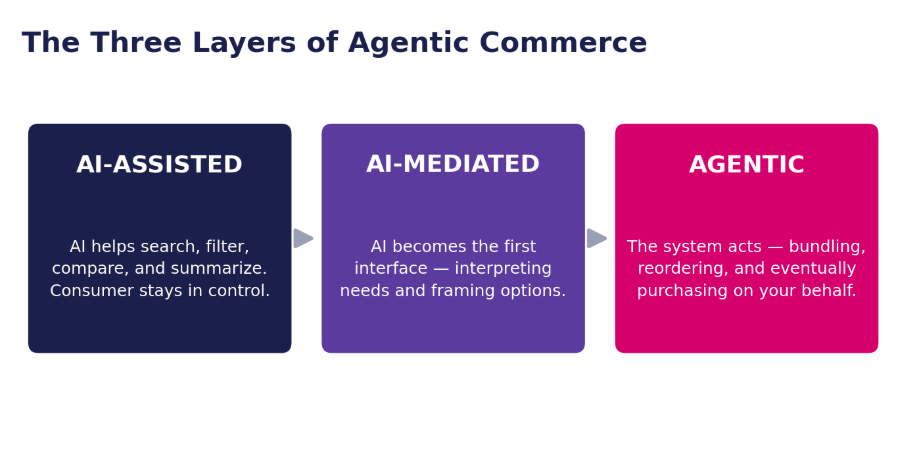
Agentic commerce isn’t one thing — it’s three layers stacked on top of each other. The first is AI-assisted commerce, where AI helps a shopper search, filter, compare, and summarize, but the shopper stays in control of the journey. The second is AI-mediated commerce, where AI becomes the first interface between a consumer and the market, interpreting needs and framing options before a human ever reaches a retailer’s own search bar. The third is agentic commerce proper: the system doesn’t just recommend, it acts — bundling, reordering, initiating, and eventually purchasing on a consumer’s behalf. Most brand and retail organizations are still building for the first layer while consumer behavior is already sliding toward the second and third — at very different speeds depending on the market, even if the direction is the same.
The bigger shift underneath that framework is behavioral, not technological — a move from individual cognition to assisted cognition. Consumers are already comfortable asking AI systems and AI shopping assistants for help with health questions, life decisions, and problems they might not raise with another person; commerce is simply one more domain where that trust extends naturally. The practical consequence can be distilled into a single word: delegation. The shopper’s role is moving from “I search, I compare, I choose” to “the AI chooses, and I approve.”
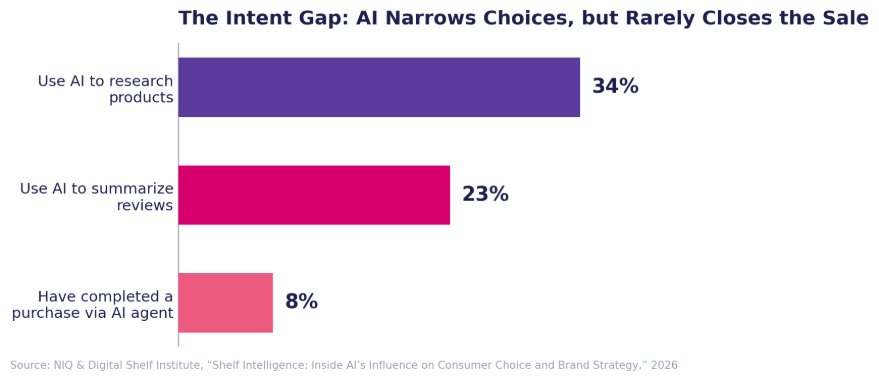
That shift is real, but it isn’t complete. NIQ and Digital Shelf Institute research (Shelf Intelligence, 2026) shows that 68% of consumers now use generative AI tools at least monthly, and roughly a third or more use it specifically to research products or summarize reviews.

The New Risk Is Invisibility
The practical consequence for brands is a new kind of audience. A product now has to be understood, trusted, and recommendable by a system that increasingly powers AI product search and product recommendations. That is a fundamentally different bar. Decades of marketing practice were built to influence a human brain: packaging, imagery, brand equity built up over years of exposure. None of that transfers automatically to an LLM deciding what to recommend. A product effectively has three audiences now: the shopper, the search algorithm, and the machine reasoning over structured data to decide what’s worth suggesting at all.
The stakes of getting this wrong are unusually high. NIQ’s own 2026 global research is direct about it: brands that invest now in structured product data, AI-readable attributes, and cross-platform measurement infrastructure will be positioned to capture share; those who wait risk becoming invisible to the agents that will increasingly determine what consumers buy (NIQ, The Commerce Revolution). Invisibility is a harsher form of exclusion than simply ranking lower in a search result — if a product isn’t part of the answer an AI system gives, it was never in the running, especially as consumers increasingly rely on AI for shopping decisions.
This is reshaping what “digital shelf” means, as digital content increasingly fuels AI ecommerce personalization and recommendation engines. For years, digital shelf work — clean images, complete bullet points, accurate availability — was treated largely as retailer execution, sitting near the bottom of the marketing funnel. In an AI-mediated world, that same content becomes upper-funnel: it’s part of what teaches a model what a product is, who it’s for, and when it should be recommended. The funnel itself is compressing, too — discovery, comparison, evaluation, and decision increasingly happen inside a single conversational exchange rather than as separate stages a shopper moves through over days.
Digital shelf content alone isn’t sufficient anymore, either. Brand websites, editorial content, forums, and user reviews all play a role in how product discovery AI systems evaluate and recommend products, and inconsistency across those sources is actively penalized: a model fed contradictory claims about the same product doesn’t average them into a safe middle ground, it tends to lose confidence in the product altogether. NIQ’s broader 2026 research, produced with Kearney, puts a number on how quickly this discovery shift is moving: nearly three-quarters of shoppers (74%) are now using AI for some form of product discovery, and smaller, more agile brands are already gaining share in categories — like Pet Care, Personal Care, and Health & Wellness — where AI-led discovery is accelerating fastest (NIQ and Kearney, The New Growth Frontier).
New Metrics for a New Era
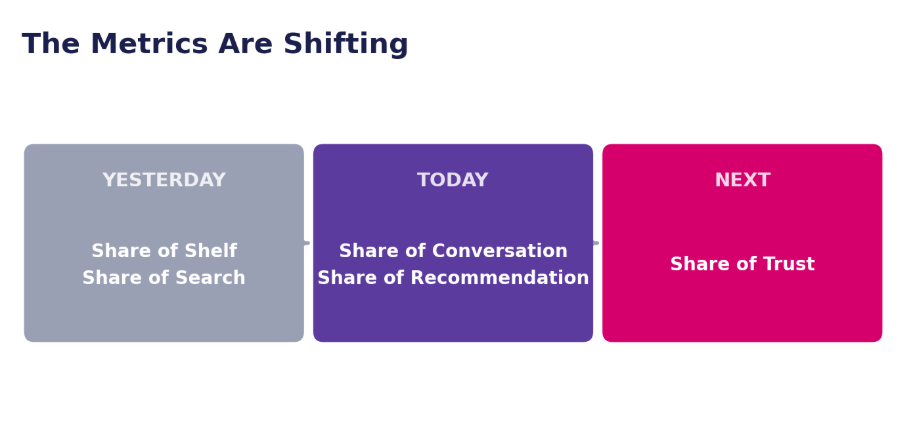
If the funnel is collapsing, the metrics built for it have to change too. Share of shelf and share of search are giving way to share of conversation and share of recommendation — how often a brand shows up, and is actually recommended, within AI-generated answers in its category. Looking further out, the metric the industry isn’t yet equipped to measure may be the most important one: share of trust. Recommendation only matters if a consumer actually trusts the system enough to follow it.
The practical version of this is more actionable than it sounds. Consider a brand that discovers a single topic — say, “whitening” in the toothpaste category — dominates AI-mediated conversations among its shoppers. It can deliberately strengthen content and claims around that topic for the products in its range that can credibly support it. It’s a fast, iterative loop: measure share of conversation, find what’s actually being discussed, adjust content, and watch whether the number moves.

Why It All Comes Back to Data
None of the above works without a foundation most organizations haven’t built. The clearest way to picture it is an iceberg: a shiny AI shopping agent as the visible tip, and years of unglamorous data infrastructure work sitting beneath the waterline, mostly ignored because it isn’t exciting. It’s the classic “garbage in, garbage out” problem, except almost nobody wants to spend the effort fixing the “in” part.
The Foundation Nobody Wants to Build
Commerce data is a genuinely different problem than data in general. Offline retail measurement has had decades to become structured and standardized. Digital commerce data hasn’t had that runway — it’s fragmented across retailers, platforms, and formats, and for years, many organizations simply didn’t have enough of it to make confident decisions, let alone data labeled, coded, and structured well enough to cross-reference across sources.
Part of the reason nobody solved this earlier is organizational, not technical. E-commerce was, for years, treated as a small, separate function, often one or two percent of total revenue, staffed and structured differently from the offline commercial discipline that had already solved similar data problems decades earlier. As online share has grown, companies are only now reintegrating e-commerce into the core business, and confronting, often for the first time, how fragmented its underlying data really is.


AI raises the stakes on all of this considerably because modern personalized shopping experiences depend on clean, connected, and trustworthy product data. If a product database isn’t structured on common identifiers, comparing performance across retailers becomes nearly impossible, and an AI model won’t fail quietly; it will confidently surface the wrong answer, or invent one. Speed compounds the problem: data delivery has moved from monthly, to weekly, to daily, to multiple times a day, because AI-driven decisions increasingly need to happen at that pace, creating real tension between speed and cleanliness that most data teams are still working out.
Two patterns show up again and again in practice. The first: media dollars quietly wasted optimizing products that were already organically top-ranked, simply because measurement wasn’t precise enough to reveal it. The second: AI models producing confidently wrong recommendations — including recommending that perfectly viable products be delisted — when given data without enough context about its own gaps and coverage.
Governance is probably the most underestimated layer of all. A common early mistake is prioritizing the acquisition of more and more data sources over the discipline of maintaining and governing the ones already in place — which eventually produces a system too complex and too unreliable for anyone to trust. The fix is to invert the usual approach entirely: instead of buying data, then infrastructure, then hiring data scientists, and only then asking what to do with it all, start by naming the 10, 20, or 30 specific decisions the business actually needs to make, and work backward to the minimum data required to make them well. It’s a small reframing with a large practical effect: it turns an open-ended, unfundable data project into a series of scoped, demonstrable wins.

So What: What Brands and Retailers Should Do Next
For Brands
- Name 10–20 specific use cases before acquiring another data source — let the application define the minimum data you actually need, not the reverse.
- Structure and centralize product and commerce data now, while executive attention, and budget, is genuinely focused on AI.
- Fix the ways of working alongside the data: decide who owns, governs, and acts on it before scaling any AI use case, not after.
- Build for consistency across every place your product is described — PDP, brand site, retailer listings, reviews, forums — since consistent content improves visibility across AI product search and recommendation systems. A model fed contradictory information tends to trust none of it.
- Treat governance as an ongoing discipline, not a one-time project; most data value is lost through drift after launch, not through the initial build.
For Retailers
- Treat product content as infrastructure, not simply retail execution — it now functions as training data for the systems deciding what gets recommended.
- Extend experimentation and measurement capabilities inside your ecosystem, and share more of that data, so brands can prove what’s actually working with you specifically.
- Move deliberately as retail media evolves into conversational formats; trust, once lost inside an AI interface, is far harder to rebuild than a lost click.
Looking Ahead
Agentic commerce is not a hype cycle. It is part of a broader transformation in AI in personalized shopping, where discovery, recommendation, and purchasing are increasingly AI-mediated, even if full autonomous purchasing is still early. But its commercial payoff is gated, almost entirely, by whether a brand’s data can support it. NIQ’s own response to this gap is already in market: NIQ Product Intelligence, launched in June 2026, was built specifically to turn fragmented product data into the kind of structured, AI-ready layer this shift requires — the same foundational work described above as unglamorous but non-negotiable. As NIQ’s leadership has framed the company’s broader AI strategy, trusted, governed, decision-grade data is becoming the real competitive moat as AI moves from experimentation to daily operation.
The brands that treat that foundation as sequencing work to start now, imperfect and iterative, built one use case at a time, will be the ones the agents actually find.


Ready to Prepare for Agentic Commerce?
If you’d like to explore how NIQ can help you structure your commerce data, measure AI-driven discovery, and build the foundation agentic commerce requires, we’d love to connect with you. Contact us to speak with an NIQ expert, or learn more about NIQ’s Digital Commerce solutions
1. NIQ, Agentic Commerce: From Search to Conversations (podcast)
2. NIQ, From Complex to Connected: Making Commerce Data AI-Ready (podcast)
3. NIQ, The Commerce Revolution: Where East Meets West, 2026
4. NIQ and Kearney, The New Growth Frontier, March 2026
5. NIQ and Digital Shelf Institute, Shelf Intelligence: Inside AI’s Influence on Consumer Choice and Brand Strategy, 2026
6. NIQ, NIQ Launches Product Intelligence to Power AI-Driven Commerce, June 2026
7. NIQ, Q4 & Full Year 2025 Results, February 2026