In this series
The State of FMCG
Across NIQ’s own tracking of markets, categories, and shoppers, one pattern keeps repeating in 2026: pricing and portfolio decisions are under more pressure and facing more scrutiny than they have been in years. Growth is slowing in places it used to be reliable, and inflation is moving unevenly, which is squeezing margins at a different pace depending on where, and what, a business sells.
NIQ’s own Global Inflation Tracker, which is built on 225 consistent categories across 58 countries, puts total global CPG inflation at 2.7%. Confectionery & Snacks and Non-Alcoholic Beverages categories already sit among the highest-inflation ones that NIQ tracks worldwide, well ahead of other consumer categories like Paper Products.
Source: NIQ Global Inflation Tracker, 4-week periods ending Jan 24, 2026.
NIQ’s Global Strategic Planner shows the growth mix shifting underneath that inflation: global FMCG value grew 1.8% in the year to March 2026, but unit volume growth trailed at just 0.7%. NielsenIQ Homescan data explains why: in most markets, shoppers aren’t buying more per trip. They’re shopping more often and paying more each time they do.
Sources: NIQ Global Strategic Planner, latest 52 weeks ended 22 Mar 2026 vs. previous year; NielsenIQ Homescan, data ending March 2026.

NIQ’s own experts see the same pressure from two different angles. In our recent Expert Perspectives discussion on Turn Volatility Into Growth Advantage, Steve Zurich, NIQ’s VP of Thought Leadership, Category and Shopper Insights, points to global conflict now hitting commodities like petroleum and grains directly. This exposure impacts almost every CPG company through packaging alone, whether that’s the ink on a carton, the plastic in a bottle, or ingredients that are tied to world petroleum prices. Carlotta Crespi, who leads NIQ’s Global Revenue Growth Management practice, points to a second, quieter shift: shopper polarization no longer moves in one direction. Where difficult times used to push shoppers cleanly toward either premium or entry-price, baskets today are more complex. Premium brands and private labels are sitting side by side with promoted items, functional products, big brands, and challengers, often in the very same basket.
Source: NIQ Expert Perspectives — Pricing in Uncertain Times, 2026 (Steve Zurich, VP of Thought Leadership, Category and Shopper Insights, Carlotta Crespi, Global RGM Practice Lead).
What NIQ’s Own Data Is Telling Us
54%
of consumers are willing to trade up to premium
68%
say private label is a good alternative to name brands
2.7%
Total Global CPG inflation rate, led by Snacks & Non-Alc. Beverages
1.8% vs 0.7%
Global FMCG value growth vs. unit volume growth — value is outpacing volume
Sources: NIQ 2025 Private Label & Branded Products Report; NIQ Global Inflation Tracker, 2026; NIQ Global Strategic Planner, 2026.
That first pair of numbers describes the same shopper, in the same basket, on the same trip, who is trading up for one occasion and trading down, or switching to private label, on another. NIQ’s own data on category leadership shows who is absorbing the difference: private labels are rising sharply across Europe, and smaller manufacturers are gaining ground in North America. Top players in Non-Alcoholic Beverages still drive 60% of category value growth, but in Snacks, that figure drops to just 40%. This means that challengers and private labels are growing more than the incumbents.
Source: NIQ Global Strategic Planner, latest 52 weeks ended 22 Mar 2026 vs. previous year.
Takeaway:
Value isn’t one thing anymore, and NIQ’s own data keeps confirming it from every angle. Winning means knowing exactly where each shopper draws the line: market by market, category by category, SKU by SKU.
Pricing strategy and decision-making have become even more consequential for consumer goods companies regardless of size. Growth is no longer driven by broad market expansion but by a company’s ability to understand where price elasticity, promotion effectiveness, assortment strategy, and consumer value perception differ across markets, channels, brands, and individual SKUs.
Answering these business-critical questions is exactly where NIQ’s portfolio of advanced pricing and portfolio optimization capabilities are supporting our clients to better understand the pricing choices and decisions they face. And specifically, NIQ’s Line Price Optimizer helps Clients simulate changes in their assortment to better understand how price and availability changes impact individual SKUs and how to maximize share potential and incrementality.
Three Ways We Partner With Clients
Based on our work with clients, we’ve observed that many consumer organizations don’t have one pricing problem: they have several, and they compound. Pricing today must be correct (structurally sound across markets and SKUs) and resilient (able to absorb shocks like cost inflation, geopolitical conflict, and regulatory change without panic decisions). These are challenges every business faces, regardless of category. For clients running holder-and-refill business models, there’s a third dimension: unlocking growth by understanding how refill pricing shapes holder adoption and retention.
That’s why we’ve crafted the following Insight series around three connected topical ideas: two are foundational, one specialized. Each tackles a distinct piece of the pricing-value equation.
Here’s a preview of the three articles that will be published over the course of the coming weeks.
Part 1: Building The Right Price Pack Architecture & Future Portfolio
Find the exact price and pack strategy that wins, market by market and SKU by SKU.
Part 2: Navigating Unprecedented Times
Turn cost shocks, geopolitical disruption, and regulatory change into a tested, confident pricing response.
Part 3: Unlocking Holder & Refill Growth
Understand how refill pricing decisions impact holder choices, and plan your portfolio accordingly.
Access Now – Part 1: Building The Right Price Pack Architecture and Future Portfolio
Part 1 of 3
Right Price Pack Architecture & Future Portfolio
The market that rewards a price increase and the market that punishes it look identical on a spreadsheet.
When One Price Doesn’t Fit All
NIQ’s proprietary data settles a question a lot of pricing teams are still answering by instinct: does raising price reliably grow value? Looking at NIQ’s Strategic Planner view of the world’s top 100 manufacturers, one major snacks and beverages player took a 1.3% price increase and saw value grow only 0.6% and in a separate period, a 0.3% price increase actually came with a 0.1% value decline. The price line and the value line don’t move together nearly as often as most portfolios are priced as if they do.
Source: NIQ Strategic Planner; latest 52 periods ended 22 Mar 2026 vs. previous year; Top 100 manufacturers globally by value sales, excluding all other and private label.
The reason behind this becomes clearer at SKU level. NIQ’s own Price & Promotion study repository shows regular price elasticity ranging from roughly 1.1 to nearly 2.0 within the very same portfolio. Some items absorb a price increase with relatively little volume loss, while others just a few SKUs away are almost twice as sensitive. NIQ’s Everyday Analytics benchmark shows the same pattern by channel: regular price elasticity for Snacks swings from low to extreme depending on where the product is sold, so a strategy built for one channel can actively work against you in another.
Sources: NIQ Internal Price & Promotion (PnP) study repository; EDA Benchmarks, Snacks, Q1 2026.
As Carlotta Crespi, NIQ’s Global RGM Practice Lead, explains in our recent Expert Perspectives discussion, elasticity isn’t a single number that just differs brand to brand. It differs within the same brand, format by format, and not only in scale. How much of a volume change comes from the absolute price you charge, versus the price gap you hold against a competitor or private label, changes case by case. Understanding that distinction, she notes, is what turns a general sense of pricing power into a precise, defensible plan.
Source: NIQ Expert Perspectives — Pricing in Uncertain Times, 2026 (Carlotta Crespi, Global RGM Practice Lead).
Assortment Isn’t Immune Either
The same granularity problem shows up in assortment, not just price. NIQ’s analysis finds that two-thirds of the time, a retailer’s slowest-moving SKUs are not the same as its least incremental ones. If one were to swap out the slowest movers, unit sales don’t move at all. Swap out the genuinely least incremental items instead, and unit sales rise 8.4%. More items on shelf doesn’t automatically translate into more sales, and neither does defending the items that merely look safe.
Source: NIQ Strategic Planner analysis, 2026.
Steve Zurich frames the retailer side of that challenge: category assortments are often loaded with cannibalistic items, and much of what looks like promotional lift is just share moving back and forth between two SKUs in the same category. There is no real growth attached; just a volley back and forth. Manufacturers who can show a retailer genuine incremental volume, he notes, get a fundamentally different conversation than the ones offering only deeper discounts.
Source: NIQ Expert Perspectives — Pricing in Uncertain Times, 2026 (Steve Zurich, VP of Thought Leadership, Category & Shopper Insights).
Pack Architecture Is Shifting Under You
The picture gets more complicated once you factor in who’s actually shopping. As Steve Zurich notes, aging populations – especially in the United States – are reshaping the household sizes that pack architecture was originally built around. Gen Xers are becoming empty nesters, Baby Boomers are largely already retired, and Gen Z isn’t forming the larger households that bonus packs and club packs were designed to serve. The pack sizes built for a bygone shopper profile don’t disappear on their own, and in some cases, what used to be an opening price point is quietly becoming tomorrow’s promoted price tier.
Source: NIQ Expert Perspectives — Pricing in Uncertain Times, 2026 (Steve Zurich, VP of Thought Leadership, Category & Shopper Insights).
The NIQ Way
NIQ Line & Price Optimizer (LPO) replaces one national price move with a tested, SKU-by-SKU architecture, so the items that are price-sensitive and the items that are promotion-sensitive each allocated a strategy the category will likely respond to.
Behind the simulator is a predictive-choice methodology grounded in real purchase behavior, not assumption. NIQ uses retail data to define a representative SKU list, which is typically covering at least 70% of in-market volume and every major competitor. Subsequently, our approach puts survey respondents through 12 to 16 realistic virtual shopping trips, choosing what they’d buy as price, pack, and promotion vary. That choice data is modeled with advanced choice-estimation techniques into a simulator the client’s team keeps using long after the engagement with NIQ ends.
The NIQ Line & Price Optimizer is designed to provide clients with specific, actionable answers to the following pricing challenges:

Sourcing & cannibalization:
where new or repriced SKUs pull volume from the brand’s own portfolio, or the competition;
Portfolio optimization:
which SKUs, existing or new, drive the most incremental value, and which can be safely rationalized;
Innovation impact:
the incremental potential of a new size, flavor, or pack, and its effect on the rest of the brand
Optimal pricing & promotion strategy:
the combination that maximizes value for every SKU in a competitive context.
Because the NIQ LPO methodology can also be run with a promotion overlay, drawing on point-of-sale promotion history alongside behavioral choice data, it reduces the need for back-of-the-envelope estimates of what a past promotion actually delivered. This helps direct future promotional spend toward the activity proven to generate incremental volume, rather than subsidizing sales that would have happened anyway.
Case study: defending market share against low-cost challengers
Background
A leading global diaper brand held more than 30% volume share in the Pants segment of the General Trade channel, anchored in medium and large sizes within the mass price tier. Over just eight months, a wave of low-cost regional and local challengers disrupted the market with pricing that matched the brand’s own, but bundled in more free inserts, steadily eroding both share and profitability.
Objective
The Client asked NIQ to help identify the most effective pack and price strategy to counter the competitive pressure, understand how shoppers were weighing pack size against value cues, and land on a profit-maximizing response without sacrificing share or shopper appeal.
Approach
NIQ Line & Price Optimizer tested a full matrix of pack and price scenarios across the brand’s six core SKUs, measuring shopper response to small pack-count adjustments while holding key absolute price points unchanged.
| SKU | Existing Pack | Recommended Pack |
| L38+6 | 38 + 6 | 38 + 6 (unchanged) |
| M42+6 | 42 + 6 | 40 + 6 |
| L52+8 | 52 + 8 | 50 + 8 |
| M60+8 | 60 + 8 | 58 + 8 |
| L68+8 | 68 + 8 | 66 + 8 |
| M76+8 | 76 + 8 | 74 + 8 |
97
Volume (pieces), index vs. baseline
100
Value sales, index vs. baseline
107
Profit, index vs. baseline
- The optimized pack/price mix protected value sales while lifting profitability to an index of 107 vs. baseline, on only a minor volume dip.
- Shoppers consistently favored visible promotions, free pieces, and clear pack information over larger absolute pack counts.
- Small, targeted pack-count trims – and not price cuts – closed the competitive gap without triggering a margin fight.
Note: illustrative client example; brand and SKU names anonymized.
A blanket price move fails even in calm markets. It fails faster when the ground itself is moving, which is exactly the environment Part 2 of this series takes on next.
Access Now – Part 2: The Tariff Bill Is Coming Due. Is Your Pricing Plan Ready?
Part 2 of 3
The Tariff Bill Is Coming Due. Is Your Pricing Plan Ready?
Absorbing the cost quietly is not a strategy – it’s a delay. The bill still arrives, just later and larger.
The Shocks Keep Coming
Cost shocks in 2026 aren’t theoretical: NIQ’s own Global Inflation Tracker already shows Confectionery & Snacks and Non-Alcoholic Beverages sitting among the highest-inflation supercategories worldwide. NIQ’s own expert view on why is unambiguous. As Steve Zurich puts it in our recent Expert Perspectives discussion, this year’s dominant pressure has broadened from tariffs alone to global conflict, and the two are compounding: petroleum, grains, and other commodities are moving sharply, and virtually every CPG company is exposed through packaging alone, from the ink on a carton to the plastic in a bottle.
Sources: NIQ Global Inflation Tracker, 2026; NIQ Expert Perspectives — Pricing in Uncertain Times, 2026 (Steve Zurich, VP of Thought Leadership, Category & Shopper Insights).
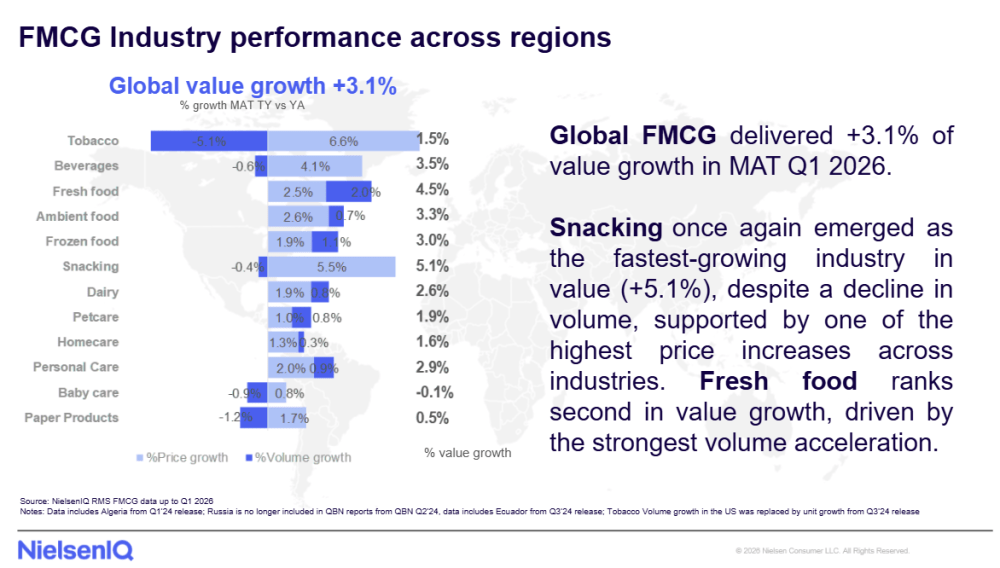
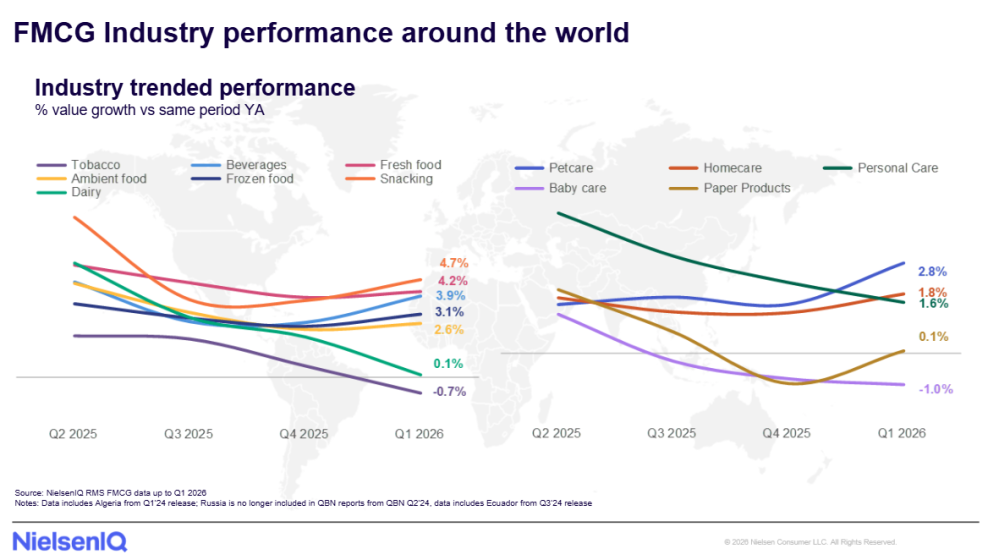
Based on our QBN Q1 2026 data, FMCG growth is no longer uniform across categories. The fresh food category is gaining momentum through volume growth, while the snacking category is relying on value growth despite falling volumes. In this environment, both pricing and portfolio decisions require greater precision. The winners will be those that understand which products, packs, and price tiers drive growth, and which parts of the portfolio require a different strategy altogether.
Key Insights
- Global FMCG volume growth is only +0.2%, meaning growth opportunities must be found at a granular SKU and pack level.
- Fresh Food and Snacking are showing completely different volume/value growth dynamics, demonstrating that category-level averages often mask very different consumer responses.
The macroeconomic pressure is already visible in how individual companies are managing their own numbers this year: Procter & Gamble closed its fiscal 2026 in late July with organic sales flat for the quarter, even after tariff-related cost recoveries helped offset higher costs elsewhere in the P&L. This is just one real-world sign of just how thin the margin for error has become.
Source: P&G Announces Fourth Quarter and Fiscal Year 2026 Results (Jul 29, 2026).
Your Choice: Absorb Costs, Pass Through Costs To Consumers, or Devise Something Smarter
NIQ’s own research shows why waiting it out is the riskiest option on the table: in NIQ’s 2025 Private Label & Branded Products survey, 68% of consumers already see private label as a good alternative to name brands. This means that brands that absorb or pass through costs poorly don’t just lose a quarter of share, they risk losing it permanently. NIQ’s Everyday Analytics view confirms cost pressure doesn’t hit every SKU or every market the same way, yet many companies still respond with one blanket price move. This means leaving money on the table in some places while overcorrecting in others and compounding promotional wastage along the way.
Sources: NIQ 2025 Private Label & Branded Products Report; NIQ Everyday Analytics.
The NIQ Way
NIQ runs the wargame before the market forces the client’s hand. Our team supports clients with modelling downsizing, price moves, and innovation together, side by side, so the decision is tested before it’s made, not after.
As Carlotta Crespi puts it, the shift that matters most right now is moving from asking what happened to asking what will happen if we move in this direction and running scenarios before a decision is forced, rather than reacting after the fact.
Source: NIQ Expert Perspectives — Pricing in Uncertain Times, 2026 (Carlotta Crespi, Global RGM Practice Lead).
The NIQ approach encompasses:
Real-time simulation tests multiple response paths side by side, before launch, using the same choice-based methodology behind LPO;
Balances margin protection against volume and share risk, scenario by scenario, rather than optimizing a single metric in isolation;
Built to handle tariffs, sugar taxes, deposit-return schemes, and other regulatory cost shocks alike. The mechanism doesn’t change, only the inputs do.
Case study: Turning Macro Pressure Into A Winning Play
Background
A leading chocolate brand was concerned about its ability to keep taking price increases without hurting revenue, amid rising input costs and cost pressure on raw materials. This is a scenario many chocolate and confectionery makers are currently experiencing as a very existential business threat, as cocoa costs remain elevated and largely locked in through hedging even as futures have retreated from their peak.
Objective
The Client requested that NIQ determine whether the brand could continue instituting price increases without meaningfully damaging volume or revenue, and identify the combination of pricing, pack, and innovation actions that would protect margin while defending category share.
Approach
Using real-time wargame simulations, NIQ modelled four distinct paths forward side by side:
| Path | Description | Outcome |
| Do Nothing | Absorb the cost increase quietly | Ruled out — highest risk |
| Downsize | Reduce 2 key pack sizes by 10% | Preserved margin, no penetration loss |
| Price Increase | +20% on the highest-selling pack alone | Contributed to combined strategy |
| Innovation | 2 new products on a price-tier bridge | Opened a premium price tier |
±9%
Prediction accuracy vs. actual in-market result
Won
Category share outcome vs. competitors
- The combined strategy, and not price increases alone, won the brand category share;
- Results validated in-market within ±9% of the model’s prediction, giving the client confidence to act decisively instead of waiting;
- Downsizing two key sizes preserved margin without hurting penetration, while a new sub-brand linked to added benefits opened a premium price tier;
- “Do nothing” was clearly the highest-risk path and validated the case for tested, proactive approach over passive absorption
Note: illustrative client example; brand and SKU names anonymized.
Cost shocks are hard enough to model when a brand sells one thing. They get harder still for the growing number of businesses that sell two things at once — a machine, and the thing that refills it. That’s where Part 3 of this series picks up.